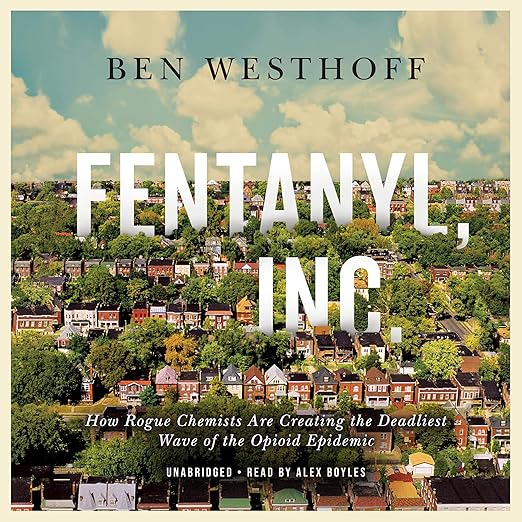
- Narration: Alex Boyles reads with a controlled gravity that suits the subject matter, keeping the material from tipping into either clinical detachment or exploitation.
- Themes: The pharmaceutical-to-street-drug pipeline, synthetic chemistry as regulatory evasion, the human cost of industrial-scale addiction
- Mood: Sobering and deeply reported, the kind of investigative journalism that leaves you more informed and more troubled simultaneously
- Verdict: An essential piece of reporting on a crisis that is still unfolding, with the rare quality of taking both the systemic and the human dimensions seriously within the same investigation.
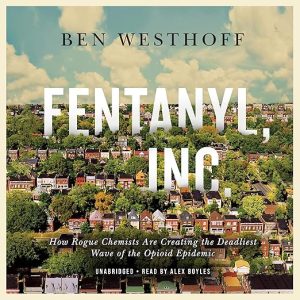
I finished Fentanyl, Inc. on a Tuesday evening and then sat with it for a while before moving on to anything else. Ben Westhoff's investigation into the synthetic drug trade is the kind of journalism that functions partly as orientation, helping you understand the shape of something you've read about in headlines without grasping how it actually works, and partly as something harder to shake: a detailed account of a system whose components are mundane and rational in isolation but catastrophic in combination. Alex Boyles narrates for Blackstone Audio, and the audiobook runs just under thirteen hours. This is also a free audiobook available through Audible membership.
The first thing to know is that the title is slightly narrower than the book. Fentanyl is the best-known and most lethal of the drugs Westhoff covers, but his investigation extends across the category he describes as Novel Psychoactive Substances: synthetic drugs including K2, Spice, and compounds with chemical names that read like acronyms from a pharmaceutical database. These drugs were, in many cases, originally developed in legitimate scientific contexts for legitimate purposes. Their formulas were then reverse-engineered by rogue chemists, predominantly operating out of China, who discovered that changing molecular structures slightly allowed them to stay ahead of law enforcement scheduling while maintaining or amplifying the drugs' effects. The result is a product category that is constantly evolving faster than regulation can track.
Our Take on Fentanyl, Inc.
Westhoff visits the chemical factories in China where much of the precursor material originates. This is original reporting of genuine consequence. He describes how China's vast chemical industry operates, how the government's relationship to that industry shapes enforcement decisions, and how the supply chain that feeds into American and European drug markets is integrated into legitimate industrial infrastructure rather than existing as a parallel underground economy. The sourcing detail here is uncomfortable and important: these are not shadowy back-room operations. They are manufacturers operating within legal grey zones created by the speed of molecular change.
One reviewer described the scope as a "global study of an increasing problem," noting that the book encompasses raw material providers in China, an abandoned ICBM base repurposed by a New Zealand drug baron, and harm reduction workers on American streets trying to minimize overdoses. That breadth is one of the book's strengths. Westhoff understands that the fentanyl crisis is not a single story about one country's drug problem. It is a network story, and he follows the network from origin to consequence.
Why Listen to Fentanyl, Inc.
What distinguishes Fentanyl, Inc. from the investigative journalism that treats policy as the only interesting angle is Westhoff's commitment to the people at the end of the supply chain. He chronicles the lives of addicted users, their families, the people who have lost relatives to overdose, and the harm reduction workers and underground drug awareness organizers who operate in a legal grey zone of their own by trying to minimize deaths without endorsing drug use. These sections carry a different register than the factory visits and the chemistry explanations, and Westhoff handles the tonal shift well without allowing the book to become two separate works.
One reviewer noted that Westhoff is "strongly empathetic toward the victims and their family members," which is accurate but undersells the structural commitment. He doesn't treat the human stories as illustration for the policy argument. They are load-bearing elements of the investigation. The book's thesis, that new strategies are beginning to emerge from the depths of this crisis that may provide long-term solutions, depends on the reader understanding what the crisis actually costs in human terms, not as an abstraction.
What to Watch For in Fentanyl, Inc.
Investigative nonfiction requires a narrator who can sustain authority across multiple registers: chemistry, human grief, policy analysis, foreign travel. Boyles handles the range competently. His delivery is controlled without being cold, and he calibrates the pacing well across the different types of content. The China factory sections, which involve names and chemical compounds that are challenging to pronounce without specific preparation, come through clearly. The personal stories are read with appropriate weight. Over thirteen hours, he maintains the consistency the material requires.
One observation worth making: the book is from 2019, which means some of the specific policy and legislative details are outdated. The underlying dynamics, the molecular game of cat and mouse, the Chinese supply chain, the harm reduction debates, remain relevant, but listeners should know they are encountering a document of a particular moment in the crisis rather than a current account. Fentanyl's role in overdose deaths has only grown since Westhoff published.
Who Should Listen to Fentanyl, Inc.
Listen if you want to understand the structural mechanics of the synthetic opioid crisis rather than just its headlines. This book is well-suited to public health professionals, policy people, journalists, and general readers who want more than a surface account of what is still one of America's most serious public health emergencies. The reporting is rigorous and the argument is clear.
Skip if the material is personally close in a way that makes detailed accounts of addiction and overdose difficult to process right now. The book handles these stories with care rather than exploitation, but the subject matter is inherently heavy and Westhoff does not protect the reader from its weight. That is a feature rather than a flaw, but it is worth knowing.