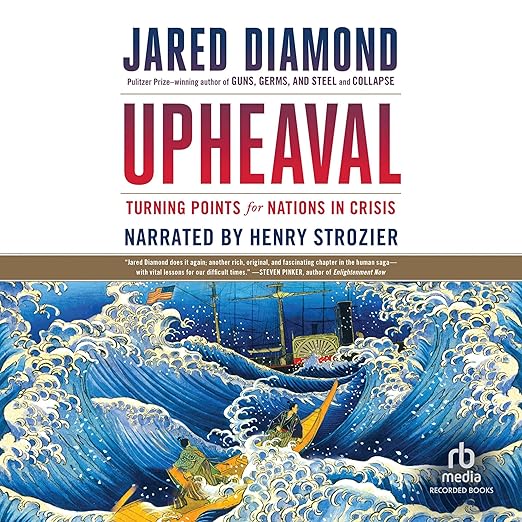
Before You Press Play
- Narration: Henry Strozier brings intellectual gravity to Diamond's sweeping comparative study, sustaining listener engagement across nearly nineteen hours of dense historical and psychological argument.
- Themes: National crisis response and selective adaptation, the parallel between individual therapy and geopolitical recovery, civilizational resilience and failure.
- Mood: Rigorous and expansive, with urgent contemporary relevance underlying the historical case studies.
- Verdict: A methodologically ambitious final chapter in Diamond's civilizational trilogy, best appreciated by listeners who have read or heard Guns, Germs, and Steel.
Jared Diamond's Upheaval asks a question that sounds almost too large to answer usefully: why do some nations recover from catastrophic crisis while others collapse under the same pressure? The audiobook, narrated by Henry Strozier at nearly nineteen hours, represents Diamond's most psychologically inflected work to date, applying a framework borrowed from crisis therapy to the political histories of seven nations: Finland, Japan, Chile, Indonesia, Germany, Australia, and the United States. If that comparative range sounds like it could support a graduate seminar or a bookshelf of specialist histories, you understand the ambition. What Diamond attempts, and largely delivers, is a single synthesizing framework that reads across these very different national experiences without destroying the specificity of each.
I came to this audiobook as the final volume in Diamond's trilogy, after Guns, Germs, and Steel and Collapse. The progression matters. Guns established Diamond's capacity for civilizational macro-analysis; Collapse applied it to failure; Upheaval attempts something more personal and more contingent, the question of how communities survive trauma that is not existential but transformative. That shift in register, from historical determinism toward something closer to psychological resilience, is what distinguishes this from Diamond's earlier work, and it is also what some readers find slightly unsatisfying after the more definitive architecture of the first two volumes.
Henry Strozier's narration is well-matched to Diamond's prose style, which is clear, deliberate, and unapologetically dense with historical evidence. The nearly nineteen-hour runtime requires a narrator who can sustain listener engagement across extended analytical passages without reducing complex argument to background noise, and Strozier does this with consistent authority. The chapter breaks help. Diamond structures the book so that each national case study functions as a self-contained analytical unit before the comparative synthesis emerges, and Strozier's pacing within each section allows listeners to process the specifics before the framework draws them together.
The Japan section is arguably the most remarkable chapter in the book. Diamond examines Japan's response to Commodore Perry's arrival and the subsequent Meiji-era transformation as perhaps the most rapid and successful case of selective adaptation in modern history: a nation that consciously chose which elements of Western modernity to absorb, and which elements of its own culture to preserve, and executed that synthesis at civilizational speed. One reviewer described this chapter as the most astonishing material in the entire book, noting that the picture of an entire nation deciding to transform itself within a generation is barely imaginable from a contemporary vantage point.
The Chile and Finland sections cover ground less familiar to most anglophone listeners: the Soviet-Finnish Winter War and Finland's subsequent navigation of superpower pressure is a masterclass in small-state survival, and the Pinochet chapter engages honestly with how catastrophe can produce divergent national responses depending on which institutions survive the crisis.
What Makes Upheaval Worth Hearing
The psychological framework Diamond imports from crisis therapy is the element most likely to divide listeners. The twelve-point crisis-resolution framework he derives from therapeutic literature and applies to national behavior is, as Diamond himself acknowledges, an analogy rather than a direct equivalence. Nations do not have therapists; they do not experience cognitive dissonance in precisely the same way individuals do. But the framework is usefully heuristic rather than prescriptive, generating productive questions about national adaptation that more conventional political history does not always ask.
One reviewer described the book as more a helpful analysis than a paradigm-shifting work on the order of Guns, Germs, and Steel, and that distinction is accurate. Diamond is not advancing a new causal theory of history in Upheaval. He is applying existing analytical tools to a set of questions about resilience and recovery that are, if anything, more immediately relevant to contemporary political life than the longer-arc arguments of his earlier work. The final chapters, which turn Diamond's framework toward the contemporary United States and the question of whether it is on a trajectory toward crisis or recovery, are the most urgent sections in the book.
At nearly nineteen hours, this is a commitment. Listeners who processed Guns, Germs, and Steel and Collapse will find themselves in familiar Diamond territory: the patient accumulation of evidence across multiple case studies, the willingness to sit with complexity rather than resolve it prematurely, the occasional methodological caveat that marks a scholar genuinely thinking through the limitations of his own framework.
Things to Know Before Starting Upheaval
The comparative synthesis that Diamond builds across the seven national case studies does not emerge until late in the audiobook. Listeners who arrive expecting the framework to precede the evidence may find the early chapters, each of which immerses you in a specific national history, somewhat disconnected from each other. The architecture is cumulative rather than deductive, and the full shape of the argument only becomes clear in the final third.
Diamond's treatment of Australia is the most personally inflected section in the book. He has lived in Australia and brings a relationship to its political and cultural history that makes the chapter warmer and more specific than some of the others. This is an interesting structural choice: the nation Diamond knows most intimately from the inside is the one whose case study benefits most from the psychological framework he is applying.
The US-facing final chapters should be heard as analysis rather than polemic. Diamond's conclusions about American political polarization and institutional stress are supported by the same evidential methodology as the historical case studies, which gives them a weight that purely political commentary does not share.
Who Jared Diamond Is Writing For
Listeners who have engaged with Diamond's earlier work will find this the natural completion of a trilogy that has been building a comprehensive theory of civilizational rise and fall across three decades of research. Political science and history readers interested in comparative national resilience will find the case studies valuable independently of the trilogy context. Listeners without prior Diamond familiarity would benefit from starting with Guns, Germs, and Steel, both for the methodological foundation and for the richer appreciation of how Upheaval's psychological turn represents a deliberate evolution in Diamond's project. At nearly nineteen hours, this audiobook rewards patient, attentive listening rather than background consumption.
Frequently Asked Questions
Do I need to listen to Guns, Germs, and Steel before this audiobook?
Not strictly required, but strongly recommended. Diamond frames Upheaval explicitly as the final volume in a trilogy, and the methodological approach and civilizational scope make considerably more sense in the context of his earlier work. New listeners will find Upheaval functional but incomplete as a standalone.
How does the audiobook handle the psychological framework Diamond applies to national history?
Diamond acknowledges the framework's limitations explicitly and presents it as heuristic rather than definitive. Strozier's narration maintains an appropriately analytical tone that prevents the psychological analogy from sounding reductive. Listeners who engage critically with the framework will find Diamond has anticipated their objections.
Which of the seven national case studies is most compelling in the audiobook?
Reviews consistently single out the Japan section as the most remarkable, particularly Diamond's account of the Meiji era transformation. The Finland section, covering the Soviet Winter War and subsequent Cold War navigation, is also frequently cited as revelatory for listeners unfamiliar with Nordic history.
Is this audiobook more about history or about contemporary politics?
Primarily history, with contemporary political implications that Diamond draws explicitly in the final chapters. The bulk of the nearly nineteen-hour runtime is devoted to historical case studies; the US-facing conclusions arrive late and are grounded in the same evidential methodology as the historical material.