Before You Press Play
- Narrator: Suleyman reads his own case for containment, which puts the argument and its conflict of interest in one voice.
- Subjects: AI proliferation, the containment problem, the limits of the nation-state, technology governance
- Tone: Urgent, dense, insistent
- Bottom line: Buy it as a primary document from inside the industry, not as a guide to what to do next.
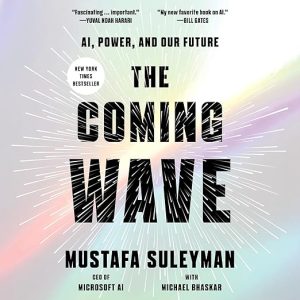
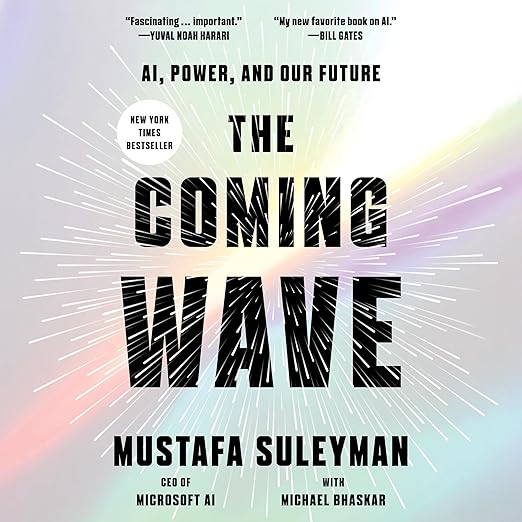
A co-founder of DeepMind reading his own warning about the industry he helped build is the first fact this audiobook asks you to hold, and nothing after it gets simpler. Mustafa Suleyman is credited as author and as narrator, and the description introduces him twice over: co-founder of the pioneering AI company DeepMind, part of Google, and current CEO of Microsoft AI. Twelve hours later you have heard a case for containing powerful technology argued by someone with a working stake in the technology being contained.
Suleyman Stacks Six Different Existential Risks
Suleyman's frame is the containment problem, which he defines as the task of maintaining control over powerful technologies. Around that frame he stacks DNA printers, quantum computers, engineered pathogens, autonomous weapons, robot assistants and abundant energy, and the stacking is a good part of the experience. Writing in July 2025, a four-star reader called the research excellent and the reading laborious in a single headline, counted twenty-nine pages of notes, and described an avalanche of information arriving faster than it could be held onto. As a description of the shape, that is fair.
Four Ratings, Five Responses, Different Averages
Before you buy, two things about the product page need saying out loud. The displayed title runs three words, while the earliest written response quotes it in full as The Coming Wave: Technology, Power, and the Twenty-first Century's Greatest Dilemma, so the half of the title that tells you what the argument is actually about has gone missing from the shelf label. Then the star average, 4.3, sits above a counter reading four ratings, while five signed responses are visible below it whose own scores average 3.6. Both numbers cannot be describing the same pool of people.
Random House Audio released this in September 2023, and the top of the description is a wall of endorsement: Yuval Noah Harari, Daniel Kahneman and Bill Gates, followed by eight best-of-the-year lists and three business-book prizes. Every one of those was awarded to a printed book. They tell you the argument was taken seriously by serious readers, which is worth knowing, and they tell you nothing whatsoever about what happens when the same argument is delivered aloud at reading pace with no page to flip back to.
Suleyman Writes From Inside the Buildings
Insider vantage is the actual product. Most books about AI risk are written from outside the buildings where the work happens, by philosophers and reporters reconstructing decisions after the fact. Suleyman helped run one of those buildings, and the description places him at the center of the revolution he is describing. Whether you trust an interested party to diagnose his own industry is a real question and a live one, but the seat he is writing from is not available anywhere else on this shelf, and the argument gains a specificity that outside accounts rarely reach.
Accessibility is the second reason, and the May 2025 five-star notice puts it plainly: on a subject usually cluttered with technical jargon, the writing stays understandable to readers without a technical background, and the case moves in what that same response called a logical and thoughtful progression. For twelve hours of listening with no diagrams to fall back on and no glossary to thumb, that quality does more work than it would in print. You are never asked to hold an equation in your head while the sentences keep coming.
Containment itself is the idea worth carrying away. Suleyman's claim is not that machines will turn hostile. It is that powerful technologies proliferate fast, that they get cheaper and more copyable as they spread, and that nothing in the architecture of the nation-state was built to hold that. The dilemma he sets up is unprecedented harm on one side and overbearing surveillance on the other, with a narrow path between them. Sitting inside that pincer for a full listen is uncomfortable in a way that turns out to be useful.
Reach for the Fifteen-Second Skip Here
Repetition is the sharpest charge against the book, and it costs more in audio than on paper. An October 2025 reader, three stars, praises a genuinely engaging opening full of sharp insights, then describes the book getting lost in endless repetitions, the same points made over and over, tiring and boring. The same response finds the tone self-congratulatory and at moments hypocritical, since Suleyman criticizes the system while being very much part of it, and closes by saying concrete suggestions were missing at the end.
Vintage matters here more than it does for most nonfiction. This recording dates from September 2023, and it argues about a discipline that revises itself faster than publishing schedules allow. The frame, containment as the organizing problem, has aged well enough. The illustrations will not have aged at the same rate, and a listener who follows this subject week to week should expect a few passages that read as forecasts of things already settled. That is not a flaw in the book so much as a fact about buying it now.
A skimmer's escape routes are also closed off. On paper you can jump a paragraph you have already met, glance at a note, or check where an assertion came from. Listening, you can only wait it out or scrub backward and lose your place, and this is a book with a thesis it likes to restate. If you are the kind of listener who reaches for the fifteen-second skip when a chapter circles, expect to reach for it here.
Diagnosis Outweighs the Missing Prescription
Policy people, technology managers and anyone whose job description now contains the letters AI will get the most from this. So will readers who have absorbed a lot of AI commentary secondhand and want to hear the case from someone who signed the papers. The book assumes no mathematics and very little engineering; what it assumes is that you care about who governs what, which makes it closer to political argument than to popular science.
The earliest of the five written responses calls the book an intellectual journey rather than simply a read, and says it resonates most with people inclined toward future thinking. That is an accurate filter. If speculative frames about the next decade energize you, this will hold your attention across the whole run without much strain. If you want engineering detail, or a technical account of how these systems actually work, you have the wrong book and the description does not pretend otherwise.
Skeptics of AI-industry self-criticism should still consider it, precisely because the conflict of interest is the interesting part. The listeners who will struggle are the ones wanting a plan: the diagnosis here is far more developed than the prescription, and sitting through the whole recording for instructions that arrive thin is a genuine letdown. Read the star average as a placeholder, and read the argument itself as the thing you are actually buying.
Why does it matter that Mustafa Suleyman narrates his own audiobook?
Because the author-narrator credit collapses the distance between the person arguing for containment and the person who helped build what he says needs containing. You are hearing an interested party make his own case in his own voice, which is simultaneously the strongest reason to listen and the reason to keep one eyebrow raised throughout.
One of the five written responses is a single star. What is it actually about?
A shipped physical copy that arrived dirty. The buyer from February 2025 describes bird waste on the outside and says the cover had to be thrown away. Nothing in it concerns Suleyman, AI or the argument, yet it sits in the same visible pool as the responses that do, dragging the picture down.
How much technical background does this audiobook assume?
Very little. The subject list runs to quantum computers and engineered pathogens, but the through-line is governance rather than engineering: who controls a technology, how fast it spreads, and which institutions break under it. The demands it makes are conceptual and political, not mathematical, and no formula ever needs holding.
Is the audiobook worth it if I already follow AI policy debates closely?
For the vantage point, yes. For news, probably not. Anyone tracking this subject closely will recognize most of the examples, and the September 2023 vintage shows in places. What is not available elsewhere is a containment argument built by a lab co-founder now running a major company's AI division. Treat it as a primary source.