In Brief
- Narration: Megan Basham self-narrates with a journalist's directness, lending the accusations their full weight; the performance is pointed and confident throughout all eleven hours.
- Themes: Evangelical Christianity, political influence, institutional capture, left-wing funding networks
- Mood: Investigative and combative, written in the tradition of political exposé journalism
- Verdict: Whether you accept its premises or contest them, Shepherds for Sale is rigorously sourced and represents the most detailed account yet published of how progressive donors have targeted evangelical institutions.
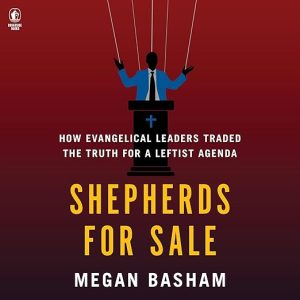
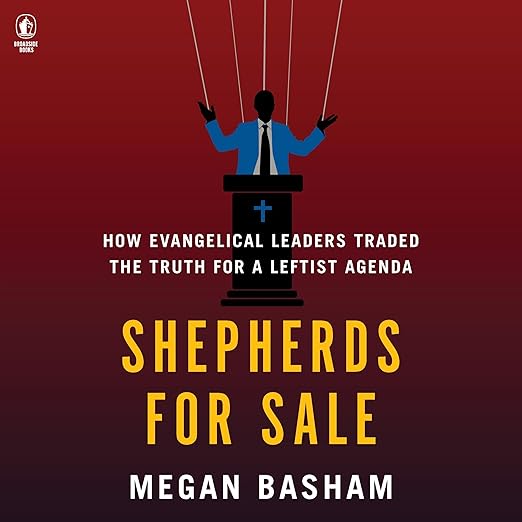
Megan Basham arrives in Shepherds for Sale with receipts. The Daily Wire journalist spent years tracking financial flows, documented influence campaigns, and named sources connecting progressive philanthropists to evangelical institutions. The audiobook, which she narrates herself across eleven hours and twenty-two minutes, does not soften the accusation in the telling. An instant New York Times bestseller and the subject of endorsements from John MacArthur and Os Guinness, Shepherds for Sale entered a specific moment in American evangelical culture where the question of institutional drift carries genuine stakes for millions of people inside those institutions. Basham wrote this book for them.
Is Shepherds for Sale Worth Your Time?
Basham's thesis is precise: left-wing billionaires and progressive foundations, including George Soros, the founder of eBay, and former Obama administration officials, have deliberately targeted American evangelical media, universities, megachurches, nonprofits, and denominations with the goal of co-opting evangelical political alignment. Her argument is not that evangelicals are simply being tricked, but that career incentives, cash, prestige, and platform access have created conditions in which many evangelical leaders have gradually shifted their public positions on sexuality, abortion, climate, and racial politics in ways that happen to align with the priorities of their funders.
She names names and cites sources throughout, which is the quality most often praised by those who have responded positively to the book. The celebrity megachurch pastor who privately encouraged fellow pastors to change their views on sexuality, the Presbyterian theologian who backed a congregation rebelling against his own denomination: these are not anonymous sources or vague patterns. Basham identifies people and organizations with documentation, and the footnote apparatus is extensive for a book aimed at a general audience. One reviewer described it as extensively researched and as clarifying problems they had wrestled with for years without being able to articulate.
The book is most compelling in the chapters dealing with specific institutions, denominations, and individual leaders where Basham can trace the money and show the timeline of position changes. The chapters on evangelical universities and on specific media organizations are particularly detailed. Less persuasive, for some readers, are the sections connecting distant actors through funding chains that require more inferential steps than the explicit documentation fully supports. Basham is cautious about overreach in her sourcing, but the implicit argument sometimes runs ahead of the evidence.
The Best Parts of Shepherds for Sale
Basham's self-narration gives the audiobook a particular intensity. She is not a neutral voice reading someone else's argument. She is the reporter delivering her own investigation, and that creates a one-sided intimacy that is both a strength and a limitation. The eleven hours are dense with names, organizations, funding amounts, and documented exchanges. In audio, some of this density is harder to track than it would be on the page, where readers can flip back to check a reference. Listeners may want to follow along with a physical copy during the more network-dense chapters.
The broader cultural context for the book matters for understanding why it generated such a strong response. Evangelical listeners had been observing the changes Basham documents for years without a consolidated account that named sources and showed money. The book provided that account, and reviewers praised it for bringing clarity to patterns that had felt diffuse and hard to articulate. One called it the single most important book on modern evangelicalism in recent years. The rating reflects a highly motivated audience that arrived already sharing Basham's concerns: every review for this title is a five-star. That consensus is worth noting both as a signal of the book's relevance to its target readership and as a reminder that its audience is not a random sample of general readers. For that audience, the self-narration and the documentation combine to produce something that functions less like journalism and more like a brief filed from inside a contested institution.
Before You Commit to Shepherds for Sale
Basham writes from within the conservative evangelical tradition she is defending, and the book's definition of orthodoxy is consistent with that tradition's most conservative wing. Readers who define evangelical Christianity differently, or who believe that genuine theological development can lead to changed positions on sexuality or racial repentance, will contest the book's framework before they get to the evidence. Basham's argument is that any shift toward progressive social positions represents captured allegiance rather than genuine conviction, which is a premise some evangelical readers will not share.
The book is not balanced in the journalistic sense. It is an advocacy document written by a journalist who believes the institutions she covers are in danger. Critics of the book argue that this constitutes a significant methodological gap. Defenders note that exposé journalism rarely presents both sides with equal charity. For listeners coming from outside the evangelical world, some of the internal denominational politics will require context that Basham does not always pause to provide.
Should You Listen to Shepherds for Sale?
This audiobook is essential listening for anyone inside conservative evangelical Christianity who wants a documented account of external funding influence on their institutions, and for anyone outside that world who wants to understand the specific grievances driving a significant sector of American religious and political life. Academics studying religion and politics, journalists covering evangelical media, and policy analysts tracking religious influence in American public life will find the sourcing useful regardless of their own commitments. Listeners seeking a neutral treatment of progressive evangelicalism will not find it here, but those willing to engage with a serious one-sided argument will find this the most detailed version of that argument available in audio form.