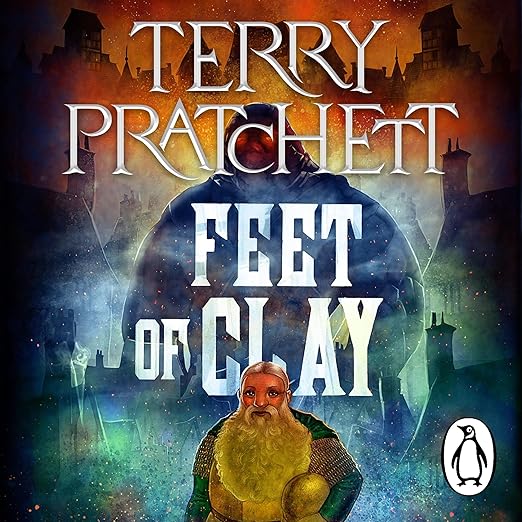
Quick Take
- Narration: Jon Culshaw brings the City Watch ensemble to life with strong comic timing, handling Vimes’s world-weary authority and the broader Ankh-Morpork cast with the craft this material demands.
- Themes: Autonomy and consciousness, institutional prejudice, the bureaucratic machinery of power
- Mood: Dry, propulsive, and philosophically satisfying
- Verdict: One of the strongest entries in the City Watch arc, where Pratchett’s satire and his murder mystery are both firing at full capacity.
I was somewhere in the middle of a long train journey when I started Feet of Clay for what was technically my third encounter with the book, the first time by audio. I had read it twice in paperback and thought I knew its rhythms. What the audiobook revealed, and what Jon Culshaw’s narration specifically surfaced, was how much of Pratchett’s comedy depends on pace, on the precise gap between a setup and its payoff, on the timing that a reader controls privately but a narrator has to make public. Culshaw gets those rhythms. He has clearly spent time with the text rather than simply performing it, and the result is one of the better Discworld audiobook recordings I have come across.
A note for those navigating the Discworld series: this is the nineteenth Discworld novel overall and the third in the City Watch sub-series. The publisher correctly notes that the novels can be read in any order, and this is broadly true, though the Watch novels accumulate emotional weight across volumes. Starting here is possible. Starting with Guards! Guards! is better.
Golems, Poison, and the Question of What Thinks
The murder mystery structure of Feet of Clay is more intricate than it first appears. Commander Vimes has no trace of anything living at his crime scenes, which is a problem when you are in a city where the definition of living is already substantially more complicated than most jurisdictions can handle. The golem thread, which reviewer ealovitt tracks through later Discworld volumes including Going Postal, is where Pratchett is doing his most philosophically interesting work here. A golem is a thing. But a thing that has begun to think for itself, a thing that has started writing its own Words in the hope of receiving the autonomy that the Words inscribed by others have always denied it, is not simply a thing any more. Pratchett was writing about consciousness, autonomy, and the moment at which a created being becomes entitled to rights at a time when those questions were considerably less common in mainstream discourse than they are today. That the philosophical inquiry arrives wrapped in a murder mystery and punctuated by Pratchett’s particular brand of footnote humor makes it no less precise.
Vimes at His Most Vimes
The City Watch arc works, fundamentally, because Vimes works. He is a fundamentally moral character operating in a fundamentally amoral city, and the tension between those two facts is where all the best City Watch comedy and drama simultaneously live. His investigation in Feet of Clay runs him against questions of institutional legitimacy, of who has the right to judge what is a person, of how power arranges itself to maintain the assumptions that power requires. Culshaw’s Vimes has the right quality of world-weariness without tipping into nihilism. The character knows the game is rigged and plays it anyway, which is where the comedy and the moral seriousness both locate themselves.
The Dwarf With Attitude and the Pre-Lunar Tension Problem
The werewolf with pre-lunar tension and the dwarf with attitude are the supporting comic creations the book builds most carefully, and Culshaw distinguishes them well. The running joke about werewolf mood cycles is the kind of Pratchett gag that sounds simple until you realize it is also a precise observation about how institutions accommodate difference only when the difference can be scheduled. The dwarf storyline carries the volume’s most pointed political satire, touching on questions of cultural identity, assimilation, and the violence that accumulates when a minority community is asked to make itself legible to the majority’s comfort. These themes arrive as jokes. They are not only jokes.
Who Should Listen and Who Might Start Elsewhere
This is an excellent entry point for Discworld if you are drawn to crime fiction with philosophical depth rather than epic fantasy structures. Listeners who are already City Watch readers will find this one of the arc’s most satisfying volumes. Absolute Discworld newcomers might consider starting with Guards! Guards! for the Watch, or with Mort or Going Postal for different entry points into the broader world. But if someone gave you this one cold, you would not be lost. Pratchett was too good a writer to leave his audience without footing.
Frequently Asked Questions
Is Feet of Clay the best entry point for someone new to the Discworld series?
It works as an entry point, and the publisher notes that Discworld novels can be read in any order. However, for maximum emotional impact in the City Watch arc, Guards! Guards! (the first Watch novel) is the better starting place. Feet of Clay builds on established character relationships in ways that reward prior familiarity.
How does Jon Culshaw’s narration compare to previous Discworld audiobook recordings by other narrators?
Culshaw brings strong comic timing and handles the ensemble Watch cast with clear differentiation. Some long-term Discworld audio listeners have preferences built around other narrators in the series history, but Culshaw’s Penguin Audio recording is considered a quality production that serves the material well.
The golem storyline is described as philosophically significant. Is the philosophy accessible or dense?
Pratchett never makes his philosophy inaccessible. The questions about consciousness, autonomy, and what constitutes personhood are woven into the murder mystery and the comedy rather than presented as formal argument. Reviewer James Collins specifically notes that it is thought-provoking and a commentary on life without losing its obligation to be enjoyable.
Is Feet of Clay suitable for listeners who are more interested in the comedy than the fantasy worldbuilding?
Yes. While Ankh-Morpork has substantial lore, Pratchett designed his world as a satire of our world, and the comedy functions independently of deep fantasy investment. Listeners who enjoy dry British wit, murder mystery, and philosophical humor will find the fantasy context a pleasure rather than a barrier.