Quick Take
- Narration: Peter Noble reads with deliberate, unhurried pacing that honors the argument’s complexity and differentiates the dialectical from the lyrical sections.
- Themes: Faith versus ethics, the paradox of Abraham, what cannot be communicated to another person
- Mood: Dense and meditative, requiring active attention rather than passive listening
- Verdict: One of the most compressed and powerful philosophical texts available in audio, best heard more than once and best heard after some grounding in Kantian ethics.
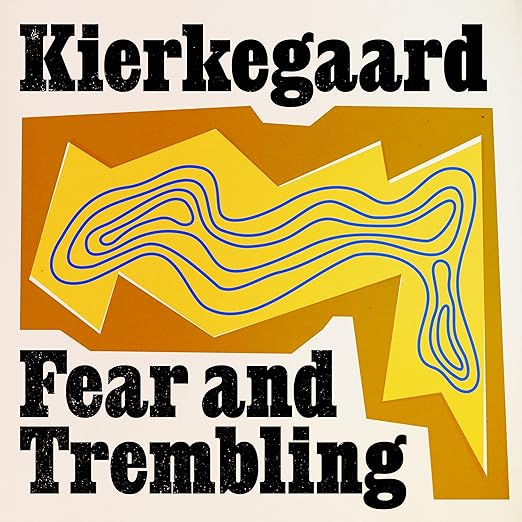
I first read Fear and Trembling in a philosophy survey course where it was assigned alongside other foundational texts of the nineteenth century. I was twenty years old and convinced I understood it. I listened to the audiobook version two decades later, narrated by Peter Noble, and discovered I had understood perhaps a quarter of what Kierkegaard was doing. The intervening years had given me the vocabulary for the remaining three-quarters, which is, I suspect, exactly the kind of preparation the text is designed to require.
Kierkegaard published Fear and Trembling in 1843 under the pseudonym Johannes de silentio, Silent John, a persona that gives the text a particular philosophical distance from its subject. The work concerns the story of Abraham and Isaac: God’s command that Abraham sacrifice his son, Abraham’s willingness to comply, and the last-moment divine intervention that prevents the sacrifice. For Kierkegaard, this story is not primarily about obedience or faith in any simple sense. It is about the collision between the ethical realm, the universal obligations we owe to other people and to reason, and the religious realm, the singular relationship between a human being and God that can require suspension of the ethical itself. Noble’s narration, measured and precise, gives the philosophical argument room to develop at its proper pace.
The Knight of Faith and What He Requires
The figure of the knight of faith is Kierkegaard’s central construction, and it is worth dwelling on what distinguishes him from what the text calls the knight of infinite resignation. The knight of resignation surrenders what he loves completely and lives in the awareness of that loss, finding dignity in the renunciation itself. He is a tragic figure in the classical sense, and we understand how to admire him. The knight of faith, by contrast, makes the same total surrender and then expects the impossible anyway: that what was given up will be returned, not through a rational chain of cause and effect but through what Kierkegaard calls the absurd, the category of the impossible that faith inhabits. Abraham gives up Isaac entirely and also walks to Mount Moriah believing, somehow, that Isaac will come back.
Reviewer Jeremy David Stevens traced this argument carefully and found it illuminating precisely because it distinguishes between a faith that has made peace with loss and a faith that insists on the return of the thing lost. That distinction is what makes Abraham extraordinary rather than merely obedient. Reviewer Richard B. Schwartz, noting that Wittgenstein considered Kierkegaard the greatest philosopher of the nineteenth century, found the text illuminating both in itself and as context for understanding Wittgenstein’s own later concerns with what can and cannot be said. That connection, between the limits of language and the limits of the ethical, runs through the text in ways that become more visible with each reading.
The Teleological Suspension of the Ethical
The most philosophically challenging section of the text is Kierkegaard’s treatment of what he calls the teleological suspension of the ethical: the possibility that faith might require acting against the universal moral law for a singular, incommensurable reason that cannot be communicated to others. Abraham cannot explain himself to Sarah, to Isaac, or to anyone. His action, if it proceeded to completion, would look indistinguishable from murder from the outside. The impossibility of communicating the religious ground of action is what Johannes de silentio finds most troubling and most fascinating about the story.
The pseudonymous persona of Johannes de silentio is itself a performance of the book’s central philosophical point about what cannot be communicated to another person. The choice of pseudonym is not decorative: by writing under the name of someone who is silent, Kierkegaard enacts the very impossibility of articulating the religious dimension of Abraham’s experience that the text describes. That level of structural self-awareness is one of the reasons this short text has generated centuries of commentary without exhausting itself.
Peter Noble and the Demands of Philosophical Prose
Reading nineteenth-century philosophical prose aloud requires a different set of skills than reading narrative fiction. The sentences are structured to develop arguments rather than build dramatic momentum, which means the narrator must find ways to sustain attention across passages that resist the kind of moment-to-moment tension that carries listeners through novels. Peter Noble manages this with a deliberate, unhurried pacing that honors the complexity of the argument without becoming monotonous. The differentiation between the dialectical sections and the more lyrical meditative passages suggests genuine engagement with the text’s structure.
At an hour and twenty-four minutes, Fear and Trembling is among the shorter audiobooks one encounters, and that brevity is consistent with the text’s historical status as a short but extraordinarily dense philosophical intervention. The compression is inherent to the work itself.
Who Should Listen and What Preparation Helps
Fear and Trembling rewards multiple encounters. Listeners who come to it with some background in Christian theology and nineteenth-century philosophy will find the argument’s full range more accessible on a first listen. Those encountering Kierkegaard for the first time will find the audiobook sufficient to grasp the central distinction between the ethical and the religious and the paradox of Abraham’s position. A note worth adding: the text assumes some familiarity with Kant’s moral philosophy, specifically with the concept of the universal ethical law. Noble’s narration cannot supply that context, but the argument is structured clearly enough that listeners without a philosophy background can still follow the central movement from the ethical to the religious sphere. At 4.6 stars across nearly 900 ratings, it has found readers across a wide range of philosophical preparation, which speaks to the accessibility Noble’s narration provides to even the most technically demanding passages.
Frequently Asked Questions
Can Fear and Trembling be approached meaningfully without a philosophy background?
Yes, though the argument about the teleological suspension of the ethical lands more fully with some Kantian context. Noble’s pacing makes the central distinction between the ethical and the religious sphere accessible to careful listeners regardless of prior training, and the Abraham narrative gives the abstract argument a concrete grounding.
How does the pseudonym Johannes de silentio function, and does the audiobook give any context for it?
The pseudonymous persona is integral to the text’s argument about the limits of communication. Kierkegaard uses the name Silent John to enact the very impossibility of articulating religious experience that the text describes. The audiobook presents the text as written; supplementary context about Kierkegaard’s pseudonym practice is worth seeking from a companion resource.
Is the text’s 1 hour and 24 minute runtime the complete work, or an abridgment?
The audio version presents Fear and Trembling as a short but extraordinarily dense text, which is accurate to its historical form. This is not an abridgment. The brevity is inherent to the original.
Reviewer Richard B. Schwartz mentioned Wittgenstein’s admiration for Kierkegaard. How does this text connect to Wittgenstein’s later philosophy?
The connection runs through the limits of what language can express. Kierkegaard’s argument that the religious dimension of Abraham’s experience cannot be communicated to others anticipates Wittgenstein’s concern with what can and cannot be said. Readers interested in that connection will find it rewarding to read Fear and Trembling alongside the Tractatus or the Philosophical Investigations.