Quick Take
- Narration: Michael Bridges delivers a calm, contemplative performance that suits the philosophical and spiritual subject matter well.
- Themes: Karma as natural law, Vedic and Buddhist philosophy, cause and effect, personal liberation
- Mood: Reflective and quietly illuminating
- Verdict: A compact and thoughtful introduction to karma that moves well beyond the pop-culture cliche, covering genuine Vedic, Buddhist, and Jain perspectives in accessible terms.
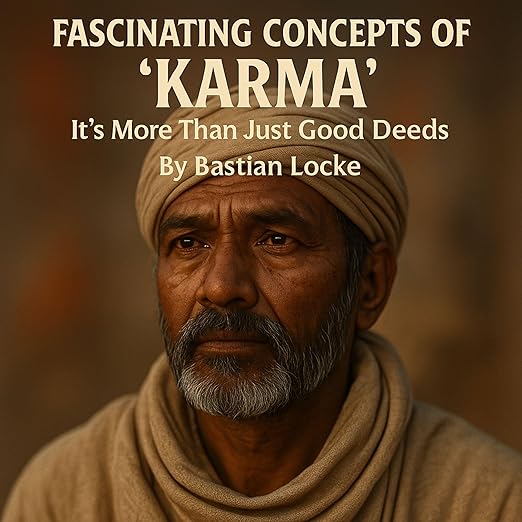
There is a particular kind of book that arrives at exactly the right moment. I came to Bastian Locke’s Fascinating Concepts of Karma during a period when I had been thinking about patterns, the way the same situations seemed to keep finding me, the way certain relationships repeated themselves in different forms. I was not looking for spiritual guidance exactly, but I was open to a perspective shift, and that is what this short audiobook offered.
At just over three hours, it does not demand much of your time, but it is denser in ideas than the runtime suggests. Locke’s central argument is that karma is neither a cosmic scoreboard nor a synonym for fate. It is, in his framing, a natural law, as impersonal as gravity, as consistent as cause and effect. That reframing matters because it strips the concept of the moralistic baggage it has accumulated through centuries of casual Western use and returns it to something more like a working principle.
Our Take on Fascinating Concepts of Karma
Locke is writing for a general audience, and he manages the translation from ancient philosophical concept to contemporary applicability without dumbing down or distorting his source material. The sections on karma’s origins in Vedic tradition are genuinely illuminating, he traces how the concept evolved across different Indian philosophical schools, noting where Buddhism and Jainism diverged from the Vedic framework and why those divergences matter for how karma is understood. This is not casual pop-spirituality. There is real intellectual care here.
The chapter structure reinforces that care. Each of the ten chapters isolates a distinct aspect of the karma concept, the relationship between intention and action, the idea of karma as feedback rather than punishment, the question of collective versus individual karma. The organization prevents the book from becoming a single long meditation on a single idea, which would quickly exhaust its material.
Why Listen to Fascinating Concepts of Karma
Michael Bridges’s narration is well-suited to this kind of content. His voice carries a natural gravity without tipping into the hushed reverence that can make spiritual audiobooks feel performative. He reads the philosophical passages with clarity and the more lyrical sections with appropriate warmth. For a short audiobook dealing with abstract concepts, having a narrator who makes the ideas feel grounded rather than ethereal is genuinely valuable.
The audiobook format also works well for material of this kind because the pacing of listening mirrors the reflective quality the content invites. You cannot skim or rush a passage the way you might with a print book. The ideas come at their own pace, which is, in a strange way, appropriate for a book about how consequences unfold on their own timeline.
What to Watch For in Fascinating Concepts of Karma
The book is short, and that is mostly a virtue, but it does mean that some topics receive lighter treatment than they deserve. The sections on collective karma and on the relationship between karma and reincarnation across different traditions feel compressed, as if Locke was aware he was approaching the limits of his format. Readers who arrive with existing knowledge of Vedic or Buddhist philosophy may find these passages frustratingly brief. For newcomers, however, they serve as excellent entry points into further reading.
There are no published reviews available for this title at time of writing, which makes it harder to gauge how different readers with different levels of existing spiritual knowledge respond to the material. The 5.0 rating across 62 ratings is encouraging, and the book comes from a series, Spirituality in all its forms, suggesting a consistent editorial focus on this kind of philosophical exploration.
Who Should Listen to Fascinating Concepts of Karma
This audiobook is ideal for listeners who have encountered karma primarily in its pop-culture form and are curious about the genuine philosophical tradition behind it. It is also well-suited to those exploring Hindu, Buddhist, or Jain philosophy for the first time and wanting a conceptual anchor before going deeper. Readers or listeners already versed in these traditions will find Locke’s treatment accessible but not advanced enough to offer new insights. At just over three hours, it is a low-commitment listen with genuine intellectual reward.
Frequently Asked Questions
Does Fascinating Concepts of Karma cover Buddhist karma as well as Hindu karma?
Yes. Locke traces karma’s origins in the Vedic tradition and then follows its reinterpretations in both Buddhism and Jainism, noting where each tradition diverges in its understanding of how karma operates. The comparative approach is one of the book’s strengths.
Is this audiobook suitable for listeners with no background in Eastern philosophy?
Yes, it is written for a general audience with no assumed prior knowledge. Locke introduces concepts from first principles and explains the historical and philosophical context as he goes. It is one of the more accessible entry points into karma as a philosophical concept rather than a pop-culture shorthand.
How does Michael Bridges handle the narration of philosophical content?
Bridges delivers a calm, measured performance that avoids the performative reverence common in spiritual audiobooks. He reads clearly and with appropriate pacing, making abstract concepts follow logically from one another. His tone suits the material without distracting from it.
Is the book part of a series, and do I need to listen to other titles first?
The book is part of the Spirituality in all its forms series published by Zentara UK, but it stands completely alone. There is no assumed knowledge from other titles in the series, and the karma exploration is self-contained.