Before You Press Play
- Read by: John Lescault reads with the measured precision the subject demands - his delivery models the very qualities Farnsworth is describing, making the narration itself a kind of demonstration.
- At its heart: The mechanics of memorable prose, rhetorical force, the wisdom of studying master stylists
- Vibe: Rigorous and quietly pleasurable
- Short version: Farnsworth's third entry in his Classical English series remains the most immediately practical - a book about style that has plenty of its own.
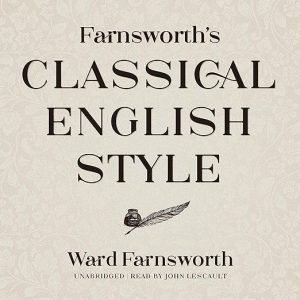
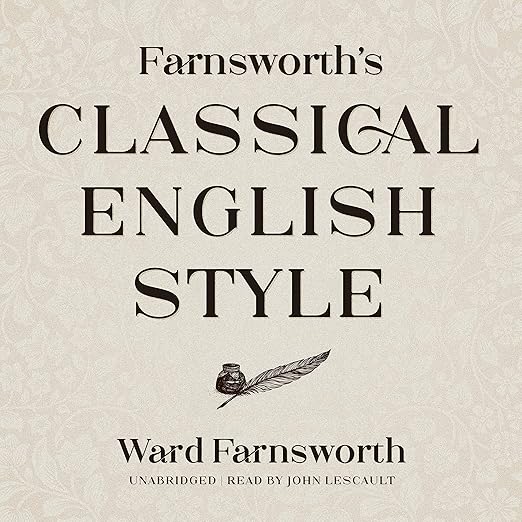
Ward Farnsworth's approach to writing instruction is not what most readers expect when they pick up a style guide. Farnsworth's Classical English Style - the third entry in his Classical English series, narrated by John Lescault across five hours and thirty-four minutes - proceeds almost entirely by example. Rather than prescribing rules, Farnsworth shows you what Lincoln, Churchill, and a small library of other masters actually did, then names the technique. The audiobook is, consequently, a pleasurable experience in a way that few educational titles achieve. You are not being lectured about style; you are being shown what style looks like when it works, and the difference between those two pedagogical methods is enormous.
I came to this book having already worked through Farnsworth's earlier entries on metaphor and rhetoric in the Classical English series. This third volume consolidates and applies those lessons at the level of the sentence and paragraph, and it is the entry most directly useful to working writers. The five and a half hours are dense - not in the sense of being difficult, but in the sense that nearly every passage contains something worth stopping on. Lescault's narration makes that density navigable.
Lincoln's Trick of Ending on the Key Word
The organizing insight of this audiobook is that classical style choices are not arbitrary preferences but functional tools - that certain ways of constructing a sentence produce force, clarity, and memorability for reasons we can identify and learn from. Farnsworth works through principles including the preference for concrete over abstract nouns, the value of short sentences at moments of emphasis, the way parallel structure creates both rhetorical power and cognitive ease for the reader, and the careful management of sentence length variation. Every principle is illustrated with multiple examples drawn from Lincoln's speeches, Churchill's wartime writing, Swift's prose essays, and dozens of other sources spanning three centuries.
Reviewer George P. Wood, an editor by profession, described the book as identifying "principles of style that are powerful and enduring" illustrated with quotations that bring the analysis alive. That is an accurate summary, but it understates what Farnsworth adds: he does not just point at good sentences. He explains why they work in terms specific enough to be actionable. When he discusses how Lincoln creates emphasis by placing the most important word at the end of a sentence, the discussion is precise enough that a writer can actually do something with it the next time they revise.
Lescault Gives Quotations Their Proper Weight
John Lescault's narration is one of this audiobook's genuine assets. Lescault, who has narrated multiple volumes in the Farnsworth series, has developed an approach exactly suited to this kind of material: he reads with the weight and deliberateness of a careful reader, giving quotations the slight elevation they need to be heard as examples rather than running text. When he delivers a passage from the Gettysburg Address or Churchill's wartime speeches, the shift in register is clear without being theatrical. For a book that exists to demonstrate the effect of rhetorical choices, having a narrator who can execute those choices in performance is not incidental - it is part of the teaching.
Reviewer Donald Dunnington noted that the examples "keep me reading" even when the analytical framework was familiar. That quality transfers directly to audio. The cumulative effect of hearing several hundred examples of classical English prose, well-read, over five hours is its own kind of education - the kind that works on your intuitions as well as your analytical faculties. Listeners who work in writing-adjacent fields report changes in their own prose after engaging with this material, which is the practical test of any craft book.
Third in a Series That Finally Completes Itself
One structural note for listeners: this is the third book in a series, and while it works as a standalone, listeners who have already encountered Farnsworth's treatment of metaphor (Classical English Metaphor) and rhetorical figures (Classical English Rhetoric) will find this volume completes a picture the earlier entries began. The three books form a loose curriculum in classical prose style, and this final entry applies the principles most directly to the level of practical writing. Reviewer Dr. Know described the combination of the book's title and Farnsworth's organizational clarity as what drew them in, and the delivery matches that promise.
The audiobook's relative brevity - under six hours - is a considered choice rather than a limitation. Farnsworth is not trying to be comprehensive; he is trying to be useful. Each chapter covers its principle with enough depth to make it stick, then moves on. The result is a guide you can actually finish, return to, and apply, rather than an encyclopedia you consult and set down. For anyone engaged with writing as a professional or serious avocational practice, the density-to-length ratio here is hard to improve on.
Editors and Lawyers Need This Most
Working writers, editors, and lawyers who need to communicate with clarity and force will find this the most directly applicable of the three Farnsworth series entries. Readers who love the rhetorical architecture of Lincoln's speeches or Churchill's wartime prose and want to understand the mechanics will find the analysis illuminating without being reductive. Journalists working toward a more distinctive written voice will find specific, nameable techniques here that most style guides either skip or bury in vague prescription.
Listeners hoping for a conventional prescriptive style guide with simple rules to follow should look elsewhere. Farnsworth's method is analytical and example-driven, not prescriptive. And anyone who has already developed strong analytical instincts about prose style may find the first half covers familiar ground quickly. But as a concentrated study of why good writing sounds the way it does, this audiobook delivers on its title with rare precision.
A Few Questions About Farnsworth's Classical English Style
Should I listen to the earlier books in Farnsworth's Classical English series before this audiobook?
Not required, but recommended for the fullest benefit. Books 1 and 2 cover metaphor and rhetorical figures; this third volume focuses on style at the sentence and paragraph level. Each works as a standalone, but together they form a coherent curriculum.
Is this audiobook useful for people who write professionally, or is it more academic?
Practically useful. The analysis is rigorous, but every principle is tied to identifiable examples from Lincoln, Churchill, and other masters, and described specifically enough to inform revision. Several reviewers who write or edit professionally reported direct improvements in their own work.
How does John Lescault's narration handle the many quoted passages from historical writers?
Skillfully. Lescault gives quoted material a slight elevation in register that signals it as example rather than analysis, without becoming theatrical. For a book that teaches through demonstration, having a narrator who can enact the qualities being discussed is a significant advantage.
At just over five hours, does this audiobook feel complete or is it a condensed treatment of a larger subject?
Complete by design. Farnsworth explicitly focuses on the most powerful and durable principles rather than attempting comprehensiveness. The brevity reflects editorial confidence, not abbreviation, and most listeners report the density feels appropriate rather than insufficient.