Quick Take
- Narrator: John Lescault brings the right academic gravity to Farnsworth's quotation-dense text, his pacing through the examples is measured enough for the listener to actually absorb each one.
- Subjects: Figurative language as a tool of clarity and persuasion, the mechanics of memorable expression, classical rhetoric applied to contemporary communication
- Tone: Intellectually pleasurable and oddly addictive, each example pulls toward the next
- Bottom line: Ward Farnsworth has written the most practically useful rhetoric guide in recent memory, and Lescault's narration makes the audio experience a genuine alternative to the print edition.
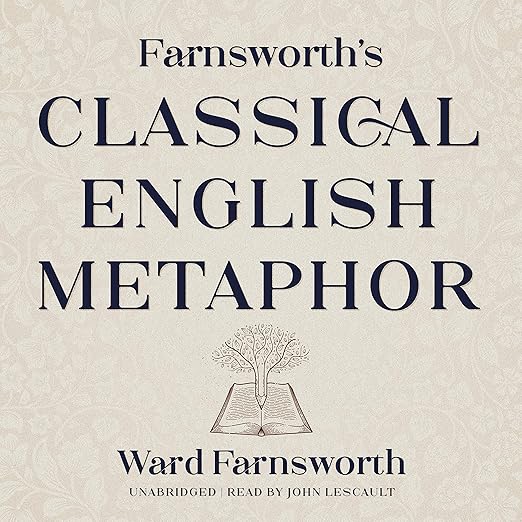
Ward Farnsworth's Farnsworth's Classical English Metaphor belongs to a project with a clear and ambitious aim: to restore practical rhetoric, the actual mechanics of how language works and why some of it stays in the mind while most of it doesn't, to the education of writers and speakers. The audiobook version of this nearly nine-hour guided tour through hundreds of metaphors organized by theme and function is one of those rare cases where listening to a reference work makes the material more engaging rather than less.
What makes the metaphor so useful as a subject for close analysis is its everyday invisibility. We use figurative comparison constantly without examining it. When someone says that a politician is a rudderless ship or that a new law is a Trojan horse, the effectiveness of the image depends on specific choices that can be studied, replicated, and improved. Farnsworth has gathered examples from novelists, playwrights, philosophers, and orators, organized them by the different things metaphors are asked to do, and then shown his work, explaining not just what the image achieves but how and why the mechanism functions.
From Dickens to Lincoln, Sorted by Function
The thematic organization is the book's most useful feature and the one that distinguishes it from a simple anthology of good writing. Farnsworth separates metaphors that make abstract ideas visible from those that produce caricature, from those that simplify the complicated, from those that give emotional states a physical reality. Each category reveals something different about the underlying demands of figurative language. By the end of the book, a careful listener has not just encountered several hundred excellent images, they have developed a taxonomy for analyzing figurative language that they can apply to their own writing immediately.
One reviewer described the book as a delightful read for the student of civil discourse and an excellent reference for businessmen and those in public life. That last phrase is worth noting, this is not exclusively an academic or creative writing resource. Figurative language is the mechanism by which difficult ideas become persuasive, by which a position in a meeting or a policy in a speech moves from abstract to felt. The classical examples Farnsworth uses, drawn from Dickens, Shakespeare, Burke, Lincoln, and dozens of others, demonstrate principles that apply to contemporary communication without requiring the reader to write like any of them.
Lescault Shifts Between Two Distinct Registers
John Lescault's narration suits the material with particular precision. The quotation-heavy structure, hundreds of brief examples, each followed by Farnsworth's commentary, requires a narrator who can shift between the literary voice of the quoted passage and Farnsworth's own analytical register without losing either. Lescault manages this throughout. His handling of extended quotations from dramatically different periods and styles, from Elizabethan drama through Victorian fiction through twentieth-century political oratory, maintains coherence without imposing a homogenizing quality that would flatten the variety.
The audio format does something interesting with this material: it makes the listening experience closer to being read to than to private study, and there is a long tradition of rhetoric instruction being primarily oral. Hearing the examples delivered aloud by a skilled reader activates their rhythmic and phonetic qualities in ways that silent reading partially suppresses. A metaphor from a speech by Lincoln or Churchill, read by Lescault at appropriate pace and emphasis, demonstrates the very point Farnsworth is making about why those images work.
Ornate on Purpose, Farnsworth's Density Is the Point
The book is a reference work as much as a reading experience, and the audio format has a specific limitation for reference material: you cannot flip back easily to a particular category when you want to consult it. Listeners who plan to use this as a practical writing resource, returning repeatedly to the section on metaphors that clarify versus those that intensify, will want the print edition alongside the audio. The audio version is excellent for the first pass through the material; the print version serves the repeated consultation that makes a rhetoric guide useful over time.
The classical examples also require a certain orientation to historical prose styles. Farnsworth draws heavily from writers who were producing work for audiences with expectations of rhetorical elaboration, they were showing off, in the best sense, and the metaphors they chose were meant to be noticed. Contemporary readers accustomed to the plain style that dominates modern nonfiction will encounter a density of figurative comparison that initially reads as ornate. That density is the point. By understanding what these writers were doing and why it worked for their audiences, a contemporary writer can adapt the underlying principles to a plainer idiom without losing the impact.
Taxing for Casual Readers, Useful for Writers
Writers at any level who want to understand the mechanical basis of effective figurative language will find this audiobook more practically useful than most books on writing style. Speakers and professionals who communicate complex ideas to non-specialist audiences will find the sections on simplification and abstraction particularly valuable. Educators teaching rhetoric or composition who want a comprehensive catalogue of how metaphor functions will find the thematic organization extremely useful for structuring their own instruction.
Casual readers looking for easy enjoyment will find the density of material somewhat taxing, this is a serious engagement with a specific craft question rather than light reading. Print alongside audio is the ideal format combination. At 8 hours and 51 minutes, this is a sustained commitment, but it is the kind of sustained commitment that produces a genuinely different relationship to language on the other side of it.