Quick Take
- Narration: L.J. Ganser is a reliable presence throughout – his measured cadence suits the book’s philosophical register well, though the material demands more from the listener than from the narrator.
- Themes: Multi-generational family governance, the ‘shirtsleeves to shirtsleeves’ dynamic, human and intellectual capital alongside financial wealth
- Mood: Thoughtful and deliberate, dense with philosophical reference
- Verdict: A serious and rewarding listen for families navigating wealth across generations, though readers seeking tactical guidance should pair it with Hughes’s earlier Family Wealth.
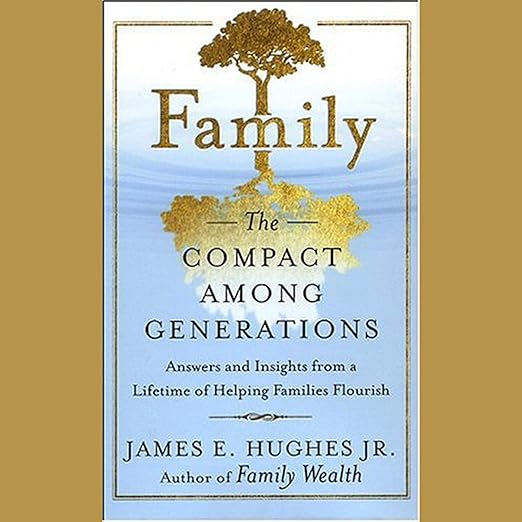
I came to Family by James E. Hughes Jr. with a specific question in mind. I had been reading about the sociology of inherited wealth, partly out of professional curiosity and partly because a family I knew well was going through an inheritance dispute that had fractured relationships built over decades. I wanted to understand why that kept happening, at every level of affluence. Hughes, whose earlier book Family Wealth established him as one of the leading voices in multi-generational family governance, seemed like the right guide.
What I found was something denser and more philosophical than I had expected. This is not a book of tactical advice, though practical insights surface throughout. It is, more precisely, a sustained meditation on what makes families flourish across generations and what causes their gradual dissolution. Hughes draws on decades of work advising wealthy families, and the panoramic quality of the book reflects that accumulated experience. L.J. Ganser narrates with measured authority, a natural fit for material that rewards careful attention.
Our Take on Family
Hughes frames the central challenge of multi-generational family life around what he calls the “shirtsleeves to shirtsleeves in three generations” problem: the near-universal tendency for family cohesion and resources, however broadly defined, to erode within three generations. What distinguishes this book from other treatments of that theme is Hughes’s insistence on a tripartite conception of capital. Financial assets matter, but so does human capital, the individual capacities and wellbeing of each family member, and intellectual capital, the shared knowledge, values, and governance systems that hold a family together. Neglect the latter two, and the first tends to follow.
This is a perspective that feels genuinely corrective given how much wealth management literature focuses almost exclusively on financial mechanics. Hughes argues, persuasively, that families fail not because they mismanage money but because they mismanage relationships and systems of self-governance. The legal and financial professionals who advise families often lack the frameworks to address those dimensions, which is part of why the book is addressed as much to the advisors as to the families themselves.
Why Listen to Family
The audio format rewards patient listening. Hughes is a writer who builds his argument slowly, layering philosophical reference with practical illustration. One reviewer from the original advisory community described the book as offering “good depth of references and philosophies behind the industry,” and that characterization is accurate. Listeners hoping for a quick-listen summary of actionable takeaways will find the pacing demanding. Those willing to follow Hughes’s thinking at his own pace will encounter a genuinely original framework for understanding family dynamics across time.
The sections on family governance, particularly the idea of developing shared systems for decision-making that distribute power without concentrating dependency, are among the most valuable in the book. Hughes does not offer a one-size template. Instead, he articulates principles that families must adapt to their own cultures and circumstances, an approach that is honest about complexity even if it occasionally frustrates readers seeking specific answers.
What to Watch For in Family
Listeners who have not read Family Wealth first may find the early sections assume a degree of familiarity with Hughes’s earlier conceptual framework. The book positions itself as extending beyond Family Wealth’s widely accepted practices, which means it can feel like it is building on foundations the listener has not yet seen laid. Starting with the earlier book, or at least reviewing its core arguments, will make this a more rewarding experience.
The book also leans heavily on abstract philosophical registers at times, particularly when Hughes draws on classical sources to ground his thinking about governance and flourishing. For some listeners this is a strength; for others, a patience-testing detour. The reviews suggest a genuine split along those lines.
Who Should Listen to Family
This is most directly useful for wealthy families actively thinking about multi-generational planning, and for the attorneys, financial advisors, and family office professionals who serve them. It is also a worthwhile listen for anyone intellectually curious about why family cohesion is so difficult to sustain across time, regardless of the financial dimension. Readers seeking concrete, step-by-step governance tools should treat this as a philosophical companion to more operational resources rather than a standalone manual.
Frequently Asked Questions
Should I read Family Wealth before listening to Family by James E. Hughes Jr.?
It helps. Family positions itself explicitly as going beyond the practices in Family Wealth, which means listeners unfamiliar with that framework may find some early chapters assume context they do not yet have. The earlier book is not a strict prerequisite, but the pairing is worthwhile.
Is this book relevant to families who are not ultra-wealthy?
Many of the governance and relationship principles Hughes articulates apply across a wide range of family circumstances. The book does address the specific challenges of financially comfortable and wealthy families, but the core insight about human and intellectual capital mattering as much as financial assets is broadly applicable.
How does L.J. Ganser’s narration handle the more philosophical passages?
Ganser’s measured, authoritative delivery suits the book’s register well. He does not dramatize the material, which is appropriate – the text rewards attention rather than performance, and Ganser respects that.
Does the book offer practical governance tools, or is it primarily theoretical?
It sits closer to the philosophical end of the spectrum. Hughes articulates principles and frameworks rather than step-by-step processes. Readers wanting practical implementation tools should look at it as conceptual grounding to accompany more operational resources.