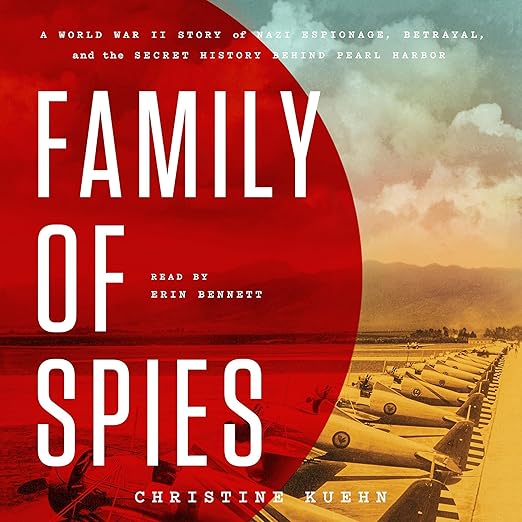
Family of Spies opens with a letter from a screenwriter that forces Christine Kuehn to confront a hidden history: her own family's involvement as Nazi and Japanese spies during World War II, reaching all the way to the attack on Pearl Harbor. This audiobook comes from narrator Erin Bennett and Macmillan Audio, produced out of Celadon Books, running 8 hours and 36 minutes and releasing in November 2025.
Rare Praise for Accents and Different Voices
A startling family history runs through the synopsis: Eberhard's sister, Ruth, who was half Jewish, had an affair with Nazi leader Joseph Goebbels. Goebbels found out about her background but, rather than having Ruth killed, sent the entire Kuehn family to Hawaii as spies instead. From there, the family passed secrets to the Japanese in the run-up to the attack on Pearl Harbor, a chain of events Christine Kuehn, Eberhard's daughter, only learned about decades later from a screenwriter's cold inquiry.
This is one of the rare listings in this genre where the review column actually addresses narration directly. A Booklist blurb calls Erin Bennett's reading 'never overdone,' and a Kirkus quote goes further, praising precise enunciation and the ability to credibly shift between accents for different nationalities as well as between male and female voices, describing the delivery's 'alto pitch and calm presentation' as well suited to the material.
Eighty Percent Excellent, Twenty Percent Iffy
That same Booklist quote appears twice in the synopsis, once near the top of the description and again at the very end, an odd bit of repetition that suggests some copy-paste in how this particular description was assembled. It doesn't change the substance of the praise, just its presentation.
Beyond the unusually detailed narration quotes, the five reviews are consistently enthusiastic about the research itself. One review's title praises the book's sleuthing and reporting directly, another highlights access to National Archives documents as the source of the book's best material, and a third frames the whole book as a page turner despite its heavy subject matter.
Douglas Thorpe's review takes an unusually specific approach, breaking the book down into roughly eighty percent excellent and twenty percent 'iffy' before praising the family's Hawaii operation and the author's archival digging as the strongest eighty percent. It's a more granular way of grading a book than a flat star count allows, and it reads as more trustworthy for it.
Part-time baker's review adds a specific personal context: the book arrived as a Christmas gift, read by someone who already follows WWII material closely and still found this particular account riveting and unfamiliar. That reviewer specifically recommends it to anyone who enjoys true WWII stories that aren't common knowledge, a fairly precise description of what this book is actually offering.
More Family Confession Than War History
A German-Jewish-American entanglement inside the Kuehn family gives the book a genuinely different angle on a well-covered period, more family confession than straightforward war history, and reviewers respond to that intimacy specifically. Douglas Thorpe's review calls the family's Hawaii operation and its aftermath 'really spectacular' while crediting the author's access to archival documents for the book's strongest material.
The Heath's review opens by calling it, in its own words, 'Deeply personal,' and adds that the story continues across generations before the secrets come to light. That generational structure, present-day discovery interwoven with wartime history, is part of what several reviewers point to as the book's strongest storytelling choice.
TRose's review calls the whole thing a total page turner, crediting the meticulous research behind a story spanning thirty years of uncovering family secrets. Taken together, the five reviews describe a book that earns its tension from real archival digging rather than from any dramatized embellishment.
A Family Tree Nobody Can Read in Print
One reviewer, Bob H, gives the book four stars but flags a production issue with the print edition specifically: the Kuehn family tree at the front of the book, called important for following the players, is printed in a way described as 'virtually impossible to read.'
That complaint is about the printed page, not the audio experience, so it may not carry over to this recording at all. Still, it's a reminder that this book exists in multiple formats with different production quirks, and that a genealogy chart doesn't have an obvious audio equivalent either way.
All five reviews here are dated after the November 2025 release, from December 2025 through March 2026, so at least the timing of the review column lines up cleanly with when this specific audiobook actually became available.
A Manageable Length for Listeners Newer to WWII
This is a strong pick for listeners of WWII history who want a personal, family-driven angle rather than a broad military history, and the narration itself comes with rare independent praise from Booklist and Kirkus specifically calling out accent work and vocal range.
Skip it only if you specifically need the printed family tree for reference, since reviewers suggest that particular element does not translate well to the page it was printed on, let alone to an audio format with no visual component at all.
Readers who appreciate a memoir-adjacent structure, present-day discovery braided together with decades-old history, should find the pacing reviewers describe especially rewarding. At 8 hours and 36 minutes, it is also a manageable length for listeners newer to WWII-focused nonfiction rather than a sprawling multi-volume commitment, and the Booklist and Kirkus quotes give performance-focused listeners unusually concrete reassurance before they even press play.
- Performance: Erin Bennett earns rare, specific praise from Booklist and Kirkus for accent work, vocal range, and an alto pitch suited to the material.
- What it covers: hidden family complicity, espionage uncovered generations later, the weight of inherited secrets.
- Feel: Tense and intimate, closer to a family confession than a conventional war history.
- Our call: This one stands out both for its research and for genuinely well-documented narration, minor print-edition gripes aside.