Quick Take
- Narration: Joe Scalora delivers the workbook-style content with measured authority, making the exercises and prompts feel actionable rather than clinical.
- Themes: High-conflict co-parenting, emotional intelligence in separation, parallel parenting as an alternative to conventional co-parenting
- Mood: Grounded and practical, with a compassionate undercurrent
- Verdict: A structured workbook-adjacent listen best suited to parents actively navigating high-conflict custody situations who need tools rather than theory.
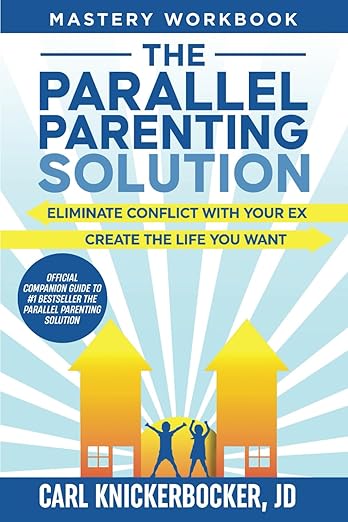
Family Court Solutions arrives at an interesting tension inherent to the workbook-as-audiobook format. Carl Knickerbocker’s book is described as the official companion to The Parallel Parenting Solution, and its structure, one hundred exercises with prompts for self-reflection and emotional processing, is designed for active engagement. Listening while driving or walking means encountering content that assumes you have a pen in hand and a quiet space to write. That tension is worth naming upfront, because the content itself is genuinely useful for the audience it addresses.
The population of listeners who would seek out Family Court Solutions is specific: parents navigating separation from a high-conflict co-parent, people caught in what the synopsis describes as enmeshed behaviors that fuel stress and confusion. For that listener, the book offers something that most legal self-help resources do not, which is explicit acknowledgment that the emotional and psychological dimensions of high-conflict custody are as real and as important as the procedural ones.
Our Take on Family Court Solutions
Knickerbocker’s framing around parallel parenting rather than conventional co-parenting is the book’s most practically useful contribution. Co-parenting assumes a baseline of functional communication between separated parents. Parallel parenting acknowledges that for families dealing with genuinely high-conflict dynamics, minimizing contact between parents while maintaining reliable structure for children is often the better framework. That reframe alone is worth the six-hour-and-twenty-seven-minute runtime for listeners who have been trying to force conventional co-parenting into a situation that cannot support it.
The one hundred exercises represent the book’s core delivery mechanism. Knickerbocker organizes them around recognizable challenges: creating stability amid chaos, protecting children’s emotional wellbeing, building the listener’s own resilience, and learning to advocate effectively in legal and institutional settings. The exercises are practical rather than therapeutic in depth, which is appropriate given the format. They point toward growth without attempting to substitute for professional therapeutic support.
Why Listen to Family Court Solutions
Joe Scalora’s narration suits the material. He avoids the two failure modes most common to self-help narration: the performative empathy that sounds like a motivational speaker rather than a guide, and the flat institutional tone that drains the exercises of any warmth. His delivery is measured and direct, which creates the impression of being talked through the material by someone knowledgeable rather than sold something. For workbook-style content that asks the listener to engage emotionally, that register matters significantly.
The book’s 604-page source text compressed into six-and-a-half hours of audio means some content is dense in places. The structural organization helps, and listeners who are actively working through a custody situation will find specific sections relevant enough to return to. This is not purely a one-pass listen but a companion text that works differently depending on where in the process the listener finds themselves.
What to Watch For in Family Court Solutions
The book’s minimal public review footprint reflects its recent release in late 2024 rather than its quality. As a companion to an established framework, it carries the credibility of an existing body of work on parallel parenting. Listeners who are not already familiar with The Parallel Parenting Solution may want to start there and use this workbook-companion as the second listen.
The audio format makes some of the exercises harder to engage with than they would be in print. Listeners who want to work through the prompts actively will benefit from having a notebook nearby. Treating it as a passive listen will yield insight but less than the engaged workbook experience the author intends.
Who Should Listen to Family Court Solutions
Directly suited to parents in high-conflict custody situations who are looking for practical tools to reduce the emotional and logistical chaos of those arrangements. Also useful for family therapists, mediators, and legal professionals looking to understand the framework their clients may be working from. Less suited to listeners whose co-parenting situation is functional and cooperative, or to those looking for legal advice rather than emotional and strategic guidance.
Frequently Asked Questions
Should I listen to The Parallel Parenting Solution before Family Court Solutions?
Knickerbocker describes this as the official companion to The Parallel Parenting Solution, which suggests that the companion works best with the foundational book as context. Family Court Solutions can stand alone as a practical workbook, but the framework it builds on will be more meaningful if you have encountered the original text.
How does the workbook format translate to audio? Can the exercises actually be used while listening?
The exercises are audible and comprehensible, but the format works best with a notebook nearby for active engagement. Listeners who treat it as background audio will absorb the frameworks but miss the deeper benefit of the reflective prompts. Setting aside dedicated listening time for the exercise sections makes a significant difference.
Is parallel parenting appropriate for all high-conflict custody situations?
Knickerbocker positions parallel parenting as specifically suited to situations involving genuinely high-conflict dynamics, where minimizing direct parental contact while maintaining structure for children is more sustainable than forced conventional co-parenting. It is not a universal framework and is not positioned as such in the book.
Does the book offer legal guidance, or is it strictly focused on emotional and practical strategies?
The book focuses on emotional intelligence, self-reflection, and co-parenting strategy rather than legal advice. It helps parents advocate for themselves and their children within family court processes but does not substitute for qualified legal counsel.