Quick Take
- Narration: Ben Gillman brings warmth and forward momentum to Alger’s period prose, treating the earnest optimism with respect rather than ironic distance, which is the correct approach for this material.
- Themes: Social mobility, honest ambition, the mythology of deserved success
- Mood: Bright and purposeful, with the uncomplicated forward motion of nineteenth-century popular fiction
- Verdict: A short, satisfying continuation of the Ragged Dick story that rewards listeners who find something real in Alger’s vision of hard work and self-improvement, even knowing its idealized limitations.
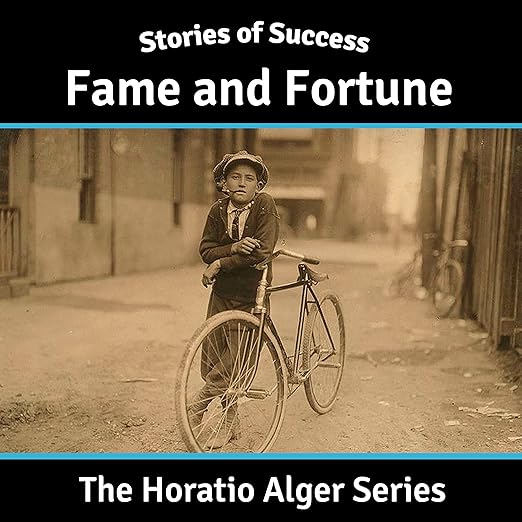
I picked up Fame and Fortune on a Tuesday morning looking for something short and uncomplicated to fill a ninety-minute commute. What I found was a book that does exactly what it promises in its title and nothing more, which is either a virtue or a limitation depending entirely on what you want from an audiobook. Horatio Alger’s sequel to Ragged Dick follows Richard Hunter, formerly the bootblack Ragged Dick, as he continues to improve himself and his circumstances through a combination of honest dealing, willingness to work, and the kind of coincidental encounters that populate Alger’s world reliably.
This is, by any serious literary accounting, formula fiction. Alger was among the most commercially successful American authors of the late nineteenth century precisely because he was writing stories that told his audience what they wanted to believe about how the world operated: that effort was rewarded, that character showed, that opportunity was available to those willing to meet it. Those of us who have spent time thinking about American inequality know that the model has always overstated the role of individual virtue and understated structural advantage. But that analysis belongs to a different kind of book entirely.
What Richard Hunter’s World Actually Offers
Fame and Fortune follows directly from Ragged Dick, and the synopsis recommends experiencing them in order. Richard Hunter enters this second novel having already made the central transformation from street child to honest young worker, and the question is whether that transformation can continue to yield results. Alger’s answer is consistently yes, mediated by specific encounters and by Richard’s demonstrated reliability and character. The plot mechanics are familiar: a favor done well, a connection made through honest circumstance, an opportunity that arrives for someone who was already doing the right thing when it did.
Reviewer M. Thorsson connects Alger’s fiction to the tradition of books like Think and Grow Rich, which is an astute cultural observation. Both traditions are in the business of narrating a relationship between inner virtue or mindset and outer material success. Alger’s version predates the self-help genre by decades, but the emotional logic is recognizable: you are reading about someone whose character determines their circumstances, and the implicit promise is that character is accessible to you too.
Ben Gillman’s Narration and the Period Register
Ben Gillman is the right narrator for this material. Alger’s prose is period-appropriate in its diction and its earnestness, and Gillman treats it with respect rather than ironic distance. A narrator who winked at the audience during Alger’s more optimistic passages would undermine exactly what makes these books work for the audience they are actually reaching. Reviewer Felicity Barrington is explicit about what that audience is: people who still find something moving in the idea that virtue and effort produce real outcomes. Gillman’s performance serves that reader rather than second-guessing it.
The audio production quality is clean and the 4 hours and 58 minutes runtime is genuinely short by contemporary standards, which suits the material. Alger’s novels were written for broad audiences in serial form, and they move quickly. There is no architectural complexity to navigate, no subplot demanding careful attention. This is a listen you can complete in a single day’s commuting.
The Honest Caveat
The 4.8 rating comes from a devoted readership that knows exactly what it is buying. Anyone coming to Alger for the first time should know they are entering a world of deliberate simplicity, where coincidence is a narrative tool and the connection between virtue and reward is stated rather than argued. Reviewer Richard Moore describes finding the principles alive and well today, which tells you something about the book’s continued resonance with a specific kind of reader. That reader exists in significant numbers, and for them this is entirely the right listening experience. For readers who find the Alger myth uncomfortable or naive, the book functions as a historical document rather than a living text, and there is genuine value in that framing too.
Frequently Asked Questions
Do I need to listen to Ragged Dick before Fame and Fortune?
The synopsis specifically frames this as a continuation of the Ragged Dick story, and Ragged Dick is typically considered the entry point for Alger’s most famous series. You can follow Fame and Fortune without prior exposure, but the character investment is richer if you begin with the first book.
Why is this book listed under comedy and humor when it reads more like inspirational fiction?
Alger’s categorization in audiobook databases is inconsistent, and Fame and Fortune is genuinely better described as inspirational or rags-to-riches fiction than comedy. The humor in Alger is mild and incidental rather than a primary quality of the work. Listeners seeking comedy in the conventional sense may find the genre tag somewhat misleading.
Is the social mobility portrayed in Alger’s fiction realistic, and does the audiobook address this critically?
The audiobook is a straightforward reading of Alger’s text without critical framing. Alger’s fiction presents social mobility as primarily a product of character and hard work without engaging with structural barriers. The book reflects the ideology of its era, and listeners should understand they are encountering an idealized version of nineteenth-century American life.
At just under five hours, is this audiobook complete, or is it abridged?
Alger’s novels are genuinely short by contemporary standards, and the five-hour runtime reflects the original length of the text rather than an abridgment. Fame and Fortune is a slim novel in print form, and the runtime accurately represents a complete unabridged reading.