In Brief
- Narration: Aasne Vigesaa handles Jennifer Crusie's overlapping ensemble with technical skill; the rapid switching between the Goodnight family's distinct personalities and Davy Dempsey's con-man register is one of the more demanding jobs in romantic comedy narration.
- Themes: Identity and self-reinvention, the ethics of deception, found family under pressure
- Mood: Fast, witty, and warm, with genuine romantic chemistry underneath the caper mechanics
- Verdict: Faking It is the kind of romantic comedy that earns its laughs through character architecture rather than situation alone, and it holds up completely even without Welcome to Temptation as prior reading.
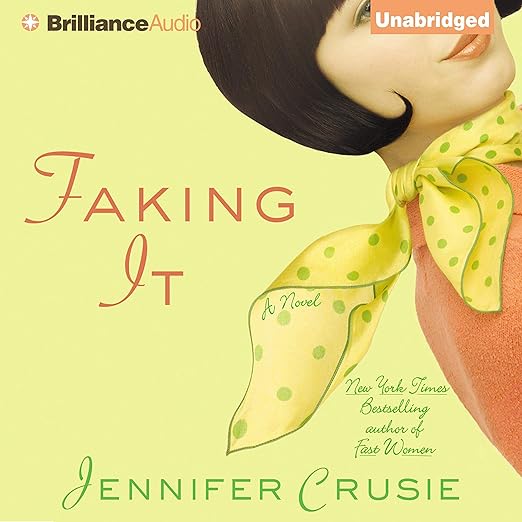
Tilda Goodnight is in a closet, in the dark, for the wrong reasons, when Davy Dempsey arrives to commit a different crime in the same house. That collision, two people each trying to steal back their own past from a woman named Clea Lewis, is the engine of Faking It, Jennifer Crusie's romantic comedy and the second entry in the Dempsey series. At eleven hours and twenty-three minutes, narrated by Aasne Vigesaa, this audiobook is the comfortable length for a fully realized comic ensemble, and Crusie uses every hour with the specific precision of a writer who trusts her characters more than her plot mechanisms.
Our Take on Faking It
The Goodnight family alone is worth the runtime. Gwen, the matriarch who escapes reality with practiced efficiency. Eve, the oldest daughter navigating two identities simultaneously. Nadine, the granddaughter looking for a direction that does not lead off a cliff. And Tilda, the youngest, who has inherited a secret locked in the gallery basement that she is willing to commit crimes to protect. Crusie constructs these four women with the kind of specificity that makes a family unit feel like a world, not just a supporting cast. The secret in the basement is the story's central MacGuffin, but the real pleasure is watching how these women operate under pressure and what their particular forms of self-deception reveal about them.
Davy Dempsey is a reformed con man, which means he is a man with a very clear picture of how manipulation works and a strong preference for not using those tools anymore, until a three-million-dollar betrayal and the involvement of Clea Lewis make the preference temporarily unsustainable. The dynamic between Tilda and Davy is built on mutual recognition: she is someone comfortable operating in the gray zone of forgery and substitution, and he is someone who has made that gray zone his professional specialty. They understand each other's methods before they understand their own feelings, which is exactly the right foundation for this kind of comedy. Reviewer Karen K. pulled the novel's opening sentence directly into her review, calling out Matilda stepping back from a van Gogh reproduction she has painted on a client's dining room wall and realizing it is the crime that will send her to hell, which tells you immediately that Crusie is operating at a very specific comic frequency.
Why Listen to Faking It
Aasne Vigesaa manages the ensemble well. The Goodnight women need to be distinct without relying on broad caricature, and Vigesaa keeps their individual registers clear across a narrative that frequently has them in the same scene reacting to the same information differently. Davy's con-man affect, the particular social intelligence of someone who has spent years reading rooms, requires a narrator who can convey strategic thinking underneath surface charm. Vigesaa handles the dual register credibly, and the pacing of the audiobook suits Crusie's chapter structure, which tends toward shorter scenes with quick point-of-view switches.
The supporting cast, a disgruntled heir, an exasperated hitman, suspicious art collectors, and a mutant dachshund with its own agenda, gives the audiobook a density of incident that prevents the romance from feeling isolated from the world around it. Crusie is notable for building comedies where the stakes feel real even when the situations are absurd, and this carries through in audio particularly well. The jukebox stuck in the sixties is a minor detail that accumulates meaning across the runtime in a way that rewards sustained listening over scattered sessions, and the art-forgery subplot gives the romance a setting with genuine stakes beyond the emotional ones.
What to Watch For in Faking It
Several reviewers suggest listening to Welcome to Temptation first, and that advice has some merit. Faking It reprises characters from the earlier novel, and knowing their history deepens the reading. However, the same reviewer who offered that recommendation called this a pretty little story by comparison, which is not the same as saying it is lesser. Faking It is more contained, more narrowly focused on the Goodnight-Dempsey dynamic, and consequently more intimate in its comedy than the sprawling first entry.
The romantic and sexual content is present throughout, though the audiobook does not tip into explicit territory. The questionable sex reference in the synopsis is Crusie's own framing, and it serves as a fair signal of tone: this is a book where physical comedy and romantic comedy are in close proximity, and neither is treated with unearned gravity. One reviewer from within the author camp mentioned a forthcoming sequel featuring Nadine planned for 2026 as part of an art series continuation, so the Goodnight world appears to be expanding. Crusie's comic timing relies on the accumulation of detail, not on single setpiece moments, and the eleven-hour runtime is the space that accumulation requires. The hitman character in particular, exasperated rather than threatening, is a running joke that pays off in a way that shorter novels rarely allow. Listeners who bail before the gallery secrets are fully resolved will miss the most satisfying structural payoff of the book.
Who Should Listen to Faking It
Listeners who like their romantic comedies with a heist architecture underneath, genuine ensemble depth, and a specific voice that earns its wit rather than assuming it, will find this rewarding. Crusie fans who have already read Welcome to Temptation should prioritize this one. Newcomers can enter here but will get more from it with the earlier book as context. Listeners who want unambiguously earnest romance without the caper elements and family-dysfunction comedy woven through every scene are probably better served elsewhere in the genre. The mutant dachshund is genuinely funny and not just a quirky prop; by the third act it has earned its place in the ensemble. The audiobook rewards listeners who surrender to Crusie's world-building pace, and Vigesaa's consistent energy across the full runtime makes that surrender easier than it might otherwise be.
How explicit is the romantic content in the Faking It audiobook?
The physical relationship between Tilda and Davy is part of the story, and the content is adult in register without being graphically explicit. Crusie's tone is more wry than heated, which means the romantic scenes are framed within the comedy rather than standing apart from it.
Is the audiobook narration consistent across the large cast?
Aasne Vigesaa handles the ensemble effectively. The four Goodnight women are differentiated clearly, and Davy's con-man affect is maintained without sliding into caricature. The rapid point-of-view switches that characterize Crusie's chapter structure are managed cleanly across eleven-plus hours.
Is there a third book in the Dempsey series that follows this audiobook?
One reviewer mentioned a sequel featuring Nadine planned for release in 2026 as part of an art series continuation. No confirmed audiobook edition for that volume has been announced at time of writing.