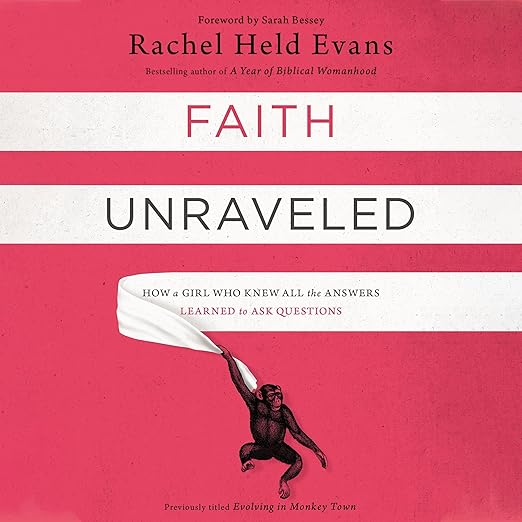
I started listening to Faith Unraveled on a Sunday morning when I had nowhere to be, which felt like an appropriate context for a book about a woman who spent years wrestling with what Sunday mornings were supposed to mean. Rachel Held Evans, who died in May 2019 at thirty-seven, had a voice, in both the literal and literary sense, that made complicated theological territory feel personal and navigable. Hearing her narrate her own memoir closes a gap that a surrogate reader could never fully bridge.
The book was originally published as Evolving in Monkey Town, a title that tells you exactly where this story takes root: Dayton, Tennessee, eighty years after the Scopes Monkey Trial made her hometown a national symbol of the conflict between faith and scientific inquiry. Evans grew up steeped in a culture that treated Christianity as a fortress requiring constant defense, and she was good at that defense. She went to Bryan College, the same ground where fundamentalism had dug its heels in, and she was the kind of student who could marshal arguments, who found comfort in certainty. Then the questions started finding her instead.
Where This One Lands
What Evans does in this memoir that most deconstruction narratives do not is refuse to resolve cleanly in either direction. She does not emerge as a triumphant atheist, nor does she retreat into a reconstituted fundamentalism. The faith she arrives at by the end is provisional, question-shaped, alive to change, which is exactly what makes it feel earned rather than performed. One reviewer, a longtime Christian who described herself as someone who accepts evolution without experiencing it as a threat to scripture, described the book as "like finding out I am not alone." That response keeps surfacing across the reviews: Evans articulated something many listeners had felt but could not name.
The memoir is structured around specific intellectual crises rather than a smooth biographical arc. The moment when her certainty first buckled, not during a dramatic event but while watching news coverage of violence and asking why a good God would permit it, lands with particular force because Evans does not dress it up. She was a smart young woman at a conservative Christian college, and the smartness was both her asset and the thing that kept generating inconvenient questions. One reviewer with a background in theology noted Evans' lack of exegetical sophistication in places, citing her acceptance of traditional Pauline authorship attributions. That critique is fair but also, as the reviewer themselves acknowledged, somewhat beside the point. This is not a work of biblical scholarship. It is a chapter from a life.
The self-narration transforms the experience in ways that are difficult to overstate. Evans had a distinctive speaking voice, warm, slightly self-deprecating, with a Southern cadence that she wielded with intention. When she reads the passages describing her most painful moments of doubt, there is no performance in it. You are hearing someone who has already been through the fire describe what it felt like while standing inside the heat. One listener described weeping, and not as a casual reader, she had read hundreds of books across genres, and this was the first to move her to tears. That level of response says something about the intimacy Evans achieves between her experience and the reader's.
What to Watch For in Faith Unraveled
The book's subtitle and marketing position it as a story of survival, of faith reborn after doubt. That framing is accurate but can create slightly unrealistic expectations about resolution. Listeners who arrive hoping for a clear theological destination, either a robust reaffirmation of orthodoxy or a clean departure from it, may find Evans' ending unsatisfying. The faith she lands on is deliberately incomplete, deliberately open. That is its whole point. Also worth noting: one reviewer observed that the book illuminates the declining trajectory of evangelical Christianity and its implications for mainline Protestantism, which suggests the text rewards reading as cultural diagnosis alongside personal memoir.
Recommended For
This recording is well suited to listeners who have experienced religious doubt themselves, whether they eventually returned to faith, left it behind, or are still in the middle of the question. It is also genuinely useful for those outside conservative Christian culture who want to understand how that world shapes its members and what it costs them to ask questions within it. Listeners who require tidy theological conclusions, or who find memoir as a form too subjective for serious engagement with religious questions, are likely to be frustrated. At four and a half hours in Evans' own voice, it asks very little of your time and a great deal of your honesty.
In Brief
- Read by: Rachel Held Evans reading her own memoir is the only version that could work, her voice carries both the certainty she once held and the cracks forming underneath it.
- At its heart: Religious doubt and deconstruction, faith evolution, the cost of asking honest questions
- Vibe: Intimate and searching, with flashes of wry humor that lighten the spiritual weight
- Short version: One of the most honest memoirs about the unraveling and cautious rebuilding of faith, best heard in Evans' own voice.