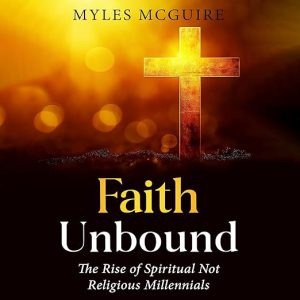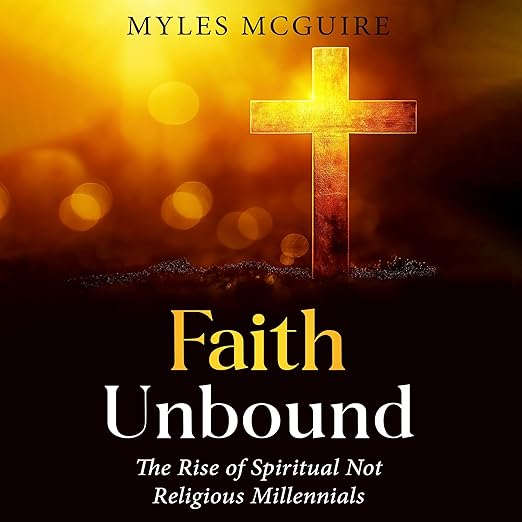
I finished Faith Unbound on a Sunday morning, which felt appropriately ironic given that the book is about millions of people who no longer spend Sunday mornings the way their parents did. I picked it up because the question it poses genuinely interests me: not whether religion is declining, which is well-documented, but what spiritual life actually looks like for the generation doing the leaving. McGuire's entry point into that question is the "Spiritual but Not Religious" movement, and the book is best understood as an accessible survey of that phenomenon rather than a deep sociological study.
Myles McGuire draws from history, sociology, and personal storytelling to trace what he calls a transformation rather than a retreat. His argument is that Millennials and Gen Z are not abandoning the search for meaning; they are relocating it outside institutional religion, pushed there by a specific constellation of forces: economic anxiety, political polarization, digital culture, and what he describes as institutional distrust. The book covers why people are leaving, what they're finding instead, and what religious communities might do if they want to understand the shift.
Three Different Readings, One Conversational Narrator
One of the more interesting tensions in the review record is between what readers expected and what they got. One reviewer came looking for an analysis of how Millennials are experiencing Christian faith outside institutional structures, and found instead a broader examination of spiritualism as an alternative. Another found the book less about "why" and more about "how to." A third reviewer, writing from a more traditional Christian perspective, interpreted the book as a diagnosis of spiritual dysfunction in a generation "creating a god they can control." All three responses are legitimate readings of the same text, which tells you something important about this book: it genuinely tries to speak to multiple audiences and, in doing so, occasionally satisfies none of them completely.
What McGuire does well is synthesize accessible research into a readable narrative. This is not an academic text, and it does not pretend to be. The writing is clear, the examples are grounded in real cultural observation, and Ben Staab's narration keeps the tone conversational. At under four hours, the book moves quickly. Whether that brevity serves or undermines the subject depends on what you're looking for. For an introduction to SBNR as a cultural phenomenon, the length is appropriate. For a rigorous examination of its sociological roots, you'll want to supplement with something like Robert Wuthnow or Charles Taylor.
Current Timing Beats a Decade-Old Trend Piece
The book's timing is one of its genuine assets. Published in early 2026, it's engaging with the current state of American religious disaffiliation rather than describing a trend that peaked a decade ago. The chapters on digital overload and how technology has reshaped spiritual community are particularly current, and McGuire's attention to how the SBNR identity offers specific psychological and social benefits is the book's most interesting analytical territory. He is fair to both sides of the institutional religion debate, avoiding both the triumphalism of secular commentators and the defensiveness of institutional religion's defenders. The reviewer who described it as "non-judgmental" is right: McGuire writes with genuine curiosity rather than a predetermined conclusion.
Sociology, Memoir, or Self-Help, Never Quite Settled
The book's title and marketing position it as something that might appeal to both religiously inclined and secular listeners, but the framing will likely feel more comfortable to people who are already sympathetic to the SBNR perspective or are themselves navigating that transition. Readers looking for a more critical examination of what gets lost when institutional religion dissolves, the community structures, the inter-generational bonds, the liturgical formation that shapes moral imagination, will find only brief gestures in that direction. The final section on what religious communities might do to reconnect is useful but brief. The book is better at diagnosis than prescription.
The review record also reflects genuine confusion about genre. Is this sociology, spiritual memoir, pastoral reflection, or self-help for the religiously unaffiliated? McGuire attempts to be all of these things across four hours, and the result is a book that occasionally lacks the depth any one of those approaches would require if pursued fully. That's a fair trade-off for accessibility, but worth naming.
Starting Point for Conversations Across the Divide
Best suited for listeners who are themselves navigating religious disaffiliation or trying to understand someone who is. It works as a starting point for conversations between religious and non-religious family members, as an introductory text for pastors trying to understand their departing young adult populations, and as a companion for anyone curious about the cultural forces reshaping American spirituality. Listeners who are already deeply read in religious sociology will find the analysis thin. Listeners expecting a devotional or a straightforwardly secular polemic will both be surprised, in different ways, by how even-handed the book tries to be.
Questions Listeners Ask
At under four hours, does Faith Unbound go deep enough on the sociology of religious disaffiliation?
For an introduction to the topic, yes. For a substantive sociological analysis, no. McGuire synthesizes accessible research into a readable narrative but doesn't engage with the academic literature in any depth. Listeners who want more rigorous treatment of the subject would benefit from pairing this with longer works on American religious change.
Does Ben Staab's narration suit the material?
Well enough. Staab reads with appropriate warmth and a measured pace that keeps the conversational tone McGuire clearly intended. The narration doesn't add much, but it doesn't detract either. For a book that already runs under four hours, a neutral, clear reading is probably the right call. A more performance-oriented narrator would likely feel mismatched with the reflective subject matter.