Two Teenagers Rescued by a Boat Named Amen
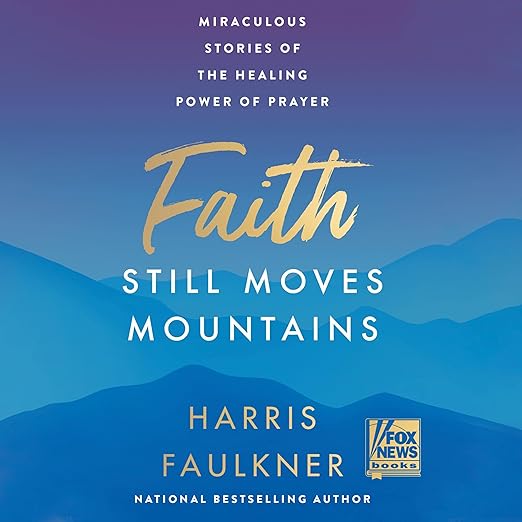
Harris Faulkner spent decades asking other people to tell their stories on air before turning the microphone toward faith and prayer for this audiobook. Faith Still Moves Mountains collects true accounts of crisis and survival, from the aftermath of Haiti's earthquake to the Aurora, Colorado theater shooting, alongside quieter stories like two teenagers rescued at sea by a boat named Amen and a woman whose near-fatal bout with COVID-19 became, in her telling, a turning point rather than an ending. Faulkner threads her own story through the collection too, including her father's faith and its influence on her own.
At eight hours and forty-eight minutes, this is a manageable listen structured more like a collection of standalone testimonies than a single continuous narrative, which suits the subject matter. Each account gets room to land on its own terms before the book moves to the next, and Faulkner closes with newly written prayers meant to translate the stories into something listeners can actually use rather than simply admire from a distance.
The newly written prayers closing the book are organized to mirror the preceding stories rather than standing apart as generic devotional material, giving listeners who want to use the collection for daily reflection a direct thematic link back to the specific testimony that inspired each one. That pairing of testimony and prayer, one grounded in a specific real event and the other written to be reused, is a structural choice a purely secular resilience memoir wouldn't attempt, and it's central to what Faulkner is trying to accomplish here.
Each story in the collection follows a loose but consistent shape: crisis, the specific moment prayer entered the picture, and the outcome Faulkner frames as evidence of answered prayer, whether that's rescue, recovery, or simply endurance through something that didn't resolve neatly. That structure repeats enough times across eight-plus hours that listeners will recognize the pattern by the midpoint, though Faulkner varies the emotional register enough, moving between disaster-scale crises and intensely personal ones, that the repetition reads as intentional rather than formulaic.
Faulkner Paces for an Audience She Can't See
Faulkner narrates her own material, and years of live television have clearly shaped how she paces a story for an audience she can't see but has learned to trust is listening closely. Her delivery carries the composed warmth of someone used to holding a room's attention without needing to raise her voice to do it, which suits testimonial material that's already emotionally loaded without any help from vocal performance.
Listener response has been strong and specific. One reviewer, J, mentions having watched Faulkner on television for years and finding it striking to hear her speak as openly here as she couldn't on air, while Errica Cooper praises the book for staying realistic rather than tipping into easy inspiration. That combination, familiar broadcaster and genuinely personal material, gives Faith Still Moves Mountains an intimacy that a book from a less publicly known author might have to work harder to establish.
Faulkner's broader career gives this project a specific credibility. Years spent as a news anchor mean she's practiced at handling difficult material without letting her own reaction overwhelm the story being told, a skill that transfers directly to narrating other people's trauma and faith with respect rather than sensationalism. That professional restraint, paired with the moments where she does let her own voice and family history into the collection, creates a useful tension between journalistic distance and personal investment throughout the book.
Prayer as Active Practice, Repeatedly Argued
This is explicitly a faith-forward book, grounded in a Christian understanding of prayer as active rather than symbolic, and it doesn't attempt neutrality on that point. Listeners outside that framework, or who prefer their resilience stories without a specific theological lens, should know what they're getting before starting. Faulkner isn't interested in convincing skeptics so much as reinforcing belief for readers who already share her framework, and the book is more effective read that way than as an argument aimed outward.
The subject matter is also heavy in places. Stories involving mass violence, natural disaster, and near-death illness are handled with care, but they're still difficult material, and the book moves between them without much tonal breathing room. Listeners sensitive to descriptions of trauma, even when framed around eventual hope, should pace themselves rather than listening straight through.
The book frames prayer explicitly as active practice rather than passive hope, and readers should expect that argument to be made directly and repeatedly rather than left implicit. Listeners who want their inspirational nonfiction to stay in the register of general encouragement, without a specific theological claim about how prayer functions, may find Faulkner's framing more assertive than expected. That directness is clearly intentional rather than a byproduct of the format, and it's worth knowing going in rather than discovering partway through.
It Lands as Personal, Never Packaged
Listeners who already follow Faulkner's on-air work, or who are drawn to faith-based nonfiction that emphasizes lived testimony over doctrine, are the clearest audience for this collection. The newly written prayers at the end add practical value for readers looking to use the book devotionally rather than just read it once and move on.
Book clubs or small groups built around faith and resilience themes may find this format particularly useful, since each story functions as a self-contained discussion piece rather than requiring the full collection to make sense. That modularity is a practical advantage worth noting for anyone considering the book for group study rather than solitary listening. Listeners looking for a secular resilience narrative should look elsewhere, but for its intended audience, Faith Still Moves Mountains succeeds on its own terms, and Faulkner's decision to narrate it herself is a meaningful part of why it lands as personal rather than packaged.
- Narration: Harris Faulkner narrates her own collection with the composed warmth of a longtime broadcaster used to holding an audience's attention.
- Themes: prayer, survival, faith under crisis, family legacy
- Mood: Uplifting and sincere
- Verdict: A comforting listen for faith-forward audiences, especially those who already know Faulkner's on-air work.
A Few Questions About Faith Still Moves Mountains
Does Harris Faulkner narrate the Faith Still Moves Mountains audiobook herself?
Yes, Faulkner narrates her own collection, bringing the same composed delivery she's known for from her television career.
Is this audiobook only for Christian listeners?
It's written from an explicitly Christian perspective and doesn't attempt neutrality on prayer or faith, so it will resonate most with listeners who already share that framework rather than skeptics seeking a secular resilience narrative.
What stories are covered in the Faith Still Moves Mountains audiobook?
The collection includes accounts tied to the Haiti earthquake, the Aurora, Colorado theater shooting, a sea rescue involving a boat named Amen, a near-fatal COVID-19 illness, and Faulkner's own family history of faith.