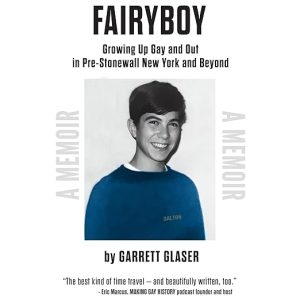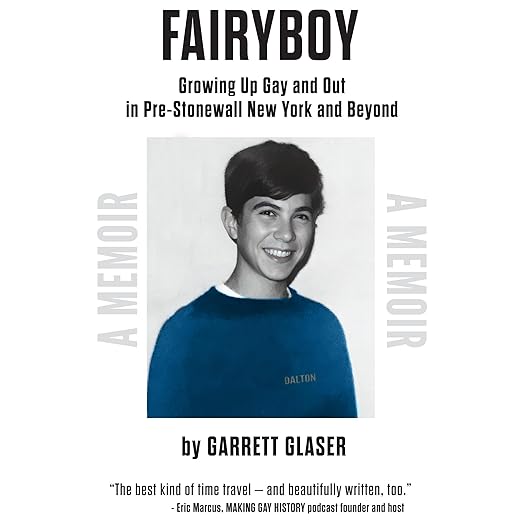
A headmaster's parting remark sits near the middle of this memoir and tells you most of what you need to know about the world that produced it, and the audiobook lets its author deliver the line himself. We just graduated our first fags, the man said of Garrett Glaser and his friend, on the occasion of their leaving one of New York's most prestigious schools. That was the late 1960s, before Stonewall, before rainbow flags, before almost anyone could live openly. Glaser was already doing it, and had been since he was fourteen.
Chapter one opens on a scene most coming-out memoirs would build toward. Glaser tells his mother at fourteen, and she answers with a sentence the description quotes verbatim: you are going to a psychiatrist right now, young man, we are going to nip this in the bud. She came around. He kept the appointments and turned them to his own purposes, using the sessions to work out how a teenager in 1967 might actually find a boyfriend. That mixture of danger and nerve sets the tone for everything after.
Honesty, wit and warmth is how one five-star response sums up the register, and adds that the book refuses to soften the realities of being gay in the 1960s while still celebrating resilience and self-acceptance. That balance is the achievement here. Plenty of pre-Stonewall accounts are written as elegy or as indictment. This one is written by someone who was, by his own account, unusually adventurous and self-assured at an age when self-assurance was dangerous, and the result reads closer to an adventure than to a lament.
What holds it together is a life with two distinct halves that the title only hints at. The Dalton School, the psychiatrist, the hidden city. Then a thirty-year broadcast career built in the open. Most memoirs of this generation have one of those stories. Fairyboy has both, and the second half keeps reframing the first.
The Voice of the Person It Happened To
Historical material is the most valuable thing on offer, and it is specific rather than general. Glaser takes listeners into the trucks along the West Side Highway and into the Continental Baths during its opening weeks, places that have been described plenty of times by historians and rarely by someone who was standing in them as a teenager. Those passages are why this belongs on a shelf next to the scholarship rather than in its shadow.
That second act earns its place too. Glaser became an Emmy Award-winning television news correspondent with stints at CNBC, NBC, ABC, CBS and Entertainment Tonight, and the interview roster the copy lists runs from Elizabeth Taylor and President George H. W. Bush to Oprah Winfrey and Charles Manson. That range means the book keeps changing altitude, from a bedroom argument in 1967 to a network assignment decades later, and the through-line the description names, the importance of mentors and of staying true to yourself, is what stops it becoming two separate books.
Authorship extends to the microphone here. The reader field carries Glaser's name, and so does the publisher line, which reads Garrett Neal Glaser, so the whole record is consistent with a self-published edition the author voiced himself. That context matters more than it would elsewhere. This is a memoir whose central material is dialogue that was said to him and about him, and hearing it in the voice of the person it happened to changes what those sentences weigh.
The Subtitle the Listing Leaves Off Entirely
Part of this book's own name is missing from the listing. One May 2025 response, from a reader who grew up watching New York local news in the 1980s and recognized Glaser instantly from Channel 7 and later from Channel 4 in L.A., gives the full title as Fairyboy: Growing Up Gay and Out in Pre-Stonewall New York and Beyond. The page shows only the first word. That subtitle is the entire pitch, and without it a browsing listener has no idea whether this is a novel, a children's book or a memoir of gay New York.
Its most practical response is also a warning about format. A January 2026 five-star advises buying it on Kindle, and explains why: every time Glaser mentions a name, an address or a detail, flip to a search engine and find the place or the person. That reader was describing a second-screen experience that audio makes awkward, and the advice is sound on its own terms. Listening gives you the voice and takes away the pause-and-look-up rhythm that this density of proper nouns invites.
Structurally, expect vignettes and reflection rather than a driving narrative. Glaser muses on how gay politics changed across the decades, and the copy itself says he weaves stories rather than builds a plot, so momentum comes from the company you are keeping rather than from a question the book is answering. Eight and three-quarter hours of that is a pleasure if you enjoy the author's company and a slog if you do not.
Firsthand Testimony From the Years Just Before Stonewall
Coming to this for the history is the right instinct. Listeners who want firsthand testimony from the years just before Stonewall, from someone who was out and moving through it rather than looking back from safety, will find little else quite like it. The entry that recommends it to the LGBTQ community for its humor and its encouragement has identified the second audience correctly: younger listeners who know the political timeline and want to hear what daily nerve actually sounded like. Media obsessives get a bonus, since the second half is a working correspondent's account of three networks and a lot of famous rooms.
Steer clear if you want a systematic history, because this is one man's route through it and makes no larger claim. It will also grate if celebrity-adjacent memoir irritates you, since the back half is full of names, or if a book without a strong forward pull leaves you restless. Anyone hunting a smooth, professionally produced literary memoir should note that this is an independent release, with the author's name filling the writing, reading and publishing slots, which is a different proposition from a studio production and one worth sampling first.
Quick Take
- Narration: Glaser reads his own book, carrying period New York geography, a mother's ultimatum and thirty years of broadcast names.
- Themes: pre-Stonewall gay New York, coming out at fourteen, mentorship, a life in television news
- Mood: Nervy, funny and matter-of-fact about danger
- Verdict: First-rate firsthand history from someone who lived it out loud, let down by a listing that hides the subtitle explaining what it is.
A Few Questions About Fairyboy
How long is the Fairyboy audiobook?
Just under nine hours, released in April 2025. That is compact for a life covering a 1960s adolescence and a thirty-year network career, so expect selected scenes told at length rather than a complete year-by-year chronicle of either half.
Is this a coming-out story or a media memoir?
Both, in that order. The first movement covers the Dalton School, the psychiatrist his mother sent him to, and the hidden gay city a teenager learned to navigate. The later material follows an Emmy-winning correspondent through a run of network newsrooms and one syndicated entertainment show.
What does the least enthusiastic response on the page say?
The single three-star is admiring rather than hostile. It credits Glaser with giving real insight into what it was and is like to be homosexual in the United States, and notes carefully that the memoir never claims to capture a universal experience, which it treats as a strength rather than a limit.
Is the Fairyboy audiobook a good entry point for listeners new to LGBTQ+ history?
Yes, with one caveat. It assumes no background and explains the world as it goes, from the trucks on the West Side Highway to the Continental Baths. What it will not give you is structure: this is one person's route through the period, not a survey, so pair it with something systematic.