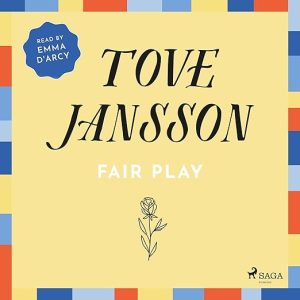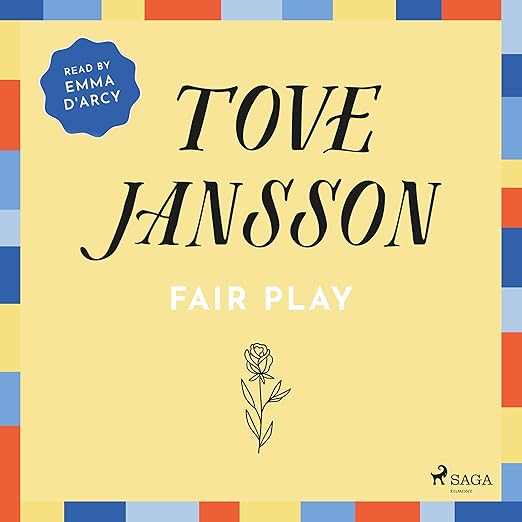
I listened to Fair Play on a Sunday morning when I had nowhere to be, which turned out to be exactly right. Tove Jansson's prose requires that particular kind of unhurried attention. You cannot rush through vignettes and expect them to accumulate properly. The structure is a series of small, precise moments, the working rhythm of two artists sharing a life across Helsinki apartments and summers on a remote island, and Jansson trusts these moments to carry their full weight without authorial scaffolding.
A note for clarity before anything else: this is Tove Jansson's 1989 novel, not the Eve Rodsky book of the same title that the metadata's genre classification suggests. The synopsis is unambiguously Jansson, and the authorship note at the end about the Moomin universe confirms it. Jansson is one of the genuinely essential voices of twentieth-century Scandinavian literature, and Fair Play, published in the English language in this edition by Saga Egmont, is where she writes closest to her own life. The two women at the center of the novel, artists who have built a relationship around creative work and mutual respect, draw directly from Jansson's decades-long partnership with the graphic artist Tuulikki Pietila.
Creative Work and Love as One Activity
What Jansson is doing here is deceptively simple. She is writing about creative work and love as though they are the same activity, both requiring attention, patience, and the willingness to let another person's interior life remain partially opaque. The vignettes move between Helsinki and the island in a rhythm that mirrors the seasonal structure of an artist's year: the city for sustained production, the island for something harder to name. One reviewer described the book as a series of vignettes tied loosely together by the twin threads of love and work, and that is accurate. The looseness is structural, not careless.
The relationship at the heart of the novel is not presented as a romantic ideal or a model to be emulated. It is presented as specific. These two women, in their particular circumstances, with their particular professional commitments and their particular forms of generosity toward one another, have built something that works. Jansson is too precise a writer to suggest this is replicable. A reviewer in the UK captured something important in calling the dynamic a true example of progressive love where generosity and respect are key. But the novel earns that description by showing the texture of what generosity actually looks like in practice, which is less dramatic and more sustaining than the word usually implies.
D'Arcy's Restraint Matches Jansson's Understatement
Emma D'Arcy's narration is a near-perfect match for the material. They read with a restraint that Jansson's prose demands. Any narration that reaches for dramatic emphasis in this text would destroy what Jansson is doing, which depends on understatement the way a certain kind of painting depends on negative space. D'Arcy seems to understand this. The quieter passages, of which there are many, are given their full duration rather than being hurried toward resolution. The effect is cumulative in the way the prose itself is cumulative: by the end of the 2 hours and 23 minutes, you feel you have spent time in the company of people who exist, rather than characters who have been constructed to perform.
At under two and a half hours, this is among the shorter listens on audiobookdaily. Length is not a measure of value, but it is worth noting that Jansson's compression is deliberate rather than incomplete. She is not writing toward a larger architecture. The vignette form is the architecture. Several reviewers expressed wanting more after the audio ended, which I think is the correct response. The feeling of wanting to spend more time with these characters is how the book registers having succeeded.
Jansson's Novella Hides Behind a Familiar Title
Listeners who prefer narrative momentum and plot-driven structure will find Fair Play slow, perhaps frustratingly so. Nothing resolves in the conventional sense because nothing in the novel is structured as a problem requiring resolution. The relationship simply continues, deepening through small adjustments rather than crisis and recovery. There is also the question of the metadata confusion noted above: if you are looking for Eve Rodsky's guide to household task division, this is not that book. Jansson's Fair Play is something altogether different, a literary novella about two women who are artists and partners and who occupy the same spaces with a kind of considered attention that Rodsky's title addresses in an entirely different register.
Pairs Naturally with The Summer Book
Readers who love Tove Jansson's adult fiction, particularly The Summer Book and The True Deceiver, will find this equally rewarding. Those approaching Jansson for the first time via her Moomin reputation may be surprised by the seriousness and quietness of the prose. Listeners who appreciate literary fiction that is interested in the daily life of creative work rather than conventional plot will find this 2 hours and 23 minutes among the most precisely satisfying they will spend this year. Those needing forward momentum to sustain engagement should look elsewhere.