Quick Take
- Narration: David Marantz handles Delezen’s lyrical, unusual prose with appropriate care – the voice does not compete with the writing’s own rhythm, which is exactly what this kind of memoir requires.
- Themes: Combat intimacy and unexpected kinship across the tactical divide, the physical environment as protagonist, the long persistence of war’s images
- Mood: Contemplative and raw, literary in a way that surprises
- Verdict: A Vietnam memoir that earns its reputation through the quality of the writing – Delezen’s prose is genuinely unlike the genre’s conventions, and the audiobook format renders that quality well.
I started Eye of the Tiger late on a weeknight, expecting the kind of combat memoir that moves briskly from firefight to firefight and keeps feeling at bay with action. What I found instead was something that stopped me more than once – not because of what happens, though enough happens, but because of how Delezen writes about it. The opening epigraph set the terms immediately: ‘We live together under the thick canopy, each searching for the other; the same leeches and mosquitoes that feed on our blood feed on his blood.’ That is not a standard entry point for a Vietnam War memoir, and the book does not become standard from there.
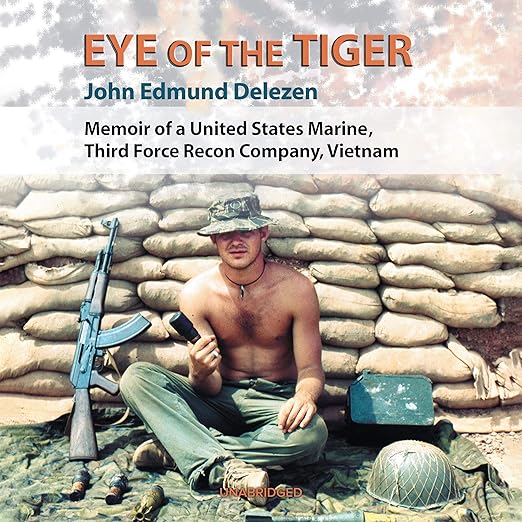
John Edmund Delezen was a Marine who served with the Third Force Recon Company in Vietnam from March 1967 through December 1968. Third Force Recon was not conventional infantry – it was small-unit deep penetration, the kind of work where a handful of men moved silently through enemy-controlled territory for days, mapping positions and learning patterns, without the option of calling for immediate support. The duty Delezen describes is about endurance and attention as much as combat, and that texture – the three-canopy jungle with its birds and monkeys that could be heard but not seen, the venomous snakes hiding in trees, the relentless insects, the malaria – is where the book is most vivid and most specific.
The Prose That Defines the Book
One reviewer described the book’s ‘rather flowery language’ as initially a distraction but ultimately revealing of ‘a deep connection the author must have developed with the land, his buddies, and even his enemies.’ That is exactly right. Delezen writes about Vietnam with the vocabulary of someone who came to know a place deeply despite – or perhaps through – the fact that the place was trying to kill him. The descriptions of the jungle are not nature writing exactly, but they have the close attention of it: sounds before sights, the hierarchy of threat organized by proximity rather than scale.
The kinship he describes with Vietnamese soldiers – enemies moving through the same terrain, subject to the same parasites, dependent on the same senses – is the book’s most unusual moral and emotional register. Delezen does not sentimentalize this. He was trying to find them to report their positions, and occasionally to kill them. But the shared conditions created something he could not ignore, and his refusal to ignore it is what makes the memoir literary rather than just documentary. It is worth noting that another reviewer, who served in similar conditions as an S-2 Infantry Scout near Khe Sanh in 1965-66, described the book as putting you ‘in his mind’s eye and body’ – the highest testimony one veteran can offer another’s memoir.
What the Jungle Actually Costs
The physical toll of Delezen’s service is cataloged without drama: malaria in November 1967, a grenade wound in February 1968, a bullet later that summer. He returned to the United States in December 1968. What the book mostly does not do is dwell on the long aftermath – there is no extended account of the psychological cost in clinical terms, though the closing sections make clear that specific images still pervade his dreams decades later. This reticence is deliberate and appropriate. Delezen is not writing a recovery narrative. He is trying to render the experience accurately, and he trusts the listener to understand what that experience costs without having its costs enumerated.
The pit of rotting Vietnamese bodies left behind by American forces is one of the book’s most disturbing passages, handled without editorializing. Delezen saw it, and he tells you what he saw. The bag of plasma that a starving man considers eating is rendered with similar directness. These are not shock effects; they are the honest accumulation of what sustained jungle combat at that level actually produces over months and years.
Who Should Listen / Who Should Skip
Listen if you have an interest in Vietnam War memoirs and a tolerance for literary prose that does not follow the genre’s usual conventions. This is not a book structured around battles or chronological action in the way many combat memoirs are – it is more meditative, more attentive to environment and inner life. Listeners who found Tim O’Brien’s The Things They Carried too fictional and Ron Kovic’s Born on the Fourth of July too political may find in Delezen’s memoir the register they were looking for. The book is also valuable for listeners with no particular interest in Vietnam who are simply drawn to first-person accounts of extreme physical environments and sustained human attention under pressure – the writing earns that kind of reader too. Skip it if you want comprehensive operational history or unit-level detail about Third Force Recon as an institution – this is one man’s subjective experience, offered as that, not as a chronicle.
Frequently Asked Questions
How does Eye of the Tiger compare to other well-known Vietnam War memoirs?
It occupies different territory from most. Marlantes’s Matterhorn is a novel built on memoir-level detail, with dense operational and unit focus. O’Brien’s work is more openly metafictional. Delezen’s memoir is closer to the documentary end – a first-person account written by someone who was actually there – but the prose quality gives it a literary dimension that sets it apart from straightforward after-action writing.
Is the book’s empathetic treatment of Vietnamese soldiers likely to feel politically contested to some readers?
Delezen does not dehumanize the Vietnamese soldiers he was tasked with opposing, and he is explicit about a sense of shared physical condition across the tactical divide. This is a genuine moral and emotional complexity in the memoir, not a political position, and most readers who serve or have served in combat have described it as authentic rather than controversial.
Does the book cover Delezen’s life after Vietnam, or only the combat period itself?
The memoir is focused primarily on the Vietnam service. The aftermath is present mainly in brief references to continuing dreams and persistent mental images of specific events. Readers looking for an extended account of post-war adjustment will not find it here – the book ends, essentially, when the service ends.
Does David Marantz’s narration suit the book’s literary register, or does it push toward conventional war drama?
Marantz respects the prose’s own rhythm and does not theatricalize Delezen’s more meditative passages. This is the right approach – the writing is doing the work, and the narration does not compete with it. The quieter passages, which are actually the hardest to deliver well in this genre, are handled with appropriate restraint.