
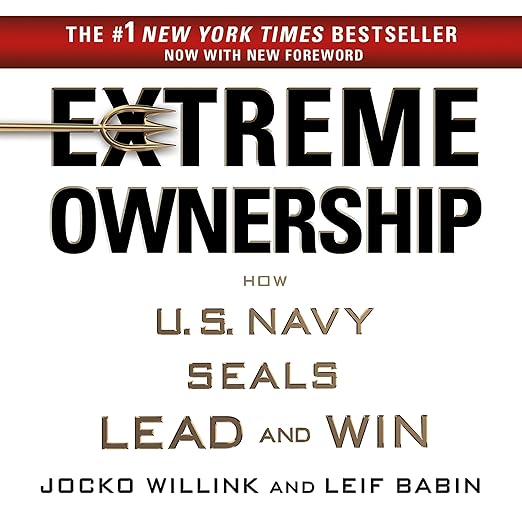
Two officers wrote this book and one name reached the byline, which is worth knowing before you press play on an audiobook that spends eight hours and forty-three minutes arguing about shared responsibility. The description names Jocko Willink and Leif Babin on nearly every line, while the author field lists a single name. On a title whose central claim is that leaders own everything in their world, an uncredited co-author is a peculiar place to start.
Leif Babin's absence from that field is the record's problem rather than the book's. What the two of them built is a leadership manual wearing the clothes of a combat memoir, or the reverse depending on the chapter: SEAL Team Three's Task Unit Bruiser fighting to secure Ramadi, a city the copy says was widely written off, followed each time by the principle that firefight demonstrates and the civilian situation where it applies. The August 2025 response describes the machinery exactly, a principle stated, a real mission behind it, then the translation into business, management or personal discipline.
Ownership is the load-bearing idea, and it asks more than the slogan does. The claim is not that a leader should absorb blame gracefully. It is that every failure below you is a failure of your own instruction, planning or standard, including failures committed by people you did not choose and would not have hired. Taken seriously, that removes the sentence most managers reach for first, the one that begins with the word they. Taken carelessly it curdles into a stick for beating subordinates, and nothing in the writing prevents that second reading.
Combat supplies the emotional weight, and the copy is straight about it: the accounts include tragic loss, not an unbroken run of victories. Register matters here more than usual, because pairing a firefight with a quarterly target could easily trivialize both. It mostly avoids that by keeping the two frames apart and letting you make the transfer yourself. Shelving is unusually revealing on this one: the record sits on three shelves at once, biographies and memoirs, business and careers, and history, with a Military and War tag over the top, and all four labels are defensible.
Ramadi Led Directly to Echelon Front
Accountability gets a framework instead of an exhortation, and that is the gap between this and most of the category. A March 2024 five-star sums the framework up as taking one hundred percent ownership for what a team does, in success or in failure, up to and including the possibility of being fired for it, and credits the book with converting failure into a growth mechanism rather than a blame hunt. That is a testable proposition. You can walk into a meeting tomorrow and discover whether you actually hold it.
Ramadi is what makes the framework land rather than float. The assignment was to help secure a city many considered lost, and the description does not soften what that required. The teaching came out of the same experience in sequence: both men returned from deployment, built SEAL leadership training to pass on what the fighting taught them, then left the teams and founded Echelon Front to run the material for companies across the civilian sector. Whatever you make of the military-to-boardroom pipeline, that sequence is documented on the page rather than merely asserted, and the writing happened after the second stage.
A Single Narrator Credit, a Plural Narration
Casting is where the record slips first. The narrator field credits Jocko Willink alone, while the trade quote the publisher places at the very top of the description praises how these officers bring the same fire to their narration in the audiobook, in the plural. Either the promotional copy is loose or the credit is incomplete. A buyer who wants to know whose voice carries which chapter cannot settle the question from this page, which is an odd gap on a book sold partly on the intensity of the men delivering it.
Edition is the second slip. The description opens by calling itself an updated edition of the leadership bestseller, then later dates the original release to October 2015, which is also the release date stamped on this record. An updated edition and the original publication date cannot both describe the same file. Anyone who specifically wants whatever the update added should confirm that before buying rather than after, because nothing else on the page distinguishes the two.
Print keeps surfacing in the written column, and one instance turns genuinely useful. An August 2023 five-star describes a 322-page hardcover, which set against a running time of eight hours and forty-three minutes works out to roughly thirty-seven pages an hour, squarely in the range a straight unabridged reading produces. Those responses are grading paper, but that one number quietly answers the abridgment question the listing never raises.
The Finest Leadership Book, Written With No Hedging
Anyone responsible for other people is the intended listener, and the book makes no secret of it. A February 2026 entry filed from South Africa puts the case in a single line: if you are leading teams, you have to get this. The material transfers most cleanly to people with direct reports and a mission they did not design, which describes most middle managers, and least cleanly to solo operators, who will find whole chapters about aligning subordinates and briefing juniors sitting idle. First responders and small unit commanders are explicitly in scope, since the copy notes the principles now sit inside official training programs for military units and business teams alike.
Two groups should think twice. Listeners hoping for a war memoir will find the combat compressed into teaching material rather than followed for its own sake, and listeners allergic to certainty will find very little hedging anywhere in it. A December 2025 entry from India calls it the finest book on leadership ever written, which is the register this title invites and receives. That firmness is an asset for anyone who needs a spine and a liability for anyone who wants nuance about the point where ownership tips into self-punishment. The book never raises that objection against itself, so you will have to.
- Narration: Author-read, which on a leadership book means the voice issuing orders in the story is the voice issuing them to you.
- Themes: Leadership accountability, combat decision-making under pressure, translating military doctrine into business practice.
- Mood: Blunt, disciplined, occasionally grim.
- Verdict: The strongest leadership framework on the shelf, provided you can hear it without turning it into a cudgel.
Before You Listen
Where does this audiobook sit in the Extreme Ownership series?
It opens the Extreme Ownership Series according to the series field, so this is the starting point rather than a follow-up. Nothing on the record requires prior reading, and the principles are introduced from scratch with their combat cases attached.
Do I need military background to follow the audiobook?
No. The copy explains the mission context, the unit and the city as it goes, and the leadership language is written for civilian readers. Jargon appears, but the surrounding paragraph almost always defines it before the principle arrives.
What is Echelon Front, and does the book explain it?
It is the company both authors founded after leaving the SEAL Teams to teach these principles to businesses. The description covers its origin and reach, including work with hundreds of companies, though the training itself is background rather than the substance of the chapters.







