- Read by: Eldredge reading his own work is essential - his voice carries pastoral authority without becoming preachy, and the intimate passages land with genuine weight because he wrote every word.
- At its heart: contemplative prayer, digital distraction vs. spiritual depth, the ordinary mystic tradition
- Vibe: Quiet and inviting, like a long conversation after church
- Short version: Eldredge's most accessible entry point into his contemplative theology, best for listeners already somewhere in the faith spectrum who want practical daily habits.
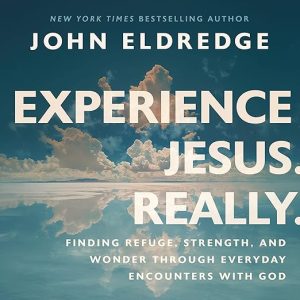
John Eldredge has built one of the more coherent bodies of work in contemporary Christian writing - Wild at Heart, Resilient, Get Your Life Back - and Experience Jesus. Really, which he narrates himself, sits in explicit conversation with those earlier books. This audiobook is Eldredge at his most direct: less narrative-driven than some of his earlier titles, more focused on the practices themselves. The 9 hours and 30 minutes of runtime reflect that - this is a substantial listen, not a short devotional primer. His premise is that the modern internet-saturated life has trained us into a state of distraction so total that it has compromised our capacity for the kind of sustained interior attention that genuine spiritual experience requires. That is a diagnosis worth sitting with regardless of where you land theologically.
The framing device Eldredge uses throughout Experience Jesus. Really is the concept of the "ordinary mystic" - a term he is careful to distinguish from anything esoteric or detached from daily life. His argument is that the biblical figures he names - David, Daniel, Paul, Esther - were not spiritual elites but people who maintained the habit of daily communion in ordinary circumstances. The path he describes is therefore meant to be recoverable by anyone, not just the spiritually gifted or the monastically inclined. What gives this audiobook force is the directness with which Eldredge names the problem: he is not gentle about the way smartphones and information addiction have displaced the kind of interior stillness that prayer requires. Reviewer John Fontaine noted it dovetails perfectly with Eldredge's recent work, and that observation is accurate - listeners who know Get Your Life Back will find this a deepening of those ideas rather than a departure. But it works as a standalone listen because Eldredge is meticulous about grounding each concept in practice rather than assumption. The specific practices he introduces - prayers, reflective pauses, approaches to listening for the voice of God in daily moments - are presented with a clarity that makes them testable rather than aspirational.
Highlights
The author's narration is genuinely the right format for this material. Eldredge writes in a voice that is simultaneously pastoral and personal, and when he reads it himself the distinction between the author and the guide collapses in a productive way. The prayers and pauses he includes in the text are not awkward in audio form - he paces them with the timing of someone who has practiced them rather than someone performing them. One reviewer mentioned using the accompanying Pause app alongside this audiobook, with 20 days of guided pauses that correspond to the book's content. That pairing is worth knowing about before you start, as it deepens the practice dimension significantly. The chapter structure is well-suited to audio: shorter chapters with clear focal points allow for the kind of reflective pauses the material invites. The book draws explicitly on the ancient tradition Eldredge describes - the daily spiritual practices of Adam and Eve in Eden, of David and Daniel, of Christ's disciples - and frames those practices as historically documented habits rather than impossible ideals. At 4.8 stars across more than 650 ratings, listener response is unusually consistent for a book making this level of devotional demand on its audience.
Weak Spots in Experience Jesus. Really
This audiobook will not satisfy listeners looking for apologetics, theological argument, or a systematic defense of Christian doctrine. Eldredge is interested in practice, not debate. His posture throughout assumes a reader who is already oriented toward faith but who feels the gap between belief and lived experience. Listeners outside that frame will find the entry point harder to locate, and the book makes no particular effort to build one. The concept of the ordinary mystic, while appealing, draws heavily on Eldredge's own contemplative vocabulary, and those unfamiliar with his earlier work may find certain terms used as though they need no definition. The book is also not shy about digital media criticism - his indictment of smartphone addiction as a spiritual obstacle is sustained across multiple chapters and will land differently depending on how sympathetic you are to that framing. The specific promises the book makes are ambitious: recovering your capacity to believe, experiencing the exquisite comfort of actual communion with Jesus every day, protecting your family through prayer. Listeners who want more measured language around spiritual outcomes may find the scope of Eldredge's claims uncomfortable.
Is This One for You?
Listeners who have read Eldredge before and found his earlier books valuable will get the most from this audiobook - it rewards prior familiarity with his theological vocabulary and builds on themes he has developed across his catalog. New listeners who arrive with a genuine desire to develop a contemplative prayer practice will find it accessible, though possibly richer on a second pass after encountering something like Get Your Life Back first. Skip this audiobook if you are looking for theological argument, historical scholarship on mysticism, or a text aimed at skeptics. The author's self-narration is genuinely essential here - it is the difference between reading a devotional guide and being led through one by someone who lives inside the practice. This is devotional writing in its most deliberate form, written from inside a specific tradition for an audience that already inhabits it.