Quick Take
- Narration: Sean Runnette delivers Lieberman’s dense scientific prose with a measured, professorial warmth that suits the material without ever going cold.
- Themes: evolutionary biology and modern health, debunking exercise myths, sedentary lifestyle consequences
- Mood: Intellectually stimulating and quietly reassuring
- Verdict: A rigorous but approachable listen that will permanently change the way you think about your own relationship to physical movement.
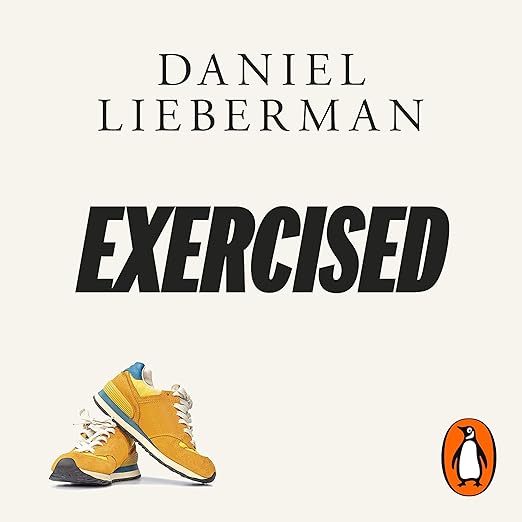
I came to Exercised on a Tuesday afternoon when I had just talked myself out of a run for the third consecutive day. I had the usual excuses lined up. I was not sure I was starting well enough, not sure the goal was right, not sure I had earned it yet. That is the precise psychological trap Daniel Lieberman spends thirteen hours methodically dismantling, and I am grateful he did it while I was on a long walk instead of a treadmill.
Lieberman is a professor of human evolutionary biology at Harvard, and the authority behind this book is genuine and earned. What makes Exercised unusual is that he turns that authority not toward telling you to exercise more, but toward explaining why the very concept of exercise as we understand it is a modern invention rooted in cultural anxiety rather than biological necessity. That reframe is not a permission slip to sit still. It is something more interesting: an invitation to understand what your body actually evolved to do.
Our Take on Exercised
The central argument is one of those ideas that sounds obvious once you hear it but quietly restructures everything. Lieberman lays out the anthropological evidence that hunter-gatherer populations move constantly throughout the day but almost never exercise in the voluntary, for-its-own-sake way we mean when we talk about going to the gym. They walk. They carry. They dig. They dance. They rest extensively. They do not run unless they have to. And they are, by nearly every metabolic and cardiovascular measure, in far better health than most people in industrialized nations.
From this starting point, Lieberman works outward into specific myths: that sitting is the new smoking (partially true, partially overblown), that you need to run fast to get fit (not really), that strength training is essential for everyone (more complicated than the marketing suggests), that more exercise is always better (it is not). Each chapter takes on a different piece of received fitness wisdom and subjects it to the same patient, evidence-first treatment. Reviewer Kim Olbrich summarized the book’s spirit well when she quoted Lieberman’s final guidance: make exercise necessary and fun, do mostly cardio, keep it up as you age. That sentence contains more practical wisdom than most fitness books manage in three hundred pages.
Why Listen to Exercised
The audio format works particularly well for this book because Lieberman’s writing has a conversational generosity to it. Sean Runnette’s narration reinforces that quality. His pace is deliberate without being slow, and he navigates the scientific terminology cleanly without making it feel like a lecture. The thirteen-hour runtime never drags because the chapters are structured as self-contained arguments that build on each other rather than recycling the same point in different clothing. I found myself stopping mid-walk to rewind and re-listen to specific passages on endurance running and the evolution of the human heel, which is probably the highest compliment I can give an audiobook about science.
Lieberman also deploys fieldwork stories with real skill. His time among the Hadza in Tanzania, one of the last remaining hunter-gatherer populations on earth, provides a running counterpoint to the Western gym culture he is critiquing. These passages are vivid without being romanticized, and they give the abstract anthropological claims a human texture that keeps the book from feeling like a journal article.
What to Watch For in Exercised
The book does have a structural quirk that some listeners will notice. The chapters on specific exercise types, strength, flexibility, endurance, can feel denser and more digressive than the opening sections, which carry the book’s central thesis most cleanly. A reader looking for a tight argument from start to finish may feel the middle third wanders somewhat. Lieberman is thorough to a fault in places, and there are passages where the weight of citations and caveats slows what is otherwise a lively intellectual argument. This is a minor complaint, but it is worth flagging for listeners who prefer their nonfiction to move at pace.
There is also a question of audience expectation. Reviewers who found the book life-changing tended to come in with some curiosity about evolutionary biology already. Listeners expecting a conventional fitness guide with specific workout prescriptions will be surprised by how philosophical the book actually is. Lieberman is far more interested in the why than the how, and the how he does provide is quite general by design.
Who Should Listen to Exercised
This is the right listen for anyone who has ever felt guilty about their relationship to exercise but is not quite sure why the guilt persists even when they are doing everything they were told to do. It is also ideal for people with an existing interest in evolutionary biology or anthropology who want to see those fields applied to a genuinely practical question about modern life. If you have read works like Robert Sapolsky’s explorations of human behavior or enjoyed the anthropological sections of Sapiens, you will feel at home here. Listeners who want a prescriptive exercise program or a motivational boost should look elsewhere. Lieberman is not coaching you. He is giving you the tools to coach yourself.
Frequently Asked Questions
Does Lieberman argue that exercise is bad for you?
No. His argument is more nuanced: we never evolved to exercise voluntarily for its own sake, but physical movement is essential for health. The book pushes back against specific myths and anxieties around exercise culture while strongly affirming that regular movement, especially walking and moderate cardio, is one of the most powerful tools we have for longevity.
Is this audiobook accessible to listeners without a science background?
Yes, quite accessible. Lieberman writes for a general audience and Runnette’s narration keeps the pace manageable. You do not need prior knowledge of evolutionary biology, though some familiarity with the field will deepen your appreciation of the fieldwork sections.
How does Sean Runnette handle the technical terminology throughout the book?
Runnette handles the scientific language cleanly and confidently. He does not oversell the material with dramatic inflection, which suits Lieberman’s measured, evidence-first style well. The narration feels like a knowledgeable friend explaining research, not a lecturer.
Does the book address specific conditions like back pain, obesity, or diabetes?
Yes, Lieberman addresses several modern conditions linked to sedentary living, including type 2 diabetes, cardiovascular disease, and musculoskeletal issues. He approaches them through an evolutionary lens, explaining how mismatches between our ancestral bodies and modern environments contribute to these conditions.