Quick Take
- Narration: Carrington MacDuffie brings scholarly confidence to Roughgarden’s dense scientific material, and her pacing respects the complexity of the argument without becoming pedagogical.
- Themes: biological diversity in gender and sexuality, challenges to Darwinian sexual selection theory, feminist and transgender criticism of evolutionary biology
- Mood: Intellectually demanding and quietly radical, the kind of listening that changes how you see both the natural world and the cultural frameworks we have imposed on it
- Verdict: A serious, often brilliant work of evolutionary biology that dismantles received wisdom about sex and gender in both animals and humans. Demanding but rewarding for readers willing to engage on its own terms.
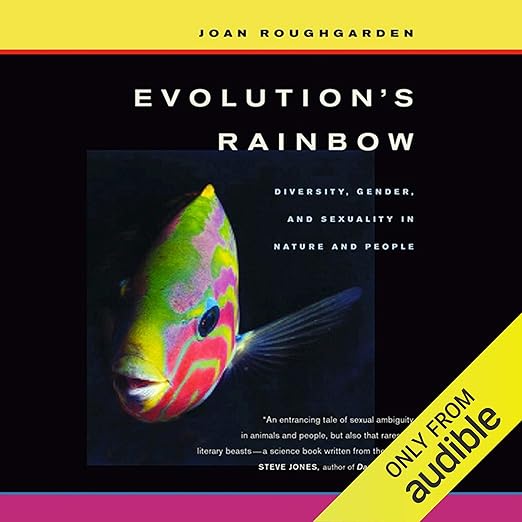
There are books that seem mild-mannered from the outside and then proceed to fundamentally reorganize the furniture of your thinking. Joan Roughgarden’s Evolution’s Rainbow is one of those books, and I came to it through an unusual route: a conversation about the biology of cooperation versus competition that eventually led me to Roughgarden’s challenges to standard Darwinian sexual selection theory. I started listening on a Tuesday morning and finished it over the course of a week, which is about right for something this substantive.
Roughgarden is a distinguished evolutionary biologist at Stanford, and this book is not a pop science overview. It is a rigorous scientific argument delivered in accessible language, aimed at a general audience that is nonetheless expected to take the science seriously. The preface notes that the book has revolutionized our understanding of sexuality. That is not hyperbole if you are coming from the conventional framework; it is a reasonably accurate description of what the evidence she marshals actually does.
Our Take on Roughgarden’s Central Challenge
The book works on two levels simultaneously. On the scientific level, Roughgarden documents the extraordinary diversity of gender expression and sexual behavior across hundreds of species: fish, reptiles, amphibians, birds, primates, and mammals. The catalogue of examples is genuinely astonishing. Bluegill sunfish with three distinct reproductive strategies. Lizards with female-female pairing. Bighorn sheep with an entire population of males who never mate with females. The breadth of biological data alone would make this a valuable reference.
But Roughgarden goes further. She argues that standard Darwinian sexual selection theory, particularly the concept of female choosiness and male competition for access to females, is not supported by the biological record and is itself a product of cultural biases that were imported into 19th-century science and have never been properly examined. This is where the book becomes genuinely provocative, and also where it has attracted the most serious criticism. A reviewer who called it brilliant but deeply flawed notes that the economic framing of social life in evolutionary biology, which Roughgarden critiques, may not have been applied with enough rigor to her own framework. That is a fair point, and listeners should engage with it rather than dismiss it.
Why Listen to Carrington MacDuffie
At 16 hours and 17 minutes, this is a substantial listening commitment, and Carrington MacDuffie carries it well. She has a clear, authoritative delivery that suits the academic register of the text without making it feel like a lecture. Technical terminology in biology and genetics is handled with confidence, which matters enormously for a book where the precision of the language is part of the argument. Her pacing allows complex passages to breathe, a quality that academic texts desperately need in audio format.
The listening experience is most rewarding in the zoological sections, where MacDuffie’s narration of Roughgarden’s descriptions of specific animals and their behavior creates almost vivid mental images. The theoretical sections, where Roughgarden dismantles existing models and proposes alternatives, are denser and may require replay. This is a book worth pausing with, not rushing through.
What to Watch For in the Scientific Claims
Roughgarden explicitly challenges Darwin, which means she is arguing against the foundational framework of most evolutionary biology. Listeners should approach this with genuine intellectual openness rather than either reflexive agreement or reflexive dismissal. The biological data she presents is real and documented. Her interpretation of what that data means for evolutionary theory is more contested.
The book also moves between evolutionary biology, cultural criticism, gender theory, and policy implications in ways that occasionally feel seamed. Listeners who are most comfortable in one of those registers may find themselves more or less engaged depending on which section they are in. That said, the integration of feminist and transgender criticism into a scientific framework is precisely what makes this book distinctive and worth the effort.
Who Should Listen to Evolution’s Rainbow
This audiobook is for readers with genuine intellectual curiosity about where the science of sex and gender actually stands, as opposed to what popular accounts of evolution typically tell us. It rewards listeners in biology, anthropology, gender studies, or philosophy of science, but it is written to be accessible to anyone willing to engage with substantive scientific argument.
Skip it if you are looking for a debate-club overview or a brief summary of competing theories. Roughgarden is making her own argument, not surveying the field neutrally, and the book is most valuable when read as that: a serious scientific intervention that deserves serious engagement, not passive consumption.
Frequently Asked Questions
Do I need a biology background to follow Roughgarden’s scientific arguments?
No, but a tolerance for scientific detail helps. Roughgarden writes for a general educated audience and explains technical concepts as they appear. The zoological case studies are accessible without specialist knowledge, though the sections engaging with evolutionary theory at a technical level reward some prior familiarity with natural selection concepts.
How does Carrington MacDuffie handle the scientific terminology in 16+ hours of audio?
She handles it with consistent accuracy and appropriate confidence. Technical terms in genetics, behavioral ecology, and evolutionary biology are pronounced correctly and without hesitation. This matters for a book where terminology is central to the argument.
Is Evolution’s Rainbow primarily about human gender and sexuality, or is it really about animal behavior?
It is genuinely both. The book’s structure uses the animal data as the scientific foundation for arguments about human gender and sexuality, and explicitly critiques how cultural biases have distorted our reading of both. Neither the animal behavior nor the human implications are incidental.
How has the scientific community responded to Roughgarden’s challenge to Darwinian sexual selection theory?
The response has been genuinely mixed. Her empirical documentation of biodiversity in sex and gender has been widely accepted as valuable. Her theoretical framework as an alternative to sexual selection theory has attracted both serious engagement and significant criticism. The book’s preface mentions a new addition addressing how the field has responded, which gives long-term context.