Quick Take
- Narration: Morley Swingle narrating his own practitioner guide is entirely appropriate, his veteran prosecutor’s cadence gives the material authority, and the technical precision of the content benefits from the author’s own delivery.
- Themes: evidentiary foundation in criminal trials, digital and electronic evidence in modern prosecution, the intersection of legal procedure and practical courtroom strategy
- Mood: Dry, authoritative, and specifically useful, this is a reference text, not recreational listening
- Verdict: An unusually practical legal reference that fills a real gap for prosecutors and criminal defense attorneys, narrated with the authority of a practitioner who has tried 178 jury trials.
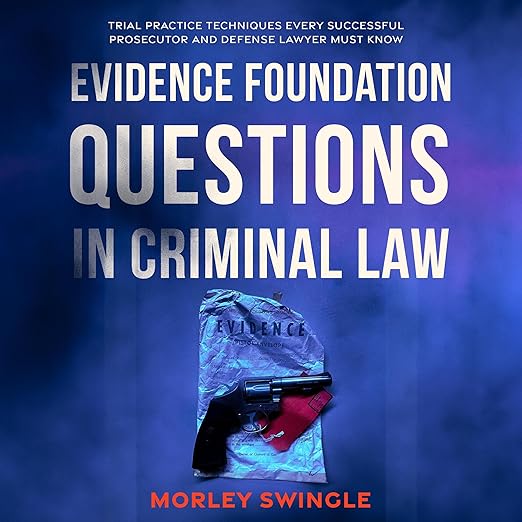
I want to be transparent about what kind of book this is before saying anything else: Evidence Foundation Questions in Criminal Law is a practitioner reference guide. It is the audiobook equivalent of keeping a legal manual in your briefcase. Reviewers who describe it as a must-have for prosecutors are not using figurative language, they mean it as a work tool. I approach it as a literary critic who also has a longstanding interest in legal nonfiction, and in that context, what strikes me most is how rare it is to find a technical legal reference that is as precisely calibrated to its audience’s actual needs as this one appears to be.
Morley Swingle brings real credentials to the material. He is a veteran of 178 jury trials and 111 homicide cases. The predicate foundation questions he provides for everything from routine fingerprints and DNA through cell tower dumps, geofence warrant results, and license plate reader data are drawn from that experience. This is not a textbook assembled from secondary sources. It is the distilled practical knowledge of someone who has successfully admitted evidence in criminal trials across a very wide range of evidentiary types, including the newer digital categories that the field is still working out how to handle.
Our Take on Evidence Foundation Questions in Criminal Law
The inclusion of both the foundation questions themselves and the legal reasons those specific questions are necessary is the book’s most valuable structural decision. A list of questions alone would be useful. A list of questions with the evidentiary logic that requires each one is considerably more useful, because it teaches prosecutors how to adapt when a witness answer goes sideways or when defense counsel objects. Understanding why a question is necessary lets you rephrase it under pressure. That pedagogical depth distinguishes this from a simple checklist.
The range of evidentiary types covered is broad enough to be genuinely comprehensive at the time of writing. Swingle addresses both the standard categories, fingerprints, DNA, chemical testing, business records, surveillance recordings, autopsy results, and the newer digital evidence landscape: cell tower dumps, geofence warrants, social media postings, text messages, license plate reader data, GPS location information, digitally enhanced photographs. That last category is where criminal law is actively evolving, and having foundation question frameworks for it is particularly timely.
Why Listen to Evidence Foundation Questions in Criminal Law
Swingle narrating his own reference guide is the right call for this material. Legal practitioners who will be using this as a study or preparation tool will benefit from hearing the material in the voice of the practitioner who designed it. His veteran prosecutor’s cadence, direct, precise, unhurried, gives the content the weight of experience rather than the abstract authority of scholarship. One reviewer mentioned emailing Swingle directly with a question and receiving a prompt, helpful response. That level of author engagement suggests this is functioning as a living resource as much as a static text.
The audiobook format for a reference guide of this type is an interesting choice, and reviewers consistently report that it works. The listen-while-commuting use case for legal professionals is real, this is material that can be absorbed and retained through audio review in a way that more narrative-dependent books cannot be. At four hours and forty-four minutes, it is also a reasonable single-day commitment for a professional who needs to come up to speed on a particular evidentiary area before a trial.
What to Watch For in Evidence Foundation Questions in Criminal Law
This is self-published through Morley Swingle Books, which means the production does not have the professional audio infrastructure of a major publisher. The narration is functional and authoritative but not produced to the standard of a Macmillan or Penguin Random House release. For practitioners using this as a professional tool, that distinction is essentially irrelevant. For general readers approaching it out of interest in criminal law, the production quality gap is worth knowing about.
The audience is specific. This book is written for prosecutors primarily, and the framing, predicate questions required to successfully present evidence in a criminal trial, reflects that. Defense attorneys and public defenders may find it useful as a way of understanding what prosecution is required to establish before objecting to evidentiary foundations, but the perspective is firmly from the prosecution side of the courtroom.
Who Should Listen to Evidence Foundation Questions in Criminal Law
New prosecutors who need a practical, comprehensive foundation question reference will find this the best available audiobook option in the category. Experienced practitioners who want to update their digital evidence frameworks or review less common evidentiary types will find specific chapters useful. Law students approaching criminal procedure or evidence for the first time may find this a useful supplement to casebook study. General readers with a strong interest in criminal procedure and legal nonfiction can engage with it, though the material is explicitly technical rather than narrative. Skip it if you are looking for courtroom drama or storytelling rather than legal instruction.
Frequently Asked Questions
Is Evidence Foundation Questions in Criminal Law useful for criminal defense attorneys as well as prosecutors?
Yes, though it is written from the prosecution perspective. Defense attorneys find it valuable for understanding what foundation is required to admit specific evidence types, which informs when and how to object effectively.
How current is the digital evidence coverage, given how rapidly that area of law is evolving?
The book covers geofence warrants, cell tower dumps, and social media postings as of its 2024 release date. Digital evidence law continues to evolve through case law, so practitioners should treat the frameworks as a starting point and verify currency for specific jurisdictions.
Does the book cover federal evidentiary rules or is it state-specific?
Swingle draws primarily on his experience as a state prosecutor, but the foundation question frameworks apply broadly across jurisdictions governed by rules of evidence derived from the Federal Rules. Practitioners in specific states should verify local rule variations.
Is this book accessible to law students or only to practicing attorneys?
Law students taking criminal procedure or evidence courses will find the practical foundation question frameworks a useful complement to abstract doctrine. The material assumes some baseline legal literacy but does not require courtroom experience to understand.