Quick Take
- Narration: James Lindsay narrating his own work brings intellectual conviction, though the delivery occasionally mirrors the book’s tendency toward repetition.
- Themes: Psychology of religious belief, the limits of the God debate, meeting unmet human needs outside religion
- Mood: Philosophically combative but earnest, like a seminar conducted by someone who genuinely wants to solve the problem rather than win the argument
- Verdict: A reframing of the atheism-religion conversation that is more interesting as a proposal than as a fully executed argument, and worth the listen for the core insight alone.
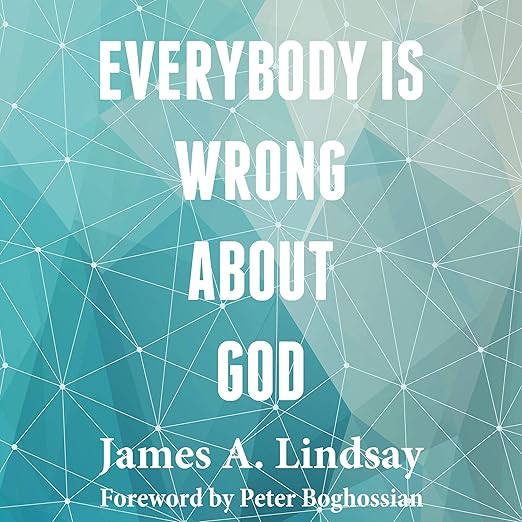
I came to Everybody Is Wrong About God in a particular mood. I had just finished reading a debate transcript between a prominent atheist philosopher and a theologian and found myself exhausted by the familiar shapes of the argument: the same moves, the same counterpoints, the same stubborn non-resolution that both sides had performed versions of for decades. Lindsay’s premise, that this particular conversation has become useless and that everyone participating in it is wrong in different ways, landed with some force under those circumstances.
The book was published in 2016, and Lindsay has since become a considerably more controversial public figure. I am not going to let that subsequent history determine how I evaluate what is in the text, but I mention it because listeners who come to this knowing his later work will be reading the 2016 version of his thinking, which is considerably more measured and more philosophically grounded than what he has become known for since.
Our Take on Everybody Is Wrong About God
Lindsay’s central argument is one of those ideas that, once you hear it, feels obvious, which is usually a sign that it is true. He argues that when people say they believe in God, they are not primarily making a metaphysical claim that can be addressed with evidence and logic. They are expressing something about their psychological and social situation: unmet needs for community, certainty, meaning, and structure. Debating whether God exists does not touch those needs. It just gives people something to argue about while the needs remain unaddressed.
The prescription follows from the diagnosis: stop arguing about God’s existence, drop the label of atheist (which Lindsay sees as a purely reactive identity defined entirely by what it opposes), and address the actual needs that religious communities are meeting. That is a more interesting and more difficult project than winning a debate, and the book is better at articulating what is wrong with current approaches than at specifying exactly how to do what Lindsay proposes.
Why Listen to Everybody Is Wrong About God
Lindsay narrates his own book, and for intellectual nonfiction the author’s voice is often the best guide to their own thinking. He reads with conviction and with the slight over-deliberateness of someone who knows the ideas are unconventional and wants to make sure you follow the logic. The pacing is measured rather than dynamic, which suits a book that is primarily argumentative rather than narrative.
The early section, specifically critical of the atheist movement and its various sociopolitical offshoots, is where the book is at its sharpest. Reviewer Book Fanatic noted wanting to highlight every sentence in this section despite being someone who never writes in books. That enthusiasm tracks with what I found: Lindsay is a more compelling critic of his own side than he is of religion itself, which is both the strength of the book and a slight imbalance in the overall architecture.
What to Watch For in Everybody Is Wrong About God
Reviewer kie-ole’s critique that the book is repetitive and stretches ideas appropriate for essays into a full-length argument is fair. Lindsay has a central insight and several supporting observations, but the argument does not have enough density to sustain eight hours without some paddling. There are chapters that feel like restatements of points already made rather than developments of them.
Reviewer Lover of Children’s Books came to the book hoping for something as rigorous as Pascal Boyer’s Religion Explained and found the psychological framework only partially satisfying on the evolutionary question of why religious belief is so persistent across human societies. That is a legitimate limitation. Lindsay is not attempting the same kind of evolutionary cognitive science that Boyer does, and readers expecting that depth will find this somewhat shallower on the biological and anthropological dimensions.
Who Should Listen to Everybody Is Wrong About God
This is for listeners who are already skeptical of both conventional religious apologetics and the standard new atheist debate format, and who are curious about a third position: one that takes the psychological reality of religious belief seriously without accepting its metaphysical claims. Listeners who have found the God debate circular and unproductive will find Lindsay’s reframing genuinely useful even where the execution is uneven. Those who want a comprehensive treatment of the psychology of religion would be better served by Boyer’s Religion Explained or Jonathan Haidt’s The Righteous Mind as companion or alternative texts. This is a provocative, somewhat flawed, genuinely interesting contribution to a conversation that needed a different kind of interruption.
Frequently Asked Questions
Is Everybody Is Wrong About God hostile to religious believers, or does it engage with belief sympathetically?
Lindsay’s argument requires genuine engagement with why people believe, not dismissal of them. His central claim is that religious belief signals real psychological and social needs, which is a more respectful and analytically useful starting point than treating believers as simply irrational.
How does this book relate to Lindsay’s later public work and controversies?
This 2016 book reflects an earlier phase of Lindsay’s thinking, more philosophically careful and less politically inflected than his subsequent public persona. Evaluating the book on its own terms rather than through the lens of his later positions gives a more accurate picture of what it offers.
Is eight hours long enough for the argument Lindsay is making, or does the book feel padded?
Multiple reviewers noted the writing is repetitive in places and that the core ideas might have been better served by a shorter format. The central insight is strong; the execution sometimes circles back over ground already covered.
Does Lindsay explain concretely what should replace the God debate, or does he leave that open?
He gestures toward addressing the psychological and community needs that religion meets through secular means, but the book is stronger on diagnosis than prescription. The how of replacing those functions is left more open than the argument for why the debate itself needs to stop.