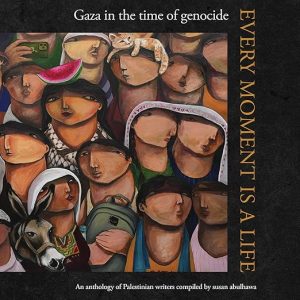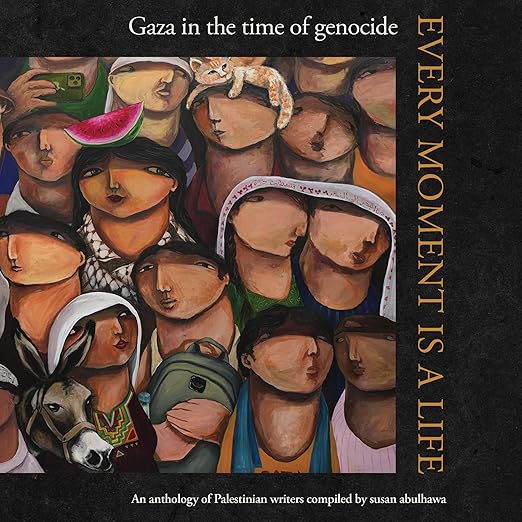
Samya remembers an old man mending shoes on a street that may no longer exist, one small tender image inside eighteen young writers' attempts to record their own survival, and this audiobook turns that record into three hours of direct testimony rather than distanced reporting.
Called 'History's First Livestreamed Ethnic Cleansing'
This is a bilingual Arabic-English anthology compiled by novelist Susan Abulhawa from workshops she personally ran at the Culture and Free Thought Association after entering Gaza twice through the Rafah crossing in early 2024. The eighteen contributors are young writers, not professional journalists, and the pieces are essays, not fiction, testimony written from inside tent encampments rather than narrative built for effect.
The book describes its own subject in stark terms, as genocide and what the synopsis calls 'history's first livestreamed ethnic cleansing,' so listeners should know going in that this isn't a softened or hedged account. It's testimony from people still living through displacement, food and water insecurity, and constant danger as they wrote.
Susan Abulhawa's own reputation adds real weight to her role as compiler rather than sole author: she's best known for Mornings in Jenin, a bestselling novel about Palestinian displacement across generations, so the workshops behind this collection extend fiction she's spent a career writing into direct facilitation of other people's true testimony.
Samya's Shoe-Mender Memory Gets Equal Narrative Weight
The collection's title states its own thesis plainly: every moment, however small, counts as a full life rather than a footnote to a larger casualty count. That principle governs how the book is structured, giving Samya's shoe-mender memory and Ghassan's rescued baby equal narrative weight rather than ranking whose suffering deserves more space on the page.
The synopsis itself describes the emotional range across all eighteen accounts as 'courage, anger, love, agony, and, impossibly, hope,' a list that refuses to flatten the contributors into either pure victims or pure symbols of resilience; both registers coexist across the collection rather than one canceling out the other.
Proceeds Go Back to the Contributors Still There
The individual pieces work at a granular, human scale that statistics can't match: Saja hiding books in her closet hoping she and her home will still be there when she returns, Ghassan haunted by a rescued baby who briefly became his son, Fatima risking a drone-monitored zone to retrieve her own clothes. That specificity is what makes testimonial writing land harder than summary ever could.
Both attached reviews respond directly to that impact. One calls the collection a set of 'stories that will break your heart' and notes how differently people can experience the same catastrophe; the other praises the contributors' bravery outright. Neither reviewer hedges on the emotional weight of what they heard.
Proceeds from the book go directly to the contributors still living through what they wrote about, plus the Palestine Writes Literature Festival, a detail worth knowing since it shapes how a listener might think about this purchase beyond the listening experience itself.
Ten Named Voices Forming One Genuine Chorus
As a genre, testimonial anthologies assembled from workshop settings carry a different weight than either solo memoir or journalism; the multiplicity of voices, eighteen separate perspectives rather than one, resists any single narrative arc being imposed on a collective experience, which is part of why both attached reviews specifically praise how differently each contributor's account reads from the next.
Presenting the collection bilingually in Arabic and English carries its own quiet argument: these accounts exist first in the contributors' own language rather than only as material translated for an outside audience, a choice worth recognizing as part of the book's stance before ever reaching the individual essays themselves.
The contributors range across at least ten named voices in the synopsis alone, Samya, Saja, Ghassan, Fatima, Maram, Amr, Samah, Lubna, Rizq, and Nebal, a scale that keeps this from reading as one representative account standing in for an entire population, closer instead to a genuine chorus of distinct individual experiences.
English, Arabic, or Both, and Nobody Will Confirm
The bilingual Arabic-English format raises a real, practical question the listing doesn't fully resolve: whether the audiobook is narrated entirely in English, in Arabic, or in some mix of both, and how a single credited narrator handles eighteen distinct authorial voices across that structure. Previewing a sample before committing is a reasonable precaution here.
Neither of the two attached reviews addresses narration technique specifically; both respond to the writing and the testimony itself. That means the audio performance quality is harder to confirm from available data than the content's emotional impact, which the reviews document clearly.
This is heavy material by design, violence, loss, displacement, a child's death referenced directly, so it isn't background or casual listening. It rewards choosing a moment when full attention and real emotional bandwidth are available rather than treating it as commute filler.
Hearing testimony read aloud, rather than reading it silently on a page, changes the experience in ways worth naming directly: audio format removes the option to skim past the hardest passages, which is either exactly what a listener wants from testimonial literature or a real reason to choose the print edition instead, depending on what kind of engagement you're looking for.
Compared to journalism covering the same events, this anthology offers no analytical framing, no explanation of political context or history, only direct first-person testimony; listeners wanting background and context alongside the personal accounts should expect to seek that out separately rather than finding it built into this specific listen.
Primary-Source Writing From Contributors Still Inside Gaza
Recommended for listeners seeking firsthand testimonial literature over secondhand commentary, readers of Abulhawa's fiction curious about her curatorial and editorial work, and anyone specifically wanting primary-source writing from inside Gaza rather than outside analysis of it.
Less suited to listeners wanting emotional distance or a conventional narrative arc, or anyone who needs confirmed English-only narration and hasn't yet verified the language format directly before buying.
In Brief
- Narration: Ali Andre Ali carries eighteen distinct voices across a compact runtime; the exact language format, English, Arabic, or a mix, is worth confirming before you buy.
- Themes: War testimony, displacement, the granular texture of survival, collective authorship
- Mood: Devastating and intimate, built for full attention rather than background listening
- Verdict: A powerful primary-source listen for anyone seeking direct testimony over commentary, best approached when you can give it your complete presence.