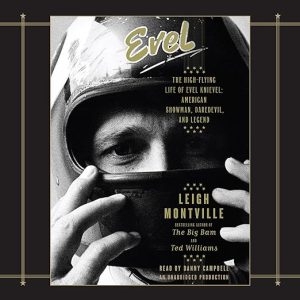
Nobody in American life has ever monetized failure the way Evel Knievel did, and Leigh Montville's biography spends seventeen and a half hours working out how the trick was done. Random House Audio released this audiobook in April 2011 with Danny Campbell holding the reading credit, and 169 ratings have since accumulated at a 4.5 average. The publisher copy promises to pull back the red, white and blue cape on a cultural icon. What the book actually does is take the cape seriously, as a business decision.
Mild Seasoning in Print, Interruption by Ear
Montville's structural choice is to refuse the highlight reel. The Caesar's Palace crash and the Snake River Canyon rocket are both here, and both arrive as the consequence of years of groundwork rather than as isolated spectacles. That is the right decision for a subject whose whole career ran on advance publicity, and it produces a biography spending far more time on promotion, negotiation and money than on the riding. The stunts are punctuation, not sentences.
All five write-ups on this listing describe reading a book. One of them, four stars in August 2018, is explicit about owning it twice: read in hardcover when it was first published, then finished again years later as a recording. That single response is the only place anybody confirms hearing the text at all, which tells you plainly where the 4.5 average was earned and what it was earned on.
Authorial presence is the one substantive complaint on the whole listing, and it deserves weighing before you commit to a long recording. The objection is that Montville occasionally inserts too much of his own personality and opinion into what otherwise reads as accurate reporting of historical events. On a page you can let an aside slide past. On a track you cannot, so a habit that registers as mild seasoning in print turns into a recurring interruption by ear.
The Ordinary Operating System of Fame
Spectacle is the obvious draw and the book is generous with it. Somebody who watched the glory days unfold on ABC's Wide World of Sports left five stars in October 2011, reporting that the author calls it the way it was remembered, with plenty of fleshing out and stories that build a complete picture of the man. That is the specific reward on offer for anyone who was alive for it: confirmation and correction arriving in roughly equal measure.
Television is the real subject underneath the motorcycle. The copy points at a crash unlike anything previously seen on broadcast and a canyon rocket only P. T. Barnum could have staged, and Montville tracks how a man in star-spangled leather converted a weekend sports slot into a national event. That story has aged into something considerably stranger than nostalgia. The apparatus Knievel improvised is now the ordinary operating system of fame.
Money, injury and the long decline get as much room as the ascent, which is the part newcomers rarely expect. The synopsis frames its man as unknown, complex and controversial rather than beloved, and the writing honors that framing instead of retreating into fond memory once the story turns ugly. Somebody who looked like Elvis on afternoon television was also, in the copy's own terms, a stranger to the millions who were certain they knew him.
Close to Eighteen Hours for a Stunt Performer
Length is the first thing to weigh, since close to eighteen hours is a great deal to hand the life of a stunt performer, and a top grade filed in March 2013 identifies exactly where that scale usually hurts: the early chapters before the fame, which in most biographies drag. The verdict on this page is that they do not, and that the pre-fame material was the outright surprise of the book. Budget for a slow opening stretch anyway, because slow is what it is.
Print artifacts run right through the reception. Five stars arrived in January 2025 for a copy somebody had come back to after it helped with a project years before, which is a research relationship with a physical object rather than a listening one. None of that counts against the recording. It does mean the enthusiasm stacked up here was formed almost entirely with a book in hand, and it is not transferable evidence.
Anyone hoping for the visual record should adjust early. Knievel's career was photographed and broadcast obsessively, and a prose biography of that career is necessarily a description of pictures you either remember or will have to go and find. Montville describes them well. He cannot supply them, and the chapters set in the seventies assume somebody who can already picture the leathers, the ramp and the crowd without assistance.
An Owner of Eleven Different Knievel Books
Sports listeners are the assumed audience and probably the least interesting one. The May 2011 write-up, five stars, comes from somebody who owns eleven books with Evel Knievel in the title, running from children's editions up to Sheldon Saltman's Evel Knievel On Tour, and reports that this one carries facts and first-hand accounts none of the earlier books told. When a completist of that description says so, the claim carries weight.
Collectors of American cultural history will take more from it than motorcycle enthusiasts will. Publicity, patriotism, television economics and the particular texture of the nineteen seventies are the real material, with the jumps operating as load-bearing set pieces rather than as the point. If you have never watched a motorcycle race in your life and never intend to, nothing in the material will shut you out.
Look elsewhere if you want a technical account of the jumps or a picture-led tribute, because this is a long prose life with an argument about American celebrity built into it. Look elsewhere too if you need something compact, since the book takes a considerable while to reach the famous parts and declines to hurry once it arrives. Judge it on the reporting rather than on the stunts and the hours pay for themselves.
- Performance: Danny Campbell is the credited reader on Random House Audio's 2011 production, which is the only edition the listing offers.
- What it covers: Manufactured celebrity, self-promotion as a career, injury and decline, 1970s broadcast culture
- Feel: Brash, exhaustive, quietly sad
- Our call: The fullest account of a man who turned falling into a livelihood; give it the hours and you get the machinery behind the myth.
Which house released this audiobook, and how old is the recording?
Random House Audio put it out on April 26, 2011, so this is a trade production rather than an independent one, and it has been in circulation for well over a decade. Danny Campbell holds the reading credit. No later edition is listed here at all, which makes this the version all 169 ratings attach to.
Is this a sports book or a cultural history?
It is shelved under biographies and memoirs alongside sports and outdoors, carrying a Sports tag. In practice the sport is the occasion rather than the subject, since promotion, television, injury and money occupy far more room than riding does. A listener with no interest in motorcycling loses very little.
Does the audiobook cover Knievel's whole life or only the famous years?
The copy describes a definitive biography reaching back well before the fame and staying with the story once it collapses, not a chronicle of jumps. Just under eighteen hours is what that scope costs. Expect long passages on promotion, money and reputation, with the famous stunts arriving as consequences.