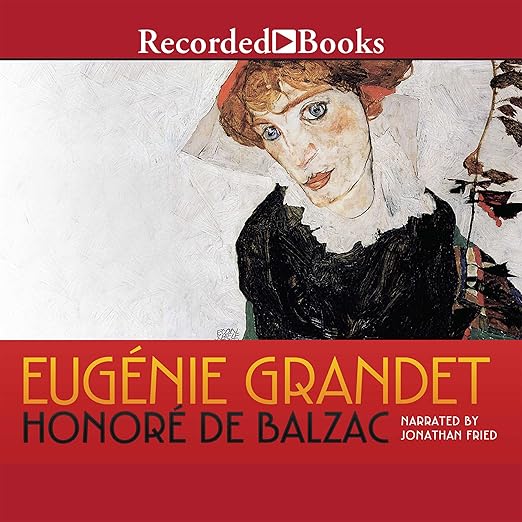
In Brief
- Voice: Jonathan Fried is patient with Balzac's descriptive density, treating it as substance rather than a preamble to rush through.
- Big ideas: Miserliness versus devotion, provincial bourgeois morality, the corrosive power of money
- Atmosphere: Quiet, melancholic, slow-burning
- Worth it?: A faithful, patient gateway into Balzac for listeners willing to sit with nineteenth-century pacing.
Eugénie Grandet's birthday gold sits at the center of this audiobook's entire domestic catastrophe: six thousand francs in coins her father has doled out one piece at a time since childhood, hoarded rather than spent, until her cousin Charles arrives from Paris with a ruined inheritance and a broken heart to match. Balzac sets the scene in provincial Saumur, inside a cold, shuttered house ruled by a miser so calculating that even his wife and daughter live on rationed candles and counted sugar lumps. When Eugénie hands her entire fortune to Charles before he sails for the Indies to rebuild the family name, she sets off a chain of consequences that will define the rest of her life. It is a small, domestic-scale tragedy, and that scale is exactly what makes it devastating.
What Balzac accomplishes in under eight hours of listening is a full portrait of two competing economies: the miser's economy of denial and the daughter's economy of feeling. Monsieur Grandet is drawn with a comic precision that never tips into caricature. He is genuinely, terrifyingly rational within his own logic, a former cooper who parlayed provincial cunning into one of the largest fortunes in the region, and Balzac never lets the listener forget that this man's cruelty is a business decision rather than a lapse in character. Eugénie, by contrast, is almost entirely interior for the novel's first half, a young woman whose entire emotional life has been compressed into secret hoarding of her own, coins instead of feelings, until Charles's arrival gives her something worth spending them on.
The novel's back half, after Charles sails away and years pass in near silence, is where the book's real argument arrives. Balzac is not especially interested in whether love wins. He is interested in what happens to a person taught, by example, that devotion looks exactly like miserliness, just redirected. Eugénie's eventual fate, wealthy, respected, and essentially alone, mirrors her father's own isolation so precisely that the parallel feels less like plot than diagnosis. Listeners of Père Goriot or Cousin Bette will recognize Balzac's recurring conviction that money in nineteenth-century France does not corrupt people so much as reveal exactly who they already were.
Eugénie Grandet is also a useful entry point into understanding what Balzac was attempting across his career as a whole. La Comédie Humaine eventually grew to include more than ninety interconnected novels and stories, unified by recurring characters who appear as protagonists in one book and minor figures in another, all in service of what Balzac called a complete social history of his era. This novel does not lean heavily on that cross-referencing the way some later entries do, but knowing the larger ambition behind it adds real weight to what might otherwise read as a comparatively small, contained story about one provincial family.
Fried Keeps Grandet's Menace Low and Matter-of-Fact
The case for the audio format here is mostly about pacing discipline. Balzac's prose, even in translation, tends to load its early chapters with social and economic exposition, the provincial hierarchy of Saumur, the mechanics of Grandet's fortune, before the emotional plot proper gets moving. Jonathan Fried treats that descriptive density as argument rather than throat-clearing, giving the opening chapters room to establish Saumur's claustrophobic social world instead of rushing toward the romance. That patience pays off once the emotional stakes tighten, since a listener has already absorbed exactly how much power money holds over every relationship in this house before Charles ever walks through the door.
Fried's reading also earns its keep in how it handles Grandet himself. The character could easily become a pantomime villain in a lesser reading, all wheedling and miserly cackling, and Fried resists that temptation, keeping Grandet's menace low and matter-of-fact instead. That restraint matters because Balzac's satire depends on Grandet sounding entirely reasonable to himself at every turn. One listener review credits the novel's opening with being 'very descriptive of the time and setting,' crediting that detail with letting readers eventually 'characterize the persons in their true nature,' which lines up closely with how the narration actually plays out.
One House, One Family, No Subplots Competing
This is a nineteenth-century French novel in English translation, and that combination asks something specific of listeners: patience with a narrative rhythm that predates the modern three-act structure, and comfort with Balzac's habit of pausing the plot entirely to deliver a paragraph of social commentary. If you come to this expecting a brisk romance, the first two hours will feel slow. The romance is real, but it is embedded in what is really a study of provincial economics and family psychology, and the audiobook does not speed that up for you.
One detail worth flagging before you start: the specific English translation used for this audiobook is not identified in the listing. Balzac's prose has been rendered into English by multiple translators over the past century and a half, with real variation in tone between older, more formal renderings and looser modern ones. Listeners who care about translation choice, or who want to follow along with a specific print edition, should verify which text this production actually uses before assuming it matches a particular paperback already on their shelf.
It is also worth setting expectations around Charles. Listeners who know only the broad strokes of the plot, faithful cousin returns wealthy and heartless, sometimes expect a clean villain turn. Balzac is subtler than that: Charles's transformation from naive Parisian dandy into a calculating colonial trader happens gradually enough that his final cruelty toward Eugénie reads as drift rather than betrayal, a harder, more interesting note for a narrator to land than straightforward villainy, and one Fried handles without overplaying the shift.
Listeners coming from longer nineteenth-century doorstoppers, Tolstoy, Dickens at his most sprawling, should recalibrate expectations in the other direction here. Eugénie Grandet is tightly focused rather than expansive: one house, one family, a handful of named characters, and almost no subplots competing for attention. That containment is a genuine strength for listeners who want a complete, satisfying classic without a multi-week commitment, though it also means the social panorama is narrower than in Balzac's more populated novels.
French Provincial Counterpart to Dickens and Flaubert
This audiobook rewards listeners building out a classic-literature habit, especially anyone who has already spent time with Dickens or Flaubert and wants the French provincial counterpart to that tradition. It also works well for listeners specifically curious about Balzac's La Comédie Humaine as a whole; Eugénie Grandet is shorter and more contained than Père Goriot, making it a reasonable entry point before tackling Balzac's longer, more populated novels.
Skip it, or at least postpone it, if you want something plot-forward and fast. The pleasures here are in Balzac's social observation and slow character revelation rather than incident, and at just over seven and a half hours it can still feel like a longer sit than its runtime suggests if you are pushing against the pacing rather than settling into it.
Does this audiobook use a specific English translation of Balzac's original French text?
The listing does not specify which English translation this audiobook uses. Balzac has been translated multiple times since the nineteenth century with real variation in tone, so listeners who care about a specific edition should verify before assuming it matches a particular paperback.
Is Eugénie Grandet a good starting point for readers new to Balzac's Comédie Humaine?
Yes. At just over seven hours, it is shorter and more contained than Père Goriot or Cousin Bette, with a single family and a single plot thread, making it a reasonable entry point before tackling Balzac's longer, more populated novels.
How does Jonathan Fried's narration handle Balzac's descriptive opening chapters in this audiobook?
Fried treats the descriptive density of the opening chapters as substance rather than throat-clearing, giving Saumur's social hierarchy and Grandet's finances room to breathe before the romance plot accelerates, which pays off once the emotional stakes tighten.