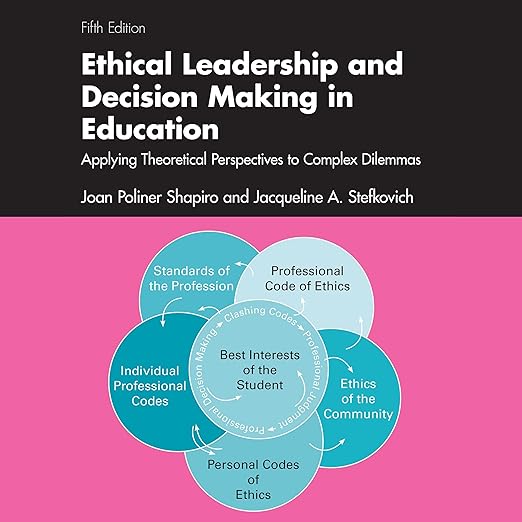
Should a school run lockdown drills on children too young to understand what the drill is actually preparing them for? That is one of more than ten new dilemmas added to the fifth edition of Ethical Leadership and Decision Making in Education, alongside cases on food insecurity, transgender students navigating university life, refugees inside a Swedish school, and hate speech on campus, each one written by a real graduate student, practitioner, or academic who faced something close to it firsthand. Joan Poliner Shapiro writes this alongside Jacqueline Stefkovich, walking every case through four ethical paradigms, justice, critique, care, and the profession, rather than settling for a single correct answer. Kim Handysides narrates the audiobook, and this is not her first time steering listeners through exactly this kind of dense, case-heavy professional education material for the same publisher.
Handysides Narrates the Justice-Versus-Care Tension Clearly
Handysides has a demonstrated track record with acronym-heavy, legally precise education content for this specific publisher, Echo Point Books and Media, navigating dense procedural material without blurring the distinctions that matter to a working administrator. That same reliability-over-expressiveness approach is exactly right here too, where the content is less about narrative color and more about a listener correctly retaining which paradigm applies to which kind of dilemma.
The four-paradigm framework (justice, critique, care, and the profession) is the book's real structural backbone, and it is worth understanding as more demanding than a simple case-study anthology: each dilemma gets worked through all four lenses in sequence rather than resolved with one tidy verdict, which means the book is training a way of thinking, not just supplying pre-packaged answers administrators can quote back.
The justice-versus-care tension specifically is where most of the book's genuine difficulty lives: a justice paradigm asks whether a policy applies its rules evenly and legally, while a care paradigm asks what happens to the specific, named child sitting in front of an administrator when that same rule gets applied. Shapiro and Stefkovich do not resolve that tension in the abstract, they let each case study force it back open again, which is precisely why the book keeps working as a teaching tool rather than a reference manual with fixed answers.
New Cases Ground Decisions Beyond Abstract Ethics
The fifth edition's more than ten new cases skew toward genuinely current pressures rather than recycled classic dilemmas: pandemic-era learning loss across unevenly resourced school populations, a student's sexual orientation becoming a flashpoint in a conservative community, transgender students navigating university housing policy, and hate speech surfacing inside the academy itself. That currency matters for a field where a decade-old case study can start to feel disconnected from what administrators are actually facing this year.
The case-writing methodology itself deserves a mention: rather than commissioning polished, sanitized hypotheticals from professional textbook writers, the collection draws on real dilemmas written by graduate students, practitioners, and academics who lived through something close to each scenario, which gives the material a rougher, more specific texture than a typical composite case study usually manages.
The book's title itself sets honest expectations: this is decision making in education specifically, grounded in real cases rather than abstract philosophical ethics, which is exactly the register a working administrator needs rather than a semester of pure theory.
Two Reviewers Kept Reading Past the Syllabus
Reviewer Timothy Murphy's account captures the book's durability past its original assignment: required 'for a couple graduate classes,' but kept afterward because, in his words, 'the case studies are applicable and useful,' a distinction worth noting since a lot of assigned academic texts get resold the moment the course ends.
Reviewer natalieperkins offers a shorter but equally telling endorsement, writing simply, 'Bought for a class and actually read most of it,' the kind of backhanded honesty that carries real weight for a dense professional reference text. Genuine engagement beyond the syllabus requirement is a meaningfully higher bar than most assigned reading clears.
Both reviews on record come from the same essential context, a required graduate course, yet both independently describe genuine, voluntary engagement past the minimum the assignment demanded. For a book whose natural first audience is a captive classroom, that pattern of reviewers choosing to keep or actually finish the material is a more meaningful signal of quality than enthusiasm from a reader who sought the book out with no external pressure at all.
Discussion Questions Assume Pauses During Listening
The synopsis notes that discussion questions follow each case, built for a classroom or seminar's pause-and-discuss rhythm, plus instructor teaching notes emphasizing self-reflection. Passive audio listening does not naturally support that kind of stop-and-respond structure, so listeners using this for coursework or professional development should plan to pause deliberately at each case rather than letting the audiobook simply run through to the next one.
One reviewer's complaint, that their physical copy arrived 'cut incorrectly with the top 1-1.5 inches missing,' is a print-manufacturing defect entirely unrelated to the audio product, but it is worth mentioning here only so listeners browsing the attached reviews are not confused about which format that specific complaint applies to.
Eleven Hours of Cases Reach Beyond America
At eleven hours and thirty-nine minutes, this runs long for a professional reference text, and that length reflects genuine density rather than padding: dozens of individually written cases, each with its own four-paradigm walkthrough, add up rather than repeat themselves. Listeners hoping to absorb the whole framework in a single sitting should plan instead for a chapter-at-a-time approach spread across multiple listening sessions.
The book's international case examples, a Swedish school's refugee population among them, push back gently against any assumption that ethical leadership dilemmas in education are a purely American phenomenon, positioning the four-paradigm framework as a genuinely portable analytical tool rather than one calibrated only to U.S. legal and cultural context.
Administrators Preparing for Licensure Will Value This
Current and aspiring school administrators, teacher-leaders, and education policy graduate students, especially anyone assigned this text in a leadership program, will get real, durable value here well past the end of a single semester.
Practitioners specifically facing one of the fifth edition's newer case categories in their own building right now, a lockdown drill policy under community scrutiny, a hate speech incident, a transgender student's housing question, will find the four-paradigm method genuinely applicable to an active decision rather than purely theoretical.
Anyone preparing for a licensure or comprehensive exam built around education leadership ethics specifically gets a genuinely useful study structure out of this too, since the same paradigm-application skill the book trains is exactly what such exams are typically built to test.
General listeners without some stake in school administration or education policy will likely find the case-by-case academic structure slow going, since this is reference and training material written for practitioners first and general nonfiction readers a distant second.
The Short Version
- Voice: Kim Handysides brings the same reliable, clearly enunciated professional delivery to this dense case-study material that she has demonstrated on prior education titles for the same publisher.
- Big ideas: Ethical decision-making frameworks in education, real school leadership dilemmas, justice versus care in institutional conflict
- Atmosphere: Serious and practitioner-focused
- Worth it?: A durable, well-structured professional resource for education leaders, though its classroom-discussion format asks more active pausing than typical passive listening.
Frequently Asked Questions
Is this audiobook useful outside of a graduate school assignment?
Reviewer accounts suggest yes. Timothy Murphy specifically kept the book after his required coursework ended because the case studies remained applicable, which points to real value beyond the syllabus.
Has Kim Handysides narrated similar education-focused audiobooks before this one?
Yes, she has a demonstrated track record with dense, legally precise education content for this same publisher, Echo Point Books and Media, which shows in her reliable, clearly paced delivery here.
What are the four ethical paradigms this audiobook keeps returning to?
Justice, critique, care, and the profession. Shapiro and Stefkovich apply all four to each case rather than resolving dilemmas with a single correct answer.