Quick Take
- Narration: Phil Martin reads his own material with genuine authority, one reviewer specifically called out the self-narration as outstanding, and the author’s familiarity with the content shows in his delivery of role-specific scenarios.
- Themes: Secure software development, role-based security responsibilities, exam strategy
- Mood: Engaging and practical for an exam prep title, with a real-world engineering lens that keeps 19 hours from feeling like a textbook recital
- Verdict: The strongest audiobook option currently available for CSSLP candidates who want exam content presented through the lens of how security actually works in engineering teams.
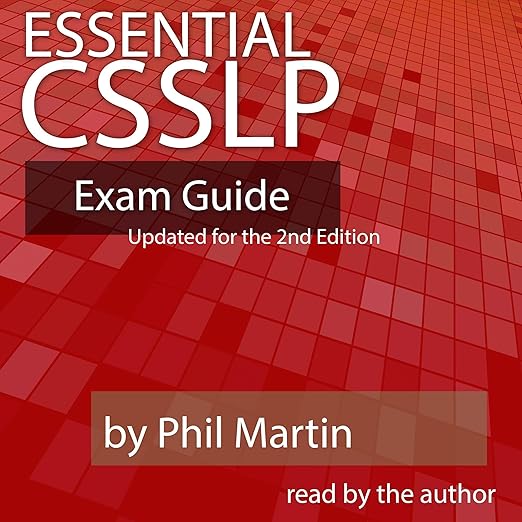
There’s a specific kind of audiobook that I find genuinely interesting to spend time with: the one where the author and narrator are the same person, and you can hear that the person talking actually knows what they’re talking about. Not performing expertise, but thinking out loud with it. Phil Martin’s Essential CSSLP Exam Guide is one of those. I spent parts of three evenings with it, and whatever gaps it has, that quality of authorial presence carries the 19 hours further than most exam prep titles manage.
The CSSLP, Certified Secure Software Lifecycle Professional, is an ISC2 certification that functions less like a technical skills test and more like a professional judgment exam. It asks whether you understand how security integrates into software development across an entire organizational ecosystem, from the developer writing code to the architect making design decisions to the DBA managing data access. That scope is the thing that defeats most candidates: they study it like a vocabulary test and find themselves unable to translate their memorized definitions into the scenario-based questions the exam actually delivers.
The Role-Based Architecture That Separates This From Other Guides
Martin’s structural choice is unusual enough that it deserves direct attention. After establishing core security concepts that anyone in the field should already hold, he reorganizes the remaining exam content not by ISC2 domain but by professional role: DevOps, Infrastructure, DBA, Development, Product, Architect, Engineering Manager, Testing, Project, Security, Change Management, and Auditor. This maps neatly to how real development organizations actually assign security responsibilities, and it means the content lands differently depending on where you sit in your organization.
If you’re a security engineer coming to this exam, the Security and Auditor chapters will feel like confirmation of things you already do. The Development and Testing chapters will show you how the exam expects you to think about security from a developer’s vantage point, which is precisely the perspective shift the CSSLP demands. That’s a more honest preparation approach than front-loading all eight ISC2 domains as abstract categories and hoping the real-world application emerges through osmosis.
The Navigation Problem and How Much It Matters
One reviewer’s 2-star complaint deserves acknowledgment: the absence of a functional table of contents in both the Kindle and Audible versions is a real usability problem for a reference tool. Exam guides are consulted non-linearly. You finish a practice exam, identify that you’re weak on change management concepts, and want to return to that specific chapter without manually seeking through 19 hours of audio. The chapter structure exists, Martin clearly organized this by role, but the absence of navigable chapter titles in the Audible version means you’re working with chapter numbers rather than descriptive headings.
For a first-pass listen during initial study, this limitation is manageable. For targeted review in the weeks before the exam, it’s genuinely frustrating. The practical workaround most candidates will reach for is using the audiobook for comprehensive first exposure and keeping a physical or digital copy open for indexed review. That’s not an ideal user experience, but it doesn’t invalidate the content quality.
What the Self-Narration Adds
David Christie’s review calls the self-narration outstanding and recommends buying both the book and the audiobook, worth noting because reviewer enthusiasm about a narrator is relatively rare in the exam prep category. What Martin delivers is a sense that he has personally wrestled with this material, encountered the edge cases, and arrived at explanations that reflect real comprehension rather than content assembly. He reads technical definitions at a pace that lets you process them. The role-specific sections benefit particularly from this, because the transitions between roles, from how a DBA thinks about access controls to how a Security professional frames the same problem, require someone who can hold both perspectives simultaneously, and Martin can.
At 4.0 stars from 26 reviews with a specific 5-star validation from someone who passed the exam using this guide, the audiobook has the kind of results-based credibility that matters more in the exam prep category than general likeability.
The Right Audience for This Title
Working IT professionals with three or more years of secure software development experience who are preparing for the CSSLP and prefer conceptual learning over rote memorization will find this the most useful audio resource currently available for this exam. If you’re a developer who has lived the software development lifecycle but never had to articulate its security dimensions formally, Martin’s role-based framing will make a lot of implicit knowledge explicit in a way that transfers directly to exam performance.
Pure beginners to security or those without hands-on development background should treat this as a companion rather than a primary resource, the guide assumes you already function in IT, as the CCSP For Busy People from the same author’s Bare Metal Cyber series explicitly states. That’s an honest calibration, not a weakness.
Frequently Asked Questions
Does this guide cover all eight ISC2 CSSLP domains, and how does the role-based structure map to them?
Yes, all eight domains are covered, but the content is reorganized by professional role rather than domain sequence. This means CSSLP domain material is distributed across the role chapters (DevOps, Infrastructure, DBA, Development, etc.) rather than presented domain-by-domain. Candidates should cross-reference the ISC2 domain outline to verify coverage before exam day.
Is Phil Martin’s self-narration difficult to follow for someone without a software engineering background?
The narration assumes IT fluency. Martin’s delivery is clear and measured, but the content moves through secure software concepts at a pace suited to working engineers rather than complete beginners. Candidates with development or security operations backgrounds will find it accessible; those new to the field may need to pause and review more frequently.
How does this guide compare to the official ISC2 CSSLP Study Guide for exam preparation?
The main differentiator is the role-based organizational structure. The official ISC2 guide follows domain sequence, which is more useful for domain-by-domain verification. Martin’s guide is more useful for understanding how security responsibilities distribute across a real development organization, which is how the scenario questions on the exam are framed.
Can the audiobook be used effectively for review after an initial read-through, given the navigation limitations?
The absence of descriptive chapter titles in the Audible version makes targeted review more difficult than it should be. Most candidates use the audiobook for first-pass comprehensive listening and then rely on the print version for indexed review of specific role chapters. Using both formats together is the approach that appears to produce the best results.