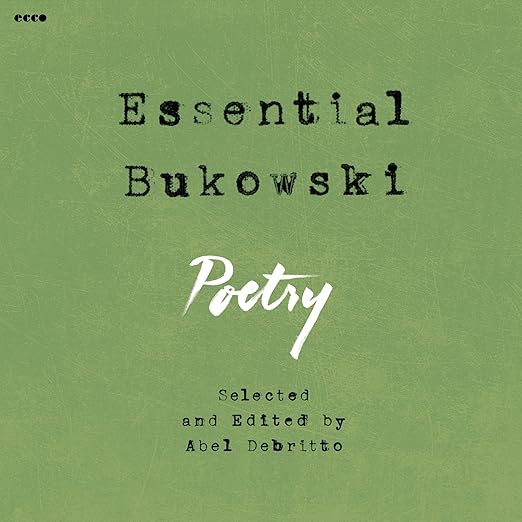
What this audiobook is filed under, Diaries and Correspondence, describes nothing that happens inside it. Essential Bukowski is a book of poems, edited by Abel Debritto and offered by the publisher's copy as the definitive collection, and the genre slots park it beside memoir and letters. The tag is wrong in a useful way, though, because the five responses underneath really do read like correspondence. All five are written in the first person, four of them about what Bukowski did to the person writing, and the fifth about a parcel. The number I would look at first is the runtime: two hours and thirty-eight minutes for a career the publisher calls definitive.
The Poems About Writing Are Where the Fire Is
Every claim the description makes is about reach, not length. It promises subjects running from love to death and sex to writing, verse it calls unvarnished and self-deprecating, and a poet who speaks to the deepest longings and strangest predilections of the human experience. It calls the collection definitive. What it never supplies is a number. No poem count, no list of titles, no indication of which decades are represented or how a career is meant to compress into a single sitting. Ecco sits in the publisher field and Abel Debritto is named in the description as editor, and between them they made the selection decisions that matter most in a book of this kind, with nothing here about how they made them.
Five people have written and the vote counter beside them says one. That is not a rounding quibble: 4.7 cannot come out of a single whole-star vote under any convention, so the badge is averaging something this page is not showing. Set it aside and read the column, because the column is unusually good. One entry says the poems about writing are where the fire is, and then tries to relay Bukowski's advice to young writers in a sentence that loses a word along the way. Another, from someone describing the moment they started reading in English and could suddenly enjoy this kind of art, calls the book the treasure and signs off by thanking Bukowski by name.
Johnny Heller Carries It, No Second Reader
Two hours and thirty-eight minutes is short by any measure, and for poetry that is not automatically a fault. A poem read aloud takes as long as it takes, and the density of a collection has nothing to do with its clock. What the runtime does tell you is the shape of the thing: an evening, not a shelf project. Johnny Heller carries all of it. The credit lists no second reader, no voice for the editor, and no separate track for whatever Abel Debritto wrote at the front of the printed edition, which is a small omission until you notice that one response treats that front matter as load-bearing.
One response is the most useful thing on this page and also the least verified. It credits the editor with capturing Bukowski in the poet's own words, without the heavy revision the work suffers in other publications, then admits in the next breath that the claim comes from the editor's own introduction and was never checked. I like the honesty of that. It is also the single most consequential question about any selected poems assembled by someone other than the poet: whose text is this? The description does not answer. It says definitive, it says edited by Abel Debritto, and it leaves the editorial history to a four-star reader who told you upfront that trust was doing the work.
Most of what the column agrees on is temperament rather than content. Refreshingly honest, sometimes brutal and dark, yet always rising to a truth a lot of people can relate to, says one. Pulls no punches, says another, adding that life is not all rainbows and puppy dogs. Nobody quotes a line. Nobody names a poem beyond the general category of the ones about writing. If you are trying to work out whether this particular selection is the one you want, the responses hand you a mood and a reputation and very little else, which puts the weight back onto the jacket's own promise of love, death, sex and writing.
A Recording Cannot Be Damaged in Shipping
If you sort the five responses by what each one is actually grading, one of them is grading a parcel. It is a five-star note about a Christmas gift that arrived in perfect condition, with the qualification that the packaging could have been better to guard against damage in shipping. A recording cannot be damaged in shipping. That grade belongs to a physical object bought, wrapped and handed over, and it is sitting on the page for an audio edition doing the same arithmetic work as the entries that are about the poems. Read the column, but read it knowing what each writer had in their hands.
When the genre fields say biographies and memoirs and the only tag says Diaries and Correspondence, the effect on a browsing listener is not neutral. Someone looking for Bukowski's letters or a life of him will land here and find verse. Someone looking for the verse may never see the entry at all. The description does not mention the misfiling, because descriptions never do, and sorting it out is left to whoever arrives from a search. The other thing to weigh is scale: definitive is the publisher's word, two and a half hours is the runtime, and only you can decide whether those two facts are in tension.
A Line Break Is Information Audio Can't Give
Anyone who has heard of Bukowski and never sat down with him has an unusually low-cost entry point here. Under three hours, a selection somebody else has already made, and one voice carrying it: that is close to an ideal first encounter with a poet whose legend runs well ahead of his pages. The column does not contradict that use. Nobody describes struggling, nobody mentions needing the text in front of them, and the one entry that compares this against other publications prefers this one. Enthusiasm without specifics is exactly what a good gateway produces.
Listeners who want the poems on a page will be frustrated in the ordinary way, because a line break is information that audio cannot hand you, and the shape of a poem is part of what it means. Skip this if what you actually want is the letters or the life, since the tag promises correspondence and the book delivers verse. Skip it too if definitive is a word you take literally, because nothing here tells you how many poems were chosen, out of what, or by what rule. Bukowski does not need two hours and thirty-eight minutes to make an impression, which is both the argument for this edition and the reason to wish for a longer one.
Questions Listeners Ask
Is two hours and thirty-eight minutes long enough for a definitive Bukowski?
That depends what definitive is doing in the description, which never gives a poem count or a list of titles. Two and a half hours is a full evening of verse read aloud, and poems do not compress the way prose does. What the selection cannot be is complete, and the publisher does not claim completeness anywhere else.
Is the editor's introduction part of this audiobook?
The credit names Johnny Heller and nobody else, with no separate track listed for front matter. One four-star response leans on something the editor wrote in an introduction, about capturing Bukowski without the heavy revision found in other publications, and admits the claim was never checked. Whether that text is inside this recording, the fields do not say.
Why is a poetry collection tagged Diaries and Correspondence?
No explanation is offered, and the mismatch is one to note before you go searching. The genre slots read biographies and memoirs alongside literature and fiction, with Diaries and Correspondence as the only tag, while the book itself is verse edited by Abel Debritto. Anyone hunting for letters will arrive here and find poems instead.
Would this audiobook work as a first meeting with Bukowski?
It is the cheapest way in that this page offers: a selection already made for you, one voice, and under three hours to find out whether the temperament suits. The written responses call the work honest, brutal and dark, and not one of them describes any difficulty following it aloud. Nobody quotes a line, though.