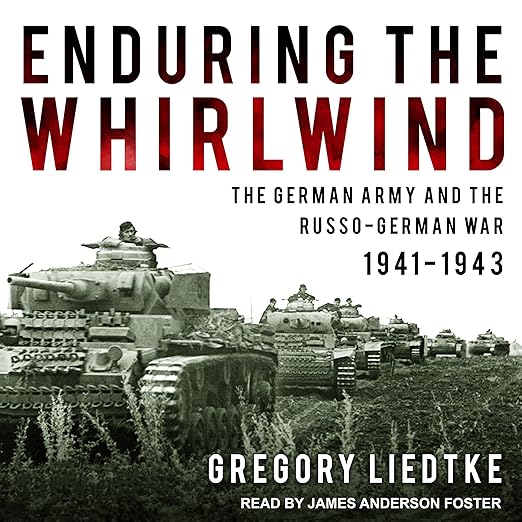
Quick Take
- Narration: James Anderson Foster handles the academic register without becoming monotonous, a measured performance suited to a heavily sourced historical argument.
- Themes: Eastern Front mythology versus documented reality, military logistics, historiography of WWII
- Mood: Dense and methodical, rewarding to specialists and patient generalists alike
- Verdict: A rigorous, evidence-driven challenge to the Wehrmacht myth, every serious Eastern Front reader should encounter this argument, even if the narrow focus requires patience.
I came to Enduring the Whirlwind during a period when I had been reading broadly about the Second World War’s Eastern Front and kept running into the same comfortable narrative: that the German Army was a paragon of military professionalism undone by Hitler’s interference and Soviet numerical mass. That narrative had always felt too clean to me, too convenient for the officers who survived the war and wrote their memoirs in comfortable postwar West Germany. Gregory Liedtke’s book is the most methodical challenge to that narrative I have encountered in audio form.
Liedtke’s central argument is specific and deliberately narrow. He is not writing a general history of the Russo-German War. He is addressing one pillar of the Wehrmacht myth: the claim that Germany was incapable of replacing its losses and that numerical inferiority was the root cause of eventual defeat. His finding, built on charts, tables, and primary-source documentation that reviewers describe as appearing nowhere else, is that Germany could and did replace its losses through the crucial first phase of the war, June 1941 to July 1943. The problem was not numerical weakness. The problems were transportation, distribution, and operational decisions that the comfortable postwar myth conveniently attributed to Hitler alone.
Our Take on Enduring the Whirlwind
What Liedtke does in the opening chapter on historiography is particularly valuable. He maps the existing literature on the Eastern Front and shows where the Wehrmacht myth originated, largely in the memoirs of surviving German officers who had strong personal and institutional incentives to frame the defeat in terms that preserved their professional reputations. Reading that context before the main argument makes everything that follows more legible. You understand not just what happened but why the false version became so durable.
James Anderson Foster’s narration is appropriate for the material. This is an academic history with a substantial apparatus of data and footnoted evidence, and Foster reads it without overclaiming emotional weight that the text does not support. The measured delivery suits a book that is making arguments rather than telling stories, though the narrative sections, Liedtke does weave individual human experience through the analysis, are handled with enough variation to prevent the nine hours from becoming purely arid.
Why Listen to Enduring the Whirlwind
For anyone who has read extensively about the Eastern Front, Enduring the Whirlwind offers something genuinely new. A reviewer who described themselves as having read a lot on the Eastern Front over the years found facts and figures they had not seen anywhere else, and found the opening historiography chapter terrific even though it is not the book’s main argument. That combination, original data plus intellectual framing of where the data fits in the existing conversation, is what serious historical scholarship should provide, and Liedtke delivers it.
A reviewer who described themselves as not a military history buff but who had grown up with war movies found the book a real eye-opener that dismantled the western narrative those films instilled. That is the wider audience this book can reach if approached with patience. The argument is academic in structure but the underlying story, how a defeated army’s survivors successfully sold a false account of why they lost, is genuinely compelling.
What to Watch For in Enduring the Whirlwind
The title is slightly misleading, as one reviewer noted. Enduring the Whirlwind sounds like a broad narrative of the Russo-German War. It is not. It is a specific evidentiary argument about German replacement capacity during a defined thirty-month period. Readers who arrive expecting comprehensive campaign history will be surprised by the book’s focused scope. That scope is not a weakness, it is what allows Liedtke to be as thorough as he is, but knowing it in advance manages expectations appropriately.
The density of the data presentation is also worth acknowledging. Liedtke supports his argument with enough charts and tables that the audio format involves a degree of trust, you are hearing summaries of numerical data that would be easier to assess visually. Listeners who want to engage seriously with the evidentiary record may want to supplement the audio with a print or digital copy that allows them to examine the tables directly.
Who Should Listen to Enduring the Whirlwind
Essential for serious students of the Eastern Front and for anyone who wants a rigorous counterargument to the postwar Wehrmacht myth. Accessible to patient general readers willing to follow a narrow academic argument across nine hours rather than a broad narrative. Not recommended as an entry point to Second World War history, the book assumes familiarity with the basic shape of Operation Barbarossa and the Russo-German War. Start with more accessible histories and return to Liedtke when you are ready to interrogate the received version of events.
Frequently Asked Questions
Is Enduring the Whirlwind a good starting point for someone new to Eastern Front history?
No. The book assumes familiarity with the major campaigns and figures of the Russo-German War. It is best approached after reading broader histories of Operation Barbarossa and the Eastern Front.
What is the Wehrmacht myth that Liedtke is challenging, and why does it matter?
The myth holds that the German Army was a professional military machine that lost on the Eastern Front primarily due to Hitler’s meddling and Soviet numerical superiority. Liedtke argues this narrative was constructed by German officers after the war to protect their reputations and that it distorts our understanding of why Germany actually lost.
How does the audio format handle the book’s charts and data tables?
The narration summarizes the data verbally, which works for following the argument but does not allow the kind of direct examination that print allows. Listeners who want to engage with the specific numbers may want a print or digital copy alongside the audio.
Does Liedtke cover the entire Eastern Front campaign or only a specific period?
He focuses specifically on June 1941 to July 1943, the first half of the Russo-German War. One reviewer explicitly hoped for a second volume covering 1943 to 1945. As of this review, no such volume has appeared.