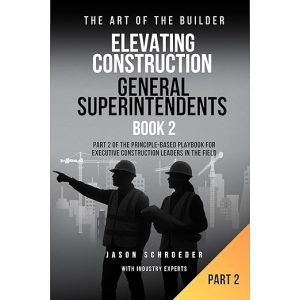
Jason Schroeder opens Elevating Construction General Superintendents - Book 2 with a clear declaration that functions as a filter for prospective listeners: this audiobook is not a management book. It is, as Schroeder puts it, a field-tested playbook. That distinction matters enormously in construction leadership literature, where the gap between theoretical frameworks developed in business schools and the actual challenges of running large-scale field operations is wide and frequently costly. This second volume in the Art of the Builder series, Book 25 in Schroeder's broader catalog, covers Plays 6 through 9 of the General Superintendent Playbook, picking up where Book 1 left off and addressing high-performance team development, project startup, strategic execution, and the specific discipline of finishing strong.
At 13 hours and 30 minutes, this is a substantial commitment, and it rewards the investment most for listeners already operating at or preparing for the general superintendent or field director level. Schroeder draws on decades in the field and the contributed wisdom of what he describes as elite builders across the country, which gives the content a collective rather than singular authority. The questions it organizes around, how to install culture rather than merely hope for it, how to develop leaders while the job is actively on fire, how to finish projects with pride rather than burnout, are the ones that distinguish executive field leadership from capable project management at earlier career stages.
Play Nine Finally Gives Finishing Its Due
The Virtual Voice narration handles the technical vocabulary of construction management competently, though a 13-hour field leadership text has a natural rhythm that practitioner narrators tend to carry more authentically. Schroeder's own voice and the voices of the industry contributors he draws from would likely add texture that synthetic narration cannot replicate. For a book that explicitly positions itself as a transmission of collective field wisdom, the impersonality of AI narration creates some friction with the content's relational emphasis. Listeners who are already deeply embedded in the construction industry may find this more natural to absorb than those approaching from adjacent professional fields.
The structure around four Plays gives the audiobook a navigable architecture. Play 6 covers developing high-performance teams, Play 7 addresses starting projects the right way, Play 8 handles strategic execution, and Play 9 returns to the underappreciated discipline of finishing. The finishing chapter deserves particular attention: construction leadership literature spends considerable time on preconstruction and early mobilization, and comparatively little on the particular psychological and logistical challenges of the final percentage of a project, when teams are fatigued, punch lists expand, and the pressure to close out conflicts with the pressure to do it right. Schroeder treating it as a Play unto itself reflects genuine field experience rather than a theoretical framework.
Thirteen Hours for the Drive Between Sites
The primary argument for this audiobook over the print edition is the same argument that applies to all professional development reading in the construction industry: the work does not stop, and audio allows absorption during the commute, the drive between sites, or the periods of waiting that punctuate field leadership. A general superintendent who cannot sit at a desk for extended reading can make genuine progress through 13 hours of targeted professional development while maintaining field presence. The sequenced Plays format reinforces this, since individual sections can be revisited without relistening to the full text.
The series context also matters here. Schroeder's Art of the Builder catalog represents an ongoing curriculum rather than a standalone resource, and Book 2 is explicitly positioned as an extension of that framework. Listeners who have worked through the earlier volumes will find the escalating complexity of the General Superintendent Playbook sequence coherent and purposefully sequenced. Those arriving here without that foundation may want to begin with earlier entries to build the conceptual scaffolding the later Plays assume as given.
Its Only Five-Star Review Comes From the Author
This volume has attracted only a single five-star note so far, and it comes from the author himself, which does not constitute independent listener validation. The content's quality can be reasonably inferred from the series track record and from Schroeder's standing in construction leadership education, but prospective listeners should weigh the absence of third-party reviews accordingly. At 13.5 hours and a professional niche subject matter, this is not a casual commitment, and the price-to-value calculation depends significantly on how directly the listener's current role maps onto the general superintendent scope Schroeder addresses throughout.
The book also assumes prior engagement with the Playbook framework from earlier volumes. Plays 6 through 9 build on the earlier numbered Plays, and the organizational logic of the series requires orientation in the earlier material. Someone seeking an introduction to construction field leadership would be better served starting from the beginning of the Art of the Builder sequence rather than entering at this point in the catalog. The book is clearly written for those who already know what a general superintendent's job requires and want specific frameworks for doing it at a higher level.
Field Directors Should Start With Book One
This audiobook is written specifically for general superintendents, field directors, and operations leaders in the construction industry, as well as those actively preparing to step into those roles. It assumes substantial field experience and positions itself as a resource for professionals who have already internalized basic project management and are now navigating the culture, people, and rhythm dimensions of executive field leadership. Listeners outside the construction industry who are drawn to field leadership frameworks may find applicable ideas, but the vocabulary and examples are industry-specific throughout. Begin with Book 1 of the General Superintendent Playbook before approaching this volume.