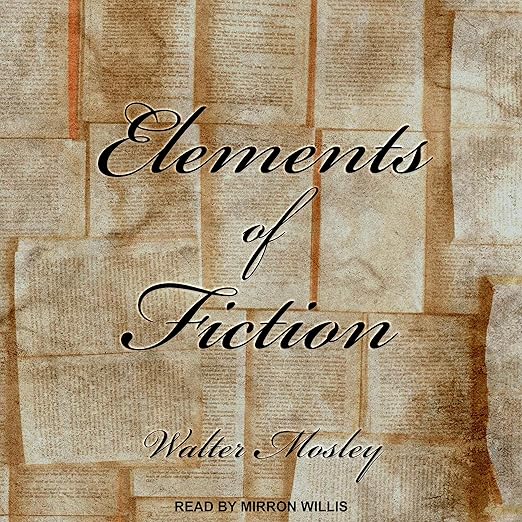
Walter Mosley refuses to hand new novelists a formula, and that refusal is what makes this audiobook worth the short investment. Positioned as a follow-up to his earlier This Year You Write Your Novel, Elements of Fiction moves past scheduling and discipline into the harder question of what actually separates competent prose from the kind that transcends convention, the Melville, Dickens, and Twain tier Mosley invokes directly as the standard worth chasing.
Voice, Not Plot, Is Mosley's Real Subject
The book's structure, a series of instructive, conversational chapters working through character, plot, voice, and context, stays deliberately loose rather than textbook-rigid, and that looseness is a feature rather than a gap. Mosley writes new demonstrative examples specifically for this book, meaning listeners hear him actually construct a piece of fiction in real time to illustrate a point about voice or pacing, rather than simply pointing to an existing published passage and asserting it works.
One reviewer, a working writer, describes the book as poetic prose more than a how-to manual, noting that Mosley does not tell you how to write a novel so much as model the playfulness and imaginative freedom that good fiction requires. That is an accurate read of the book's actual ambition: this is closer to an extended demonstration of craft sensibility than a checklist, and listeners expecting rigid, step-by-step instruction may need to recalibrate.
Mosley's choice of Melville, Dickens, and Twain as the standard worth chasing is not incidental: all three are writers whose sentences carry a recognizable, idiosyncratic voice that survives translation into summary, and Mosley's own point throughout the book is that voice, not plot mechanics, is the hardest and most valuable thing a fiction writer develops. Character and plot get their own chapters, but voice functions as the book's real organizing obsession.
The book's brevity works in its favor here specifically because Mosley resists padding a craft reflection into false comprehensiveness; where a longer writing-craft book might feel obligated to cover dialogue mechanics, chapter structure, and revision process in equal separate detail, Mosley stays focused on the handful of elements he considers genuinely foundational, character, plot, voice, context, and trusts the listener to extend the thinking outward on their own.
That demonstration-first approach, an idea followed immediately by Mosley's own freshly written illustration of it, is the book's most consistently effective structural choice, repeated across character, plot, and voice alike.
Context and description, the fourth element Mosley names alongside character, plot, and voice, gets treated as inseparable from setting a story's emotional temperature rather than as scene-setting furniture; Mosley's own examples show description doing double duty, establishing a physical space while simultaneously revealing something about the character whose perception is filtering that space.
Willis Channels a Voice Readers Already Know
One reviewer who has heard Mosley speak publicly makes a striking claim: that his lyrical speaking style comes through so clearly on the page that anyone familiar with his voice will essentially hear him narrating even though the credited narrator is Mirron Willis, not Mosley himself. That is a genuine compliment to how distinctive Mosley's written voice is, and it raises the real question of how well Willis captures that same cadence in performance.
Willis brings real seriousness to the material, treating Mosley's craft observations with the same measured gravity a listener would expect from dense analytical nonfiction, which suits the book's more reflective passages well. The conversational chapters built around Mosley's own newly written examples benefit from a narrator who can shift registers between explanatory prose and embedded fiction excerpts without losing the thread, and Willis manages that transition cleanly throughout the audiobook.
Mosley's own decades-long career as a novelist, best known for the Easy Rawlins mystery series, gives real weight to his craft observations here; this is not a writing teacher theorizing about fiction from the outside, but a working novelist describing decisions he has actually made across dozens of published books, and that lived authority comes through clearly in how specifically he can explain a choice rather than just naming it.
Willis's pacing across the book's more meditative passages, the sections closest to Mosley reflecting rather than instructing, gives listeners room to actually sit with an idea before the next one arrives, which matters for material this dense with craft insight delivered in a conversational rather than outlined structure.
Under Three Hours and Assumes a Manuscript
At under three hours, this is a companion piece rather than a comprehensive writing education, and it explicitly assumes some familiarity with Mosley's earlier This Year You Write Your Novel or at least a working manuscript already in progress. Absolute beginners with no draft yet may find themselves listening to craft-level guidance before they have the practical scaffolding to apply it.
The conversational, discursive structure that reviewers praise as inspiring can also read as light on concrete, actionable takeaways for a listener who wants a structured framework rather than a series of reflections on craft, and it is worth setting that expectation before pressing play rather than discovering the gap partway through.
Because Mosley writes new fiction examples specifically for this book rather than quoting his own published novels, listeners already familiar with his Easy Rawlins books should not expect direct connections to that series; this is freestanding illustrative material built purely to demonstrate a craft point, disconnected from his established fictional world.
This is also a book better suited to focused listening than background consumption; because Mosley's examples are written specifically to illustrate a point being made moments before, missing a stretch of audio while distracted risks losing the thread between the craft observation and the demonstration meant to prove it.
The conversational tone throughout also means Mosley occasionally circles back to revisit an earlier point from a new angle rather than moving in a strict linear sequence, character, then plot, then voice, in isolated chapters; listeners expecting textbook-style compartmentalization should instead expect ideas about character and voice to bleed into each other the way they actually do in the writing process itself.
Novelists With a Draft Already Underway
Working and aspiring novelists who already have a draft or a serious writing habit, and who want inspiration and craft-level reflection rather than another beginner's checklist, are the clear audience. Fans of Mosley's fiction specifically will get an added layer of value hearing his own creative instincts explained in his own words, even filtered through Willis's performance rather than Mosley's own voice.
Listeners who enjoy craft-focused literary podcasts or author interviews will find this audiobook's conversational register familiar and comfortable, closer to an extended, well-prepared interview about writing than a structured university lecture.
Skip it if the need is a structured, step-by-step writing methodology, or if no manuscript is yet in progress to apply these more advanced craft observations against; this book rewards writers already in the trenches of a project more than those still deciding whether to start one.
- Read by: Mirron Willis brings serious, measured control to Mosley's conversational craft reflections.
- At its heart: fiction craft, authorial voice, creative mentorship.
- Vibe: Reflective, lyrical, and loosely structured.
- Short version: A short, inspiring companion for writers already mid-manuscript, not a starting-point how-to.