
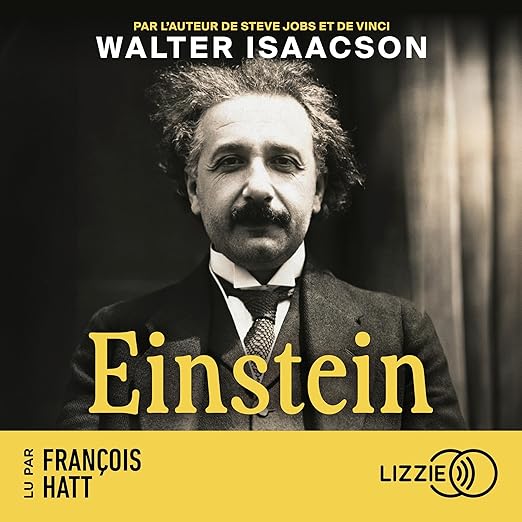
French is the language field on this audiobook listing, and nothing in the title printed at the head of the page warns you about it. The description is in French. The chapter list is in French. All five written responses are in French. Anyone arriving from an English-language search for Walter Isaacson's biography of Einstein needs that fact before any other, because twenty-four hours and four minutes in a language you do not speak is not a purchase anyone recovers from gracefully. Assuming French is exactly what you wanted, the rest of this page still repays a slow and careful look.
A Complete Chapter List Like a Book's Front Matter
Lizzie is the name in the publisher field here, which most English-language buyers will not recognize at all. The description makes large claims on the book's behalf and they are the usual ones: translated into thirty languages, more than two million readers worldwide, a line from the New York Times describing a portrait that is human and immensely charismatic, and a second line from the New York Sun. Publisher copy of that kind tells you a book has sold in quantity. It tells you considerably less about this edition than the metadata fields beneath it do.
Chapter listings rarely appear on audio pages, and this description carries a complete one: twenty-five chapters plus an epilogue, each titled and most carrying a date range. The effect is closer to a printed book's front matter than to store copy, and it is genuinely useful, because you can see the shape of the whole thing before committing to it. The arc runs from a childhood beginning in 1879, through the polytechnic years in Zurich, the miraculous year of 1905, general relativity, worldwide fame, the Nobel, the refugee period, the bomb, the anti-communist suspicion of the early 1950s, and an ending in 1955.
Captivating Narration Actually Praises the Prose
Sources are the description's central boast, and the boast is legitimate. The book draws on material not previously available, Einstein's personal letters among it. What that access produces, according to the copy, is the story of how a patent office employee with a difficult marriage, no doctorate and no teaching post came to overturn modern physics. The mechanism proposed is almost banal and probably correct: he questioned received ideas and found wonder in things everyone around him considered ordinary. That habit is then traced outward into his politics, into a morality built on respect for the freedom of individuals and of minds.
Hatt carries twenty-four hours and four minutes of this, which is a long assignment by any standard. The October 16 response praises meticulous research and what it calls captivating narration, and the second phrase is worth pausing over, because in that sentence it means storytelling rather than reading aloud. That response is describing prose. Anyone reading quickly could easily take that line as praise for the recording, which it plainly is not, and the confusion is easy to fall into on a page where the narrator field sits a few lines above a review using the same root word for something entirely different.
Translator Credits Are Missing Entirely
Reviews on this page were all filed in France, and every one of them describes a physical object. Delivery speed appears. The condition of a parcel appears. The most recent, dated December 2025, consists of three fragments separated by slashes: a very good book, very instructive, fast delivery. That last fragment does no work at all for someone deciding about a recording, and it sits in the same pool that produces the 4.5 average displayed at the top of the page. The number itself is real. What it measures is not what the page implies.
Translator credits are missing entirely, and on this particular listing the omission matters more than it usually would. The description states outright that this biography has been translated into thirty languages, and it never says who produced the version reaching your ears. The listing has no translator field at all, and no name surfaces anywhere in the copy. For a printed book that is a familiar complaint. For a recording it is stranger still, because every sentence François Hatt reads aloud is somebody's rendering, and the person responsible for those choices stays invisible throughout.
Packaging complaints dominate the bottom of this column. The single one-star grade on the page states explicitly that the star is not for the book but for the condition of the copy that arrived, damaged despite having only just been published, and it closes by announcing an intention to buy the thing at a physical store instead. The October 13 response answers that complaint directly, advising that a damaged copy can be sent back and replaced without argument, and praising what it calls a new publisher's first outing. Both responses concern cardboard and paper. Neither one can possibly concern a download.
The Only Thing Genuinely Absent Is a Name
Francophone listeners who want a full-scale life of Einstein are the entire audience for this edition, and they are well served by it. The November 14 response makes the case in a single line: a very good book, easy to understand, instructive. Easy to understand is the operative phrase for a twenty-four hour science biography, because the risk with this material is that the physics gets either skipped or made impenetrable. Listeners who already know the science will find their value elsewhere, in the marriage, the divorce, the exile, the bomb, and the political suspicion that followed him in America.
English-language listeners should stop here and look for a different edition, which is the plainest advice this page allows and the reason the language field earned the opening paragraph. Anyone who reads French comfortably but has never worked through a twenty-four hour book should weigh that number honestly too, since a biography this size rewards steady attention rather than occasional dipping. For everyone else, meaning listeners who wanted this exact book in this exact language, the listing delivers what it promises, and the only thing genuinely absent from it is a name in the credits.
Frequently Asked Questions
Is an English recording offered on this same audiobook listing?
No. The language field reads French and no alternative version is presented anywhere on the page. Anyone who wants this biography in another language will need to locate a separate listing entirely, since nothing here links across to one or acknowledges that another exists.
What are the release details for this audiobook?
Lizzie holds the publisher slot, the date shown is November 6, 2025, and François Hatt is credited as the reader. More than one response is dated before that release, a reliable sign the column pools reactions to the printed book alongside anything about this production.
Which shelves does this listing use?
Biographies and memoirs, history, and science and engineering, plus a professionals and academics tag on top. That triple filing is unusually accurate for once, since the book genuinely operates as life story, period history and popular physics in roughly equal measure.
Is the reading complete, or has it been abridged?
The page never says either way, which is common enough. What it does supply is a full table of contents running to twenty-five chapters and an epilogue, and a runtime entirely consistent with reading all of that aloud. Treat it as unabridged unless told otherwise.







