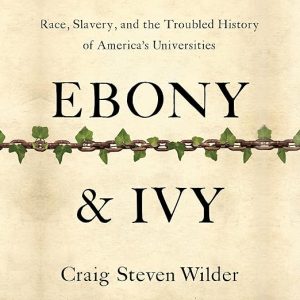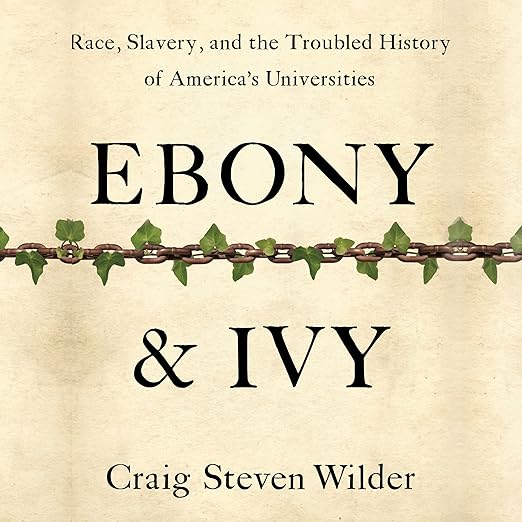
Craig Steven Wilder builds his argument the way a prosecutor builds a case, one institution at a time, until the accumulated pattern becomes impossible to dismiss as coincidence. This audiobook traces how deeply slavery is woven into the founding and financing of America's oldest universities, and it opens from a real, specific trigger: a 2006 report commissioned by Brown University that revealed the school's own entanglement with slavery and set off a controversy that spread well beyond campus. Wilder, described in the material as a rising star in the history profession, uses that Brown report as a launching point rather than an endpoint, widening the lens to Harvard, Yale, Princeton, and beyond across roughly two centuries of American higher education.
Kenneth Medford narrates with a controlled, unrhetorical gravity that turns out to be exactly the right choice for material this disturbing. He does not lean into outrage or perform indignation on the listener's behalf, and that restraint keeps you positioned as a witness working through primary sources rather than an audience being told how to feel about them. Given how easily this kind of institutional-history material could tip into either dry recitation or heavy-handed moralizing, Medford threads a difficult needle across eleven and a half hours, letting Wilder's own carefully accumulated evidence carry the emotional weight instead of adding vocal drama on top of facts that do not need it.
One reviewer, Woodrow Jones, offered a more critical note worth passing along: he found the book strong on primary sources but wanted more specificity about the actual mechanisms of dehumanization and violence involved. That is a fair point to flag going in. Wilder's approach favors institutional and financial documentation, ledgers, correspondence, funding records, over first-person accounts of individual suffering, a defensible scholarly choice that produces a book reading more like an indictment of systems than an intimate account of individual lives, and listeners should calibrate their expectations toward the former rather than the latter.
Universities Produced Racial Science, Beyond Merely Profiting
The book's real scope is broader than its title suggests. Wilder moves well past the usual Ivy League suspects to include Rutgers, Williams College, and the University of North Carolina, building a picture of an entire regional higher-education system rather than a handful of exceptional bad actors. His central argument is the sharper, more uncomfortable one: it is not simply that these schools accepted money connected to slavery, though they did, funding campuses, paying professors, being waited on by enslaved people, but that the intellectual work happening inside them actively produced and legitimized the racial science that justified the system in the first place. That distinction, complicity versus active production, is what gives the book its lasting argumentative weight.
Reviewers responded strongly to the rigor behind that argument. Phillip king called the book 'chock full of constructive information' about how deeply racism and college institutions are intertwined, and frenchiel praised how the book connects past to present without assigning easy blame, describing the scholarship as handled with real dignity. That balance, serious and unflinching without becoming a polemic, is genuinely hard to strike in institutional history, and it is a large part of why this book landed as more than a niche academic title when it was first published. Bloomsbury's involvement as publisher also signals a trade-press ambition for the book to reach general readers, not just specialists in the field.
The title's wordplay is worth pausing on: ivy for the elite institutions themselves, ebony for the enslaved people whose labor and bodies funded them, and the pairing captures the book's central move of refusing to let the two halves of that history stay separated the way official campus narratives often keep them. Brown's 2006 report did not stay an isolated event either; it helped trigger a wave of similar self-examinations at other universities in the years that followed, each one essentially confirming some version of the pattern Wilder documents at a national scale. Listening to this book now, years after that first wave of institutional reckonings, gives a useful vantage point on how much of that momentum translated into lasting change versus how much remained symbolic.
Medford Reads Archival Density With Restraint
This is dense academic nonfiction, built from archival research rather than narrative reconstruction, and the prose reflects that throughout. Listeners more accustomed to popular history's scene-setting and dialogue should expect a different register here: names of trustees, dollar figures, institutional timelines, presented with scholarly precision rather than novelistic flourish. That is not a criticism so much as a calibration note, the eleven and a half hour runtime moves at the pace of careful argument-building rather than page-turning momentum, and trying to consume it the way you would a true-crime audiobook will likely leave you frustrated with a pace that is, by design, deliberate and cumulative rather than propulsive.
The subject matter itself demands a note of caution too. This is sustained, detailed engagement with slavery's mechanics inside institutions many listeners associate with enlightenment and progress, and the dissonance between that association and the documented history is the book's entire point, but it makes for heavy listening delivered without much relief across its runtime. Wilder does not pace the material with lighter interludes the way some popular history authors do to give readers breathing room. Approach this one when you have the mental bandwidth for sustained, serious engagement rather than as background listening for a commute you're only half paying attention to.
Essential for Anyone Tied to These Universities
Readers of institutional-history nonfiction, the kind of book that sits alongside work on redlining, eugenics programs, or corporate complicity in historical injustice, will find this a genuinely essential entry in that shelf. Anyone affiliated with one of the universities named directly, current students, alumni, faculty, has particular reason to engage with this material about their own institution's documented past. General history listeners with an appetite for serious, well-sourced argument over faster narrative pacing will also find plenty to hold their attention, especially given how directly the book connects centuries-old funding structures to intellectual traditions that persisted well into the twentieth century and beyond.
Skip this one if you are looking for narrative popular history with scene-setting and individual character arcs, or if Woodrow Jones's critique about limited specificity on individual suffering would bother you more than it might other listeners. Readers wanting a gentler entry point into this subject matter, or one built more around personal testimony than institutional documentation, might find a different book a better starting place before circling back to Wilder's more systemic approach. For listeners ready for that systemic view, though, Kenneth Medford's steady narration makes a genuinely difficult eleven and a half hours feel worth the sustained attention it demands.
Quick Take
- Performance: Kenneth Medford's restrained, unrhetorical delivery lets disturbing primary-source material speak for itself.
- What it covers: Slavery's ties to higher education, institutional complicity, the origins of racial science.
- Feel: Serious, methodical, and quietly damning.
- Our call: Essential listening for anyone invested in institutional history, delivered with scholarly rigor and real narrative discipline.
Frequently Asked Questions
Does this audiobook cover universities beyond the Ivy League?
Yes, Wilder extends the argument well past Harvard, Yale, and Princeton to include Rutgers, Williams College, and the University of North Carolina.
Is the narration on this audiobook appropriate for such difficult subject matter?
Yes, narrator Kenneth Medford's restrained, unrhetorical delivery is well suited to disturbing primary-source material without tipping into melodrama.
How long is this audiobook and is it dense, academic listening?
It runs eleven hours and thirty-one minutes, and yes, expect scholarly, archival-based prose rather than a narrative popular-history pace.