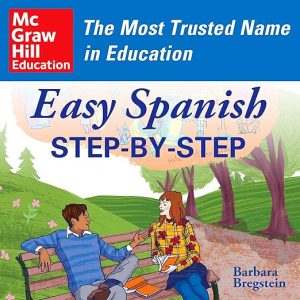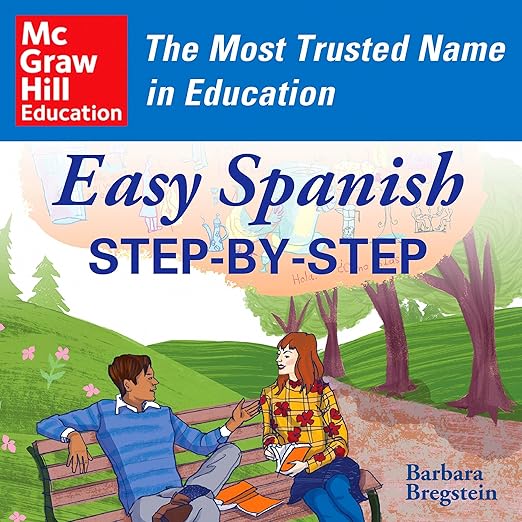
Thirty-seven hours and fifteen minutes is longer than most people spend on an entire semester of high school Spanish, and that scale alone tells you this audiobook was never built for background listening. Easy Spanish Step-by-Step, ranked the top-selling Spanish title on Amazon after more than five thousand four and five star reviews per its own marketing, pairs Barbara Bregstein's grammar-focused instructional design with an audio-first delivery built around speaking out loud from the very first few minutes, not passive absorption. The course fuses two teaching philosophies that do not always coexist comfortably, rigorous grammatical structure and the more organic, child-like acquisition that comes from pure listening and speaking, and the sheer runtime is what makes room for both approaches to actually develop side by side rather than one crowding out the other.
Story and Jorge Share the Teaching Voice
Rachel Story anchors the course as the primary teacher, walking through grammar and structure in clear, instructional English, while Jorge, a native Spanish speaker, supplies the phonetic modeling a synthetic voice or a single non-native narrator could not replicate authentically. That two-voice structure lets a listener hear both the deliberate, classroom-paced Spanish meant for comprehension and, gradually, the faster, more natural rhythm of real spoken Spanish encountered outside a lesson. Reviewer Toni House's advice, 'take your time and follow the steps,' captures the course's whole design philosophy: this builds cumulatively, each section depending on mastery of the last, rather than offering discrete, skippable topics a learner could sample out of order.
The five thousand plus four and five star reviews the course's own marketing cites reflect a track record built up over years, not a recent viral spike, which matters for a course this dense; a method that keeps earning consistent praise at this volume over time has clearly proven itself across a wide range of learning styles and starting points, not just a single enthusiastic cohort. Bregstein herself built the course around a specific pedagogical belief stated directly in the material: that adults can acquire language the way children do, through genuine listening and speaking practice, without abandoning the grammatical rigor adult learners often want and expect from a serious course. Balancing those two philosophies across thirty-seven hours, rather than picking one and committing fully, is the course's most distinctive structural choice.
Iffish Calls It Complete and Well Organized
This is explicitly not a podcast to half-listen to during a commute; the course is built around dynamic practice activities, responding to questions, filling in missing words, giving personal opinions in Spanish, which means real engagement is required rather than optional. Reviewer Jay's brief but pointed praise, 'good book and easy to learn Spanish,' undersells how central that interactivity actually is to the method's effectiveness, though the same short review does flag that it includes exercises too. The course also includes original Spanish stories and poems with comprehension questions built in, giving learners real, connected language to practice against rather than only isolated vocabulary drills, and that narrative material is exactly the kind of content that benefits from being heard aloud, with natural rhythm and intonation, rather than read silently off a page.
The Spanish taught throughout is neutral Latin American Spanish rather than any single regional dialect, a deliberate choice that maximizes usefulness across the largest possible range of real-world listening and conversation situations a learner might encounter later. Reviewer iffish bought the book back in 2016 and did not start working through it until years afterward, then called it 'an very well organized, complete, and smoothly presented overview of essential Spanish,' a review carrying real weight given that same listener describes having 'managed to learn' a 'fair amount of Spanish from a huge range of resources' independently before finally sitting down with this specific course.
Thirty-Seven Hours Punishes Long Study Gaps
Thirty-seven hours is an enormous commitment relative to shorter, app-based language tools many listeners are used to, and this course explicitly is not designed to be finished quickly or casually. The interactive design, pausing to respond aloud, filling in blanks, answering comprehension questions, means a listener genuinely cannot get the full value from passive background play the way a true podcast or narrative audiobook allows; skipping the spoken exercises defeats much of the method's actual purpose. Anyone hoping for a rapid, minimal-effort path to conversational Spanish should recalibrate expectations before starting, since Bregstein's own framing is explicit that real fluency here depends on sustained, active daily practice rather than a single long binge.
The series listing, Easy Step-by-Step, suggests companion titles exist at other levels or in other languages, worth checking before assuming this single thirty-seven-hour course is the complete Bregstein catalog available. No printed workbook or written exercise sheet is bundled with the audio itself, so learners who prefer writing out vocabulary or grammar drills by hand will want a separate notebook running alongside the lessons. The listing carries only three attached reviews despite the strong 4.6 rating, a modest sample for a course this widely marketed, though nothing in those three reviews raises any real concern about the method itself.
Because the course demands sustained daily engagement rather than occasional dipping in, learners who face a long gap, a busy work stretch, travel, illness, may find picking back up harder than with a shorter, more modular program, since the later material leans heavily on recent, active practice with what came before. Building a realistic daily or near-daily schedule before starting is worth doing deliberately rather than assuming motivation alone will carry a listener through thirty-seven hours spread out over what could otherwise become many months of inconsistent, stop-and-start progress.
Passive Listeners Will Find This Frustrating
Motivated beginner and low-intermediate learners ready for a genuinely long-term, active study commitment, not a quick primer, are the ideal audience here. Reviewer iffish's path, years of scattered self-study across many resources before finally working systematically through one complete course, is a useful case study for anyone who has tried and stalled on Spanish before; a single disciplined, cumulative sequence like this one can succeed where scattered app-hopping has not. Anyone planning travel, family reconnection, or workplace communication in Spanish, the exact use cases the course's own framing leans on, will find thirty-seven hours a genuinely worthwhile investment toward real conversational ability.
Learners wanting a five-minute-a-day casual introduction, rather than a serious, cumulative course demanding real time and active participation, should look toward a shorter program instead, since this format punishes skipping around. Passive listeners who want to absorb Spanish in the background while doing something else will also find the interactive design frustrating rather than convenient, since so much of the method depends on speaking answers aloud in real time. And anyone specifically needing a regional Spanish dialect, rather than the neutral Latin American Spanish taught throughout, should confirm that fits their actual purpose before committing thirty-seven hours to this particular course.
- Performance: Rachel Story anchors the instruction in clear English while native speaker Jorge supplies authentic phonetic modeling throughout.
- What it covers: Spanish grammar and conversation, active language acquisition, cumulative long-form study
- Feel: Disciplined, immersive, and demanding
- Our call: One of the more thorough structured Spanish courses in audio, but its thirty-seven-hour, highly interactive format rewards only committed, active learners.