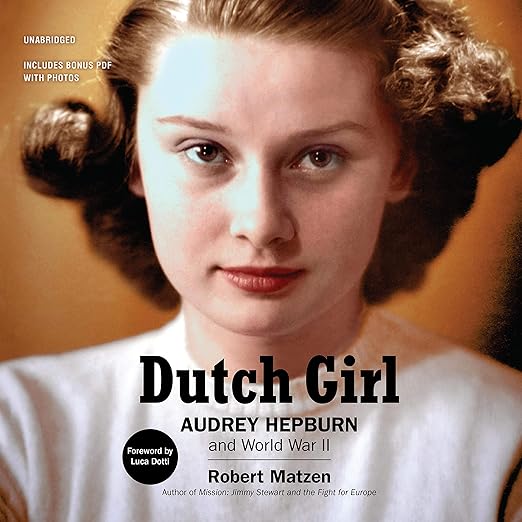
I picked up Dutch Girl on a long flight, which turned out to be the right context for it. There is something about sustained time in transit that makes you willing to receive difficult historical material without the normal impulse to look away. By the time we landed, I had heard Audrey Hepburn's uncle executed, her family torn between collaboration and resistance, and the girl who would become an icon surviving on tulip bulb flour during the Hunger Winter of 1944. I had also heard about the Dutch women who cleaned their windows in the middle of a firefight on their street, which was both darkly funny and somehow more illuminating about national character than a hundred more solemn passages.
Robert Matzen spent years in Dutch archives and interviews to assemble this account of Hepburn's wartime years, roughly 1939 to 1945. What he found was a story far more complicated and far more harrowing than the glamorous biography has generally acknowledged. Her father was a Nazi agent. Her mother was pro-Nazi for the early years of the occupation before adjusting her position. Audrey herself participated in the Dutch Resistance and was present during the Battle of Arnhem. These are not details at the margins of her story; they are the furnace in which her character was formed.
How Dutch Girl Holds Up
Matzen's best work here is the integration of the large historical narrative with the specific human story. He does not just tell you what the Hunger Winter was; he shows you what it cost Audrey specifically and what it cost her family, and then connects it to the observable facts of her adult life, her lifelong anxiety about food scarcity, her commitment to UNICEF's child hunger programs, the quality of watchfulness that her closest collaborators describe. The biographic argument is that the war made her, and Matzen earns that claim rather than simply asserting it.
The book is substantially a WWII history of the Netherlands as much as it is a biography of Hepburn, and one reviewer's observation that Audrey sometimes feels like an afterthought is fair in moments. But this is largely the right call. You cannot understand what the war did to this particular person without understanding what the war actually was for the Dutch, which is a history that has been relatively underrepresented in English-language publishing. The combination serves both stories.
Why Dutch Girl Works as an Audiobook
Tavia Gilbert's narration is well matched to Matzen's measured, research-forward prose style. She reads with the authority of someone who has done the work of understanding the material rather than simply vocalizing it. The pacing across the ten-and-a-half hours is appropriate for narrative nonfiction of this density, unhurried enough that the historical context can settle, but not so slow that the biographical thread gets lost.
Reviewer R. Christian Bohlen, whose own mother grew up in occupied Netherlands, describes the book as successfully capturing the culture and language. That kind of authentication from someone with personal stakes in the accuracy matters. Matzen did the archival work, and Gilbert delivers it with the appropriate weight.
Weak Spots in Dutch Girl
The book's focus on the wartime years means it is not a comprehensive biography. Readers who come to it hoping for thorough coverage of Hepburn's film career, her marriages, or her later humanitarian work will find those subjects briefly addressed at best. This is a tightly focused historical account, not a cradle-to-grave portrait. Approaching it as the latter will produce disappointment; approaching it as an immersive account of five specific formative years will produce something closer to revelation.
Some reviewers note that the writing has occasional passages where the prose feels slightly amateurish. This is an accurate observation in places; Matzen's strengths are in research and historical synthesis rather than in sustained literary prose. Gilbert's narration smooths some of these rougher edges.
The Right Listener for Dutch Girl
Readers interested in WWII history, the Dutch Resistance, and the experience of occupied Western Europe will find this comprehensive and well-researched. Hepburn admirers who want to understand the woman behind the image will find material here that no other biography has assembled in this form. Those who want celebrity biography in the traditional sense, film career, relationships, public life, should look elsewhere. The book rewards readers who are comfortable with the idea that a life's defining chapter might not be the one that made the person famous.
- Narration: Tavia Gilbert brings warmth and steady authority to Matzen's research-heavy narrative; she handles the period material and the biographical passages with equal confidence.
- Themes: Wartime survival and identity, the gap between public legend and private experience, the Dutch Resistance and Nazi occupation
- Mood: Measured and revelatory, occasionally harrowing
- Verdict: An essential corrective to the Hepburn mythology for anyone willing to accept that the war biography is more fully realized than the celebrity biography.
Questions Listeners Ask
Does Dutch Girl cover Audrey Hepburn's film career and personal life, or is it focused only on the war years?
The book is almost entirely focused on the five years of Dutch Nazi occupation, roughly 1940 to 1945. The film career and adult life are addressed in brief framing passages at the beginning and end, but readers expecting substantial coverage of Roman Holiday, Breakfast at Tiffany's, or her marriages will not find it here.
Is the historical material about the Netherlands accessible to readers without prior knowledge of WWII?
Yes. Matzen provides context for the Dutch situation, including the Hunger Winter, the Battle of Arnhem, and the structure of the Dutch Resistance, in ways that do not assume prior knowledge. The book works as an introduction to Dutch wartime history as well as a biography.
How does Tavia Gilbert handle the shifts between historical narrative and personal biography?
Gilbert manages the transitions smoothly. Her narration does not differentiate the registers dramatically, which is appropriate since Matzen integrates the two strands throughout rather than separating them. She brings consistent authority to both the archival material and the personal passages.