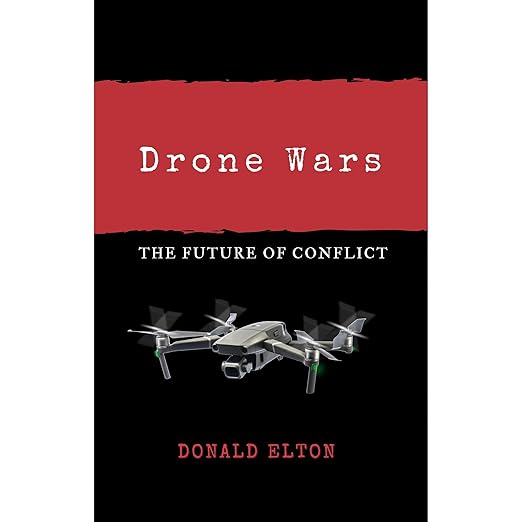
Three questions sit near the middle of the description, and they are the reason this audiobook is not simply a hardware catalog. How do you defend against five-hundred-dollar drones using million-dollar systems? Who bears responsibility when an autonomous drone kills? What happens when artificial intelligence makes decisions faster than humans can respond? Donald Elton puts all three on the page before listing a single capability, and that ordering announces what kind of book this intends to be.
From the Bronze Age to Democratized Drones
Donald Elton's frame is historical before it is technical. The copy runs from the Bronze Age through the nuclear era to argue that revolutions in military technology have always reshaped the societies producing them, then positions unmanned systems as the next entry in that sequence. It is a familiar move and it does useful work, stopping the subject from reading as gadget journalism and forcing a listener to treat cheap airframes as a structural change rather than a novelty. Whether you accept the comparison or not, it establishes the register early and keeps the book from collapsing into a parade of specifications.
Bronze Age comparisons are easy to make and hard to earn, so the specific claim matters more than the sweep. What the copy actually argues is democratization: capabilities once restricted to superpowers now sit within reach of insurgents, terrorists, criminal cartels and individuals acting alone. That is a proliferation argument rather than a technology argument, and it is the strongest and most consequential idea on offer in the entire description.
Ukraine and the Middle East supply the case studies, and the copy lists four distinct applications drawn from them: surveillance, assassination, psychological warfare and propaganda. Only one of those four is kinetic. Anyone whose mental model of drone warfare stops at a missile strike will find the psychological and propaganda material the more disorienting half of the book, and that is the ground where a title published in 2025 contributes most, since the propaganda uses postdate much of the standing literature.
Cost Asymmetry Is the Sharpest Idea Here
Democratization of a weapon system is a policy problem before it is an engineering one, and that is where the audio format earns its place. The technical explanations promised in the copy, covering artificial intelligence, sensor fusion, swarm tactics and cheap commercial innovation, are conceptual rather than mathematical. Nothing about them requires a diagram on a page, which means the argument survives being heard rather than read without losing its force.
Cost asymmetry is the sharpest idea here, and the copy poses it as a question rather than pretending to answer it. Defending against an inexpensive airframe with an expensive interceptor is an arithmetic problem that no amount of technological superiority resolves, and it explains why this subject has migrated from defense journals into general interest publishing. It is also the passage most likely to stay with a listener a week later.
Naming a Mechanism, Then Its Consequence
Autonomy supplies the ethical core, and the description does not dodge it. Assigning responsibility for a killing no person ordered is the question the whole literature circles, and posing it directly alongside the question about machines deciding faster than people can respond puts accountability and tempo inside the same frame. That pairing is the correct one, because speed is precisely what turns the responsibility question from an academic exercise into an urgent one. A decision loop faster than human review is not a philosophical puzzle, it is an operational condition, and the copy treats it as such.
Swarm tactics get named in the copy without being unpacked, and that is representative of the method throughout: name a mechanism, then ask what the mechanism does to the people on the receiving end of it. For a listener that ordering is a gift, because the strategic consequence survives a single pass while a technical specification would not. The description promises clear technical explanation, and clear here appears to mean sufficient rather than exhaustive, which is the right call for a general audience.
Ten Hours, Synthesized Straight From the Text
Four ratings sit on this entry, averaging five stars, with no written responses attached to any of them. That average carries a hard consequence worth stating: across four votes, a displayed five requires every single vote to be a five, since one four-star rating would drag the figure below it. The result is clean, extremely thin, and tells you nothing whatsoever about whether the argument holds together.
Synthesized narration deserves attention before buying, too. Virtual Voice occupies the slot where a performer name would normally appear, so the audio was synthesized straight from the text, and this is a ten-hour argument built from case studies, acronyms, place names and technical vocabulary. Plan on backing up over passages, and expect to do more of the structural work yourself than you would with a performed reading. The copy's organization is clear enough to make that workable.
Subtitle trouble is worth flagging too. The description calls the book Drone Wars: The Future of Conflict, while the entry calls it Drone Wars and nothing else. A missing subtitle is a small thing until you try to search for the title again later, and it belongs to the same category of small gaps as the empty series information, suggesting the listing was assembled in a hurry rather than proofed.
Policy Questions Matter More Than Hardware Specs
Defense-adjacent professionals are the audience the copy names outright: military professionals, policymakers, technologists and defense journalists. For that group this functions as a synthesis rather than a revelation, valuable mainly for the way it organizes familiar material around cost and accountability instead of around platforms and specifications. Anyone who reads the trade press regularly will recognize the case studies and should come for the framing.
Casual listeners curious about how wars are actually changing will get more from this than the stated audience list implies, because the historical framing does genuine work for someone starting cold. What nobody should expect is neutrality about the conclusion. The copy states its position in the closing line without hedging, insisting that the subject is not science fiction and has already arrived, which sets the tone throughout.
Policy questions rather than hardware are what this exists for. The four unwritten five-star ratings tell you nothing useful, the missing subtitle says more about the listing than about the book, and the argument about cheap weapons defeating expensive defenses is the reason to spend the hours. Read it as a synthesis of where the subject stands rather than as reporting, and it holds up.
Quick Take
- Big ideas: Drone proliferation and democratized warfare, autonomous weapons and accountability, cost asymmetry in defense
- Atmosphere: Urgent, argumentative and unhedged
- Worth it?: Strong on the policy questions, thin on independent verification from other listeners.
Frequently Asked Questions
Does Drone Wars require a military or technical background?
None is needed. The copy promises clear explanation rather than engineering specification, and concepts such as sensor fusion and swarm behavior arrive described rather than modeled. The long historical run-up, from ancient weapons through the nuclear age, exists to orient anyone arriving without a defense background.
What ground does the audiobook cover beyond the technology?
Case material drawn from Ukraine and the wider Middle East, covering reconnaissance, targeted killing, and the use of footage as a weapon of persuasion. Alongside those sit sustained questions about cheap threats defeating expensive defenses and about who answers when a machine decides on its own.
Is ten hours a lot for this subject in audiobook form?
The argument is conceptual rather than chart-dependent, so nothing essential lives in a diagram you cannot see, which suits listening well. The length is real, though, and the credit names a synthesis engine rather than a performer, so budget for replaying the denser case material more than once.