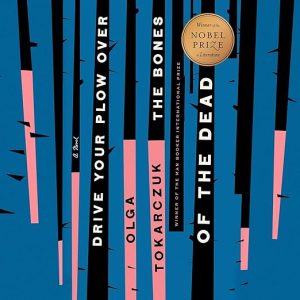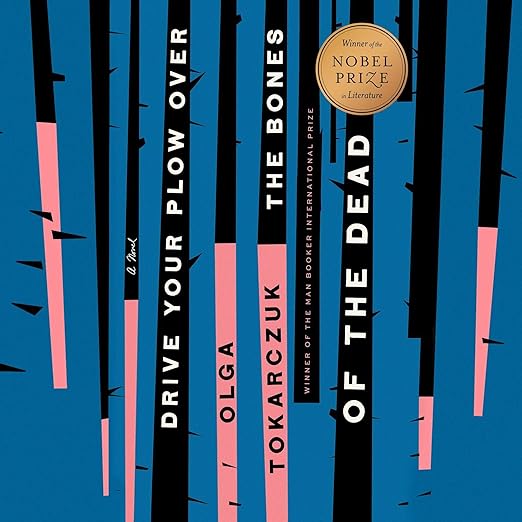
I started Drive Your Plow Over the Bones of the Dead on a gray Saturday morning in November, sitting at my kitchen table with coffee going cold beside me. I had been meaning to read Olga Tokarczuk for years, and when the audiobook landed in my queue I figured a murder mystery by a Nobel Prize winner was as good a place to start as any. Eleven and a half hours later I was doing dishes and still turning the book's central questions over in my head. That rarely happens with crime fiction.
The novel is built around Janina Duszejko, an older woman living year-round in a remote Polish village near the Czech border. She is, by the village's standards, a crank: she translates William Blake into Polish, takes astrology seriously enough to cast the horoscopes of people she dislikes, and makes no secret of her preference for the company of animals over humans. When her neighbor, a man known only as Big Foot, turns up dead, more bodies follow, and Janina becomes increasingly convinced she knows who, or what, is responsible. The police and local authorities dismiss her. The reader, stuck inside her first-person perspective, has to decide what to believe.
How Drive Your Plow Over the Bones of the Dead Holds Up
What Tokarczuk is doing here is considerably more layered than the murder mystery structure suggests. This is a novel about whose voices get taken seriously, about the violence humans visit on animals and on each other, and about what justice looks like when the official systems have decided to look away. Janina's obsession with animal rights is not incidental. The novel's moral argument hangs on it. The victims are hunters. Janina's grief over the deaths of her two dogs precedes and exceeds her grief for any of the human casualties. Tokarczuk makes this feel completely coherent within the world Janina inhabits, which is itself a significant achievement.
The Blake epigraph that gives the book its title comes from The Marriage of Heaven and Hell, and it does real work. Tokarczuk is interested in transgression as a path to something, not just transgression for its own sake. One reviewer described Janina as a loveable sociopath, which is both accurate and reductive. She is a character who has built a complete moral system that simply does not align with the one society runs on, and the novel's dark comedy comes from watching her navigate that gap with complete sincerity.
Why Drive Your Plow Over the Bones of the Dead Works as an Audiobook
Beata Pozniak's performance is a significant part of the experience. She delivers Janina's narration with a bone-dry quality that matches the character's self-possession. Janina is never shrill, never melodramatic, and Pozniak honors that. She reads the Polish setting and the rhythm of Antonia Lloyd-Jones's translation with a naturalness that grounds the eccentric material. There are moments where Janina says something genuinely funny and Pozniak lets it sit without winking at the listener, which is exactly right.
At eleven and a half hours, the audiobook rewards patience. This is not a propulsive thriller. The investigation moves at Janina's pace, which is philosophical and circuitous. Some listeners who came in expecting tight genre plotting found themselves frustrated. One review described the prose stylization as throwing them out of the narrative. That reaction is fair but tells you something about fit: if you want clean plot mechanics, this will resist you. If you want a narrator whose perception of the world feels genuinely alien and yet morally coherent, this is hard to put down.
Weak Spots in Drive Your Plow Over the Bones of the Dead
The novel's deepest pleasures are structural and thematic rather than procedural. Pay attention to Janina's astrology practice, which is not ornamental. She maps the horoscopes of the victims and uses them as interpretive tools. This would be absurdist if Tokarczuk didn't commit to it so seriously, and because she does, it functions as one of the book's recurring questions: who gets to decide what counts as valid knowledge? The police's rational proceduralism fails to solve anything. Janina's eccentric methods do not fail in the same way.
The ending will divide listeners. It is not a tidy resolution. One reviewer noted that after significant buildup, the climax felt more deus ex machina than earned. I disagree with that reading but understand it. Tokarczuk is not withholding a twist as a payoff; she is delivering a conclusion that is morally coherent within Janina's world even if it is uncomfortable within ours. The challenge is accepting that the novel's logic has been Janina's all along, and the reader has been inside that logic for nearly twelve hours.
The Right Listener for Drive Your Plow Over the Bones of the Dead
Readers drawn to literary crime fiction in the tradition of Donna Tartt or Jean-Baptiste Del Amo will find this deeply satisfying. Listeners interested in animal ethics, feminist philosophy, or Polish literature will find Tokarczuk's voice essential. The audiobook is also an excellent entry point into her work before tackling the longer, more structurally demanding Flights or The Books of Jacob.
Those expecting a conventional thriller with a clean investigative arc should adjust expectations considerably. The novel's comedy is dark and its worldview is uncompromising. It will frustrate listeners who want a mystery to be solved and closed. For everyone else, Beata Pozniak and an eleven-hour winter afternoon is a combination worth clearing your schedule for.
- Narration: Beata Pozniak brings a genuine Polish sensibility to Janina's eccentric first-person voice - her delivery captures both the character's dry comedy and her underlying sorrow without overplaying either.
- Themes: Justice and morality outside the law, aging women and social invisibility, human violence toward animals
- Mood: Darkly comedic, melancholic, quietly unsettling
- Verdict: A Nobel laureate's literary crime novel that works precisely because it refuses to be a genre thriller - best for readers who want their mysteries to leave them thinking rather than resolved.
Is Drive Your Plow Over the Bones of the Dead actually a murder mystery, or is it literary fiction using the mystery form?
Both, deliberately. Tokarczuk uses the mystery structure as a scaffold for a philosophical novel about justice, animal rights, and whose moral framework gets treated as legitimate. The mystery is real but the resolution is not the point.
How does Beata Pozniak handle Janina's eccentric first-person narration in the audiobook?
Pozniak plays Janina with dry, unsentimental precision. She never overacts the character's eccentricities, which is the right call. Janina's interior logic is delivered as earnest and self-possessed, not as comedy to be telegraphed, and that restraint makes the dark humor land harder.
Does the novel's ending feel satisfying, or does it leave things unresolved?
The ending is conclusive but not comfortable. It resolves the murder plot in a way that is morally consistent with Janina's worldview rather than socially reassuring. Readers who accept the novel's internal logic will find it earned; readers expecting genre closure may feel it arrives too abruptly.