Before You Press Play
- Big ideas: Therapy-session comedy, revival and continuity, stand-up craft, comfort listening
- Atmosphere: Loose and digressive, comedy built as company rather than assault
- Worth it?: A generous ensemble comedy recording that rewards existing affection for the show and offers newcomers a poor starting point.
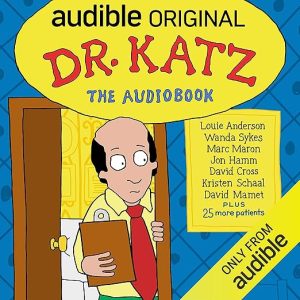
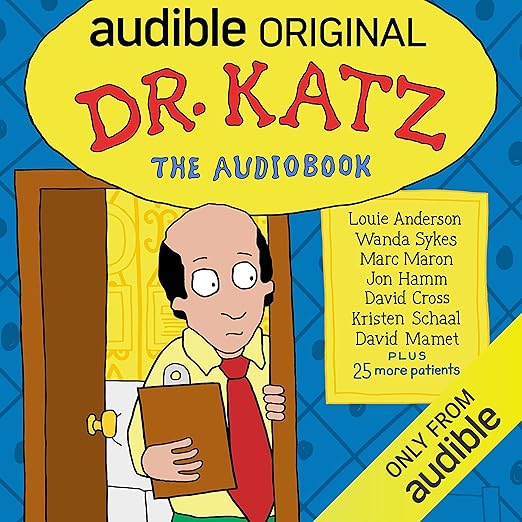
Jonathan Katz built a comedy around the idea that a therapist's office is the best excuse ever devised for letting other comedians talk, and this audiobook runs on that engine for six and a half hours. The listing names no narrator because the recording has none. What arrives instead is a cast list running past thirty performers, from Jon Hamm and Wanda Sykes to David Mamet, and the format has never needed a single reader to hold it together.
No Narrator Credit Because None Is Needed
An empty narrator credit usually signals missing information. Here it signals the opposite: an ensemble product where naming one voice would misrepresent the thing entirely. The description supplies a performer list where a reader would normally be named, which is the correct call. This is a comedy recording built from sessions, and the whole design depends on a rotating cast of visitors rather than on one interpreter carrying somebody else's prose.
The reunion is the headline. Katz is back, and so are the two voices the description frames him with: H. Jon Benjamin returns in the role of his son Ben, with Laura Silverman on reception as Laura. The description roots the whole thing in Dr. Katz: Professional Therapist, which it calls "Emmy and Peabody Award winning". A new set of recurring characters arrives alongside them, with Dom Irrera, Erica Rhodes, Rick Overton and Laura Kightlinger taking those roles on. That combination of continuity and fresh blood is precisely what a revival needs if it is going to be more than a nostalgia exercise.
One listener, posting as brycehogland, gives the clearest account of what you are actually getting, describing the book as partially new episodes of "sessions with great comedians" and then noting that "The latter portion are live sets with even more awesome guests!" That two-part structure is the single most useful fact about this release and it appears nowhere in the publisher's copy. Knowing the second half changes shape is worth more than any amount of description about the premise.
Comfort Comedy Built From a Rotating Guest List
The guest list alone justifies a look. Marc Maron, Cheryl Hines, Kevin Nealon, Rachel Dratch, Todd Barry, Kristen Schaal, David Cross, Paula Poundstone, Seth Green, Jen Kirkman, Colin Quinn, Kyle Kinane, Susie Essman, Baron Vaughn, Gilbert Gottfried, Kate Micucci, Greg Proops, Bob Saget, Demetri Martin, Scott Thompson and Fred Willard all turn up, among others. That is a genuinely wide sweep of American comedy across several generations, and brycehogland singles out Jenny Slate and Paul F. Tompkins as "big highlights".
The register is the reason people keep returning. Another reviewer describes watching for over twenty years and revisiting every few years, and puts a finger on the appeal precisely: the show has "a soothing effect" for that listener, largely because it "brings me back to a simpler time". The comment is about the series rather than this recording, and it breaks off there. Comedy that works as comfort is rarer than it sounds. Most of it depends on surprise, which decays; this depends on rhythm and familiarity, which do not.
Repeat Listening Is the Real Test Here
Six and a half hours is generous for comedy, and nothing carries over between sessions to punish you for stopping. Buck YountZ offers the least analytical and most persuasive verdict of the three, reporting a recording used to laugh at, listened to several times already, with several more listens expected. Repeat listening is the real test of a comedy recording, and one that most stand-up specials fail badly once you know the punchlines.
The distributed authorship is worth understanding before you start, because it explains the unevenness. A format where every visitor brings their own jokes means the writing changes hands each session, and the quality of any given stretch depends entirely on who is in the chair and what they brought with them. That is less a flaw than the bargain the format strikes. Across a run of this length you are trading consistency for range, and a session that does not land is over in minutes.
Therapy-Session Pacing Rewards Listening in Portions
Almost nobody has weighed in. Eight ratings sit behind that 4.8 average, which is a small enough pool that a single dissenting listener would move the number noticeably. Read it as an enthusiast sample from people who already knew what they were buying, and not as a verdict. Nothing about the score is dishonest, but it carries far less weight than a four-figure tally of ratings would, and it deserves to be treated accordingly.
Entry point matters more than usual here. One reviewer reports that it is considered the "2nd season", and the sentence is cut off there, so treat it as that listener's framing rather than as a settled fact. The description opens by saying the doctor is back and points to the earlier series, without naming a predecessor volume. If an earlier installment does exist, it would be worth looking for before committing to this one. The same reviewer frames it as an addition for people who enjoyed the earlier show, which is telling.
The pace deserves a warning of its own. A therapy session is a slow container by design, and the pleasure on offer looks like company and timing rather than a steady supply of punchlines. Arriving expecting joke-dense stand-up would be a mistake. It also plays much better in portions than in one long sitting, and I would treat six and a half hours as a couple of weeks of listening rather than an afternoon.
Anyone who listens to conversational comedy podcasts will recognize the rhythm here instantly, and that recognition cuts in two directions at once. It makes the format feel current rather than dated, because the loose host-and-guest shape is now everywhere. It also means the recording competes with an enormous quantity of free material built the same way, so the case for buying this one rests on the specific cast, the character framework around Ben and Laura, and whatever affection you already carry for the original show.
Not a Book Read to You by Anyone
Buy this if you already know the show and want more of it, or if you follow enough of the named comedians that a rotating guest format is its own reward. It suits background listening better than most comedy, because a session format rarely demands the whole of your attention and gives you natural places to rejoin after drifting.
The people who will bounce off it are newcomers hoping for a clean introduction, listeners who need structure and momentum, and anyone who wants a performance from a single voice they can settle into. No single voice is on offer here, and it is worth saying plainly rather than leaving you to discover it: this is a room full of comedians rather than a book being read to you, and buying it expecting the latter would be a genuine mistake.
A Few Questions About Dr. Katz: The Audiobook
Why does this audiobook have no narrator credit?
Because it has no narrator. This is an ensemble comedy recording rather than a book read aloud, so the description supplies a performer list of more than thirty comedians in place of a reader. The absent credit is a format feature rather than an omission, and the cast list tells you everything a reader name would.
Is this audiobook the right place to start with Dr. Katz?
Probably not. One reviewer reports it is considered the second season, though the comment breaks off mid-sentence. The description points back to the earlier series without naming a predecessor volume. If you want the beginning, it is worth checking whether an earlier installment exists before buying this one.