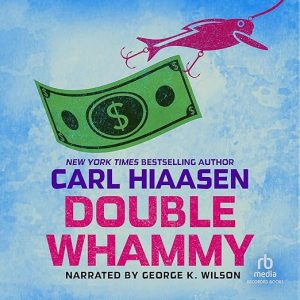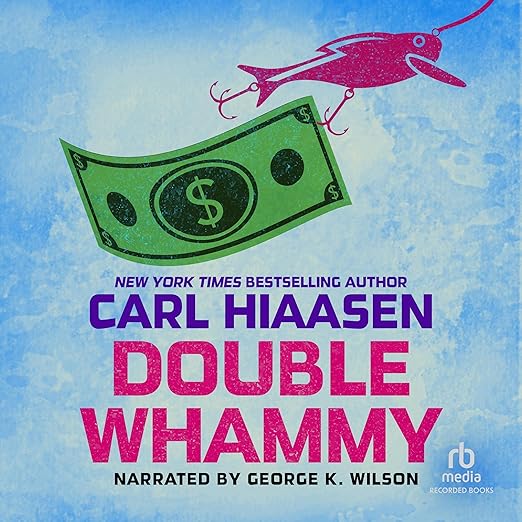
Carl Hiaasen writing about professional bass fishing tournament corruption is, in retrospect, the only logical thing for Carl Hiaasen to have written. Double Whammy, the audiobook that introduces the recurring character Skink, arrives with George K. Wilson doing the narration honors, and Wilson knows this territory: he has voiced multiple Hiaasen novels, which means he understands that the rhythm of a Hiaasen sentence is almost as important as its content. The setup involves a corpse in Coon Bog, a novice private investigator named R.J. Decker, and the kind of high-stakes bass fishing tournament where contestants will apparently do anything to win. That's a Hiaasen premise in its purest form.
Where This One Lands
Hiaasen has been staking out Florida noir territory since the 1980s, and this novel, which predates Stormy Weather and Strip Tease, shows the formula in its early, gleefully unrestrained form. The villains are venal and vivid. The hero is reluctant and compromised. The setting is a version of Florida that is both completely recognizable and cartoonishly heightened, where corruption runs from bass fishing circuits all the way up and where the only reliable moral authority is a hermit named Skink who eats roadkill. One reviewer described the book as impossible for Hiaasen to write without it being brutally entertaining, which is an accurate characterization of what it feels like to be inside a Hiaasen novel for thirteen hours.
The supporting cast around Decker and Skink is exactly as populated with grotesques as you would expect. The lures, loot, and armed pit bull mentioned in the synopsis are not decorative details but load-bearing elements of the plot, each one contributing to the accumulation of absurdity that Hiaasen manages to keep coherent all the way to an ending that one reviewer described as memorable though rather confusing. That slight confusion is a feature of Hiaasen endings, which tend to resolve with a kind of chaotic justice that mirrors the chaos that preceded them.
The novel's environmental subtext is more present than Hiaasen's comic surface suggests. The bass fishing tournament is corrupt not just because the participants are greedy but because the entire apparatus of competitive fishing has been built on a foundation of ecological exploitation and monetized nature. Hiaasen's rage at what has been done to Florida's waterways and wilderness runs under the humor like a current, surfacing occasionally in Skink's particular brand of ecological fury. That dimension gives the book a moral weight that pure farce would lack, and it explains why readers who might otherwise dismiss the comedy as lightweight find themselves caring about the outcome.
Why Listen to Double Whammy
At 13 hours and 32 minutes, this is a substantial audiobook for a crime novel, but Hiaasen's plotting is dense enough to justify the length. Wilson's narration is a genuine asset. His voice work on Skink in particular captures the character's half-mad hermit energy without tipping into caricature, which is a meaningful achievement given how easily such a character could become a performance rather than a person. The distinction between Decker's weary professionalism and Skink's feral intensity is handled with consistent tonal differentiation throughout.
The novel was written in the 1980s, which means some of the cultural texture is dated, but Hiaasen's satirical targets, tournament culture, the monetization of nature, Florida's particular brand of civic dysfunction, have not aged out of relevance. One reviewer noted that despite being written a long time ago, the book reads as current in today's climate, which suggests that either Hiaasen was prescient or that Florida has simply remained consistent. Probably both.
George K. Wilson's familiarity with Hiaasen's material shows most clearly in the supporting cast. The ecosystem of minor characters that surrounds Decker and Skink, each one more specifically Florida-grotesque than the last, requires a narrator who can differentiate voices without resorting to caricature. Wilson walks that line consistently. The armed pit bull, the tournament officials, the various lackeys and operators who populate the bass fishing world all land as distinct presences rather than background noise, which is essential for a plot that requires you to keep track of who is cheating whom and to what end.
What Gives Us Pause
Skink, who appears here for the first time in the series, is the character most readers and listeners return to. His particular combination of ecological rage, personal chaos, and unexpected honor makes him one of the more compelling recurring figures in American crime fiction, and hearing him introduced in his original context adds a layer of interest for readers who have encountered him in later Hiaasen novels. The Dynamic between Skink and Decker, a partnership built on mutual bewilderment, drives the novel's emotional core under all the comedic scaffolding.
Listeners who prefer clean moral geometries in crime fiction will find Hiaasen frustrating. There are, as one reviewer put it, no real good guys here, and the resolution of the fishing tournament corruption does not deliver the kind of satisfying institutional justice that tidier crime novels promise. Hiaasen's moral universe operates on a different frequency, one where the best you can hope for is that the bad guys get something resembling their just desserts in a sufficiently unpredictable way.
Who Should Pick Up Double Whammy
Hiaasen readers who have not yet worked back to his earlier novels will find this a rewarding origin point for the Skink storyline that runs through multiple books in his catalog. Crime fiction listeners who find the genre too earnest will appreciate Hiaasen's refusal to take any of it entirely seriously. Anyone with a taste for regional American satire, particularly the Southern Gothic variety that uses ecological anxiety and institutional absurdity as its raw material, will be well served here. Listeners who need protagonists they can admire without qualification, or who want their crime solved in emotionally satisfying ways, should look elsewhere in the genre.