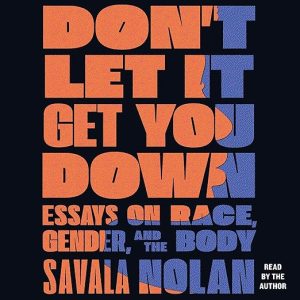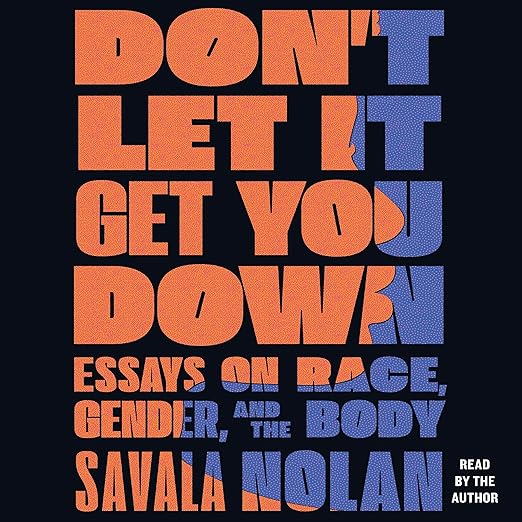
The prose in this audiobook announces itself immediately: Savala Nolan's sentences have weight and rhythm, the kind that rewards a second read even as the first carries you forward. Don't Let It Get You Down is a collection of twelve essays that operate in the space between personal testimony and cultural analysis, between memoir and argument. The NYT Book Review's description of it as 'brutal, beautifully rendered' is not hyperbole. Nolan is writing from a position that resists easy categorization, and she has constructed a prose style to match.
An Essay That Moves Like Jazz, Never Like a Thesis
Nolan's subject is the in-between, the liminal condition of existing at the intersection of Black and white, rich and poor, thin and fat, without secure citizenship in any of those territories. This is not new ground in American personal essayism, but Nolan brings to it a specificity that makes the familiar feel freshly excavated. Her mixed-race identity, descended from a Black and Mexican father and a white mother, gives her a vantage point that is both insider and outsider to multiple communities simultaneously. She does not romanticize this position. She describes it with clear eyes and considers its costs.
The essay 'On Dating White Guys While Me' is among the collection's most startling. Nolan's realization that her early romantic patterns were expressions of self-erasure rather than genuine preference arrives with the force of belated recognition, the kind that reshapes understanding of one's own past. She does not moralize about this discovery; she simply renders it with precision and allows the reader to sit with its implications.
The titular essay excavates Black experience in America with a scope that risks diffusion but achieves density instead. Moving from police brutality to the particular stigma attached to 'large Black females' to the weight that Black men carry as a function of other people's fear, Nolan connects these experiences not through argument but through accumulation. The essay operates like jazz rather than like a thesis: structured, but responsive to its own momentum.
Ancestors Who Owned the Women She Writes About
'To Wit and Also' is the collection's most formally ambitious piece, tracing the enslaved women Filliss, Grace, and Peggy, who were owned by Nolan's white ancestors. The confrontation with this knowledge, that America's original sin lives not abstractly in history but intimately within her own family story, is handled without sentimentality and without false resolution. Nolan does not pretend to have made peace with what she has found. She simply names it.
Across twelve essays, Nolan maintains the same quality of attention, which is what distinguishes a collection from a miscellany. These pieces accumulate meaning in relation to each other. The body politics of one essay reverberate in the racial dynamics of another; the class analysis of a third illuminates the gender observations of a fourth. By the end, readers will have a coherent, fully inhabited sense of the world Nolan moves through and the costs of moving through it as she does.
The comparison to Kiese Laymon's Heavy and Roxane Gay's Bad Feminist is apt but not limiting. Nolan's voice is distinctly her own, less confessional than Laymon's, more personal than Gay's. She occupies the literary space between those two poles and maps territory that neither has claimed entirely.
Sentences Written for a Spoken Cadence
Nolan narrates her own collection, and this decision is not incidental. The essays are written to be heard, with rhythmic sentences and a cadence that suggests spoken thought rather than written argument. Her voice carries the authority of someone who has lived inside these subjects, not merely researched them. When she reads 'Don't Let It Get You Down,' the emotional register shifts in real time, not performed but genuinely inhabited. This is what self-narrated memoir can achieve when the writer is also a natural speaker, and Nolan is both.
The listening experience also heightens the collection's tonal range. Nolan is funny, and the audio format lets that humor land with the timing it requires. The lyrical passages carry differently when heard rather than read on the page, the rhythm becomes audible rather than inferred. At under seven hours, the collection is a sustained but manageable listening commitment.
Trained to Internalize Rage, With No Triumph
Nolan's essays do not offer resolution. This is not a collection built toward comfort or uplift. Readers who want personal essays to deliver lesson-learned conclusions will find Nolan's endings unsatisfying in the most productive sense: she refuses to tidily close what she has so rigorously opened. 'Bad Education,' for instance, examines how women are trained to internalize rage and accept violence, and it ends not with triumph but with the ongoing fact of the training. This is honest, and it is the right choice, but readers should enter knowing the emotional territory will not be fully settled when the final essay ends.
Some of these essays are dense with historical and political context. Listeners who prefer lighter memoir fare should know that Nolan is writing in a tradition that includes scholarship alongside personal narrative, and the essays occasionally require sustained attention to follow her argument through to its conclusion.
Self-Narration Worth Choosing Over the Print Edition
Readers who found Heavy by Kiese Laymon or Bad Feminist by Roxane Gay essential will recognize in Nolan a peer rather than a follower. Her collection belongs in conversation with those books without being derivative of either. Listeners drawn to intersectional analysis rendered in personal narrative form, to the essay tradition at its most rigorous and most personal, will find Don't Let It Get You Down exactly what it promises to be: unflinching, carefully made, and worth the discomfort it asks of its audience. The self-narration makes this an audiobook worth prioritizing over the print edition if you have the choice.
The Short Version
- Read by: Savala Nolan narrates her own essays, and the result is exceptional; her timing and tonal range make the audio format the preferred way to experience this collection.
- At its heart: Mixed-race identity, body politics, class mobility, gender and rage, and America's inherited violence.
- Vibe: Lyrical and rigorous; alternately funny and devastating, always honest, never consoling.
- Short version: A significant debut essay collection that earns its comparisons to Laymon and Gay while staking out its own distinctive territory.