In Brief
- Performance: Helen Laser handles Confino's sharp period dialogue with restraint and good comedic timing, letting the material breathe rather than performing for effect.
- What it covers: Female autonomy and social constraint, generational mentorship, the cost of conformity in mid-century America
- Feel: Warm and wry with a genuine emotional undertow
- Our call: A precisely observed two-hander set in 1960 that earns its emotional resolution through character rather than sentiment.
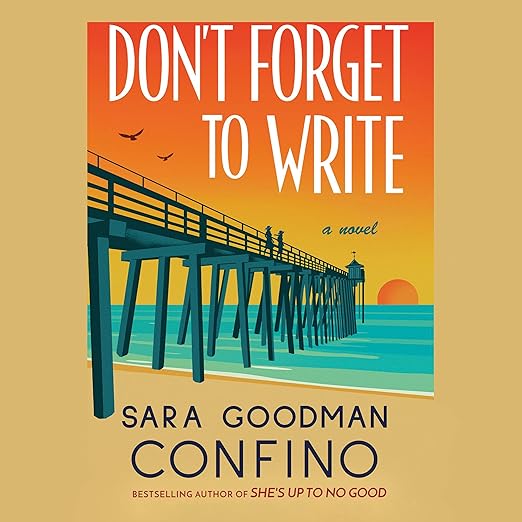
Sara Goodman Confino's craft as a novelist shines from the very first scene of this audiobook, and Helen Laser's narration captures it cleanly. Don't Forget to Write is a 1960-set coming-of-age story about Marilyn Kleinman, a young Jewish woman from Philadelphia whose romantic indiscretion at synagogue earns her a summer exile to her great-aunt Ada's care. The premise sounds like a gentle period comedy, but what Confino actually builds is more layered than that: a portrait of two women across generations figuring out, quietly and not always painlessly, what kind of lives they're willing to settle for.
What We Made of It
The novel's central relationship is its engine. Ada is not the severe matchmaker Marilyn's mother promised. She has platinum-blonde hair, an Hermes scarf, drives a Cadillac convertible, and runs her matchmaking business with both rigorous professionalism and a private flexibility she never quite explains. What Confino achieves with Ada is a character who holds real contradictions without becoming a walking paradox. She enforces the social rules of her era while quietly bending them at the edges, and Marilyn watches that closely enough to start questioning the rules herself.
Marilyn is the kind of protagonist readers of mid-century fiction will recognize as a type but experience here as a specific person. She is sharp and restless and funny in a way that does not always endear her to the people around her. Her mother ships her off precisely because Marilyn is too much. Ada, to her credit, recognizes that energy as something worth redirecting rather than suppressing. The Jersey Shore setting for their summer together is well-used: it has the warm, enclosed quality that lets a story breathe, and Confino deploys it for both comedy and quiet revelation.
Readers familiar with Confino's earlier novel She's Up to No Good will find the same generational female dynamic at work here, but Don't Forget to Write sharpens that focus considerably. The 1960 setting is not decorative nostalgia. It serves a specific purpose: the choice Marilyn faces at the novel's close, between the comfortable life her family has arranged and the riskier self-determined path she cannot stop imagining, carries real stakes that would land differently in any other decade. This is a story that depends on its era, and Confino earns that dependence.
The Best Parts of Don't Forget to Write
Helen Laser's performance is well-matched to this material. Confino's dialogue has rhythm and crispness, and Laser handles the generational contrast between Marilyn's impatience and Ada's controlled wit without exaggerating either. The comedy lands cleanly, which is not automatic in period fiction that depends on social irony. Laser does not push for laughs. She lets the lines do their own work, and they do. At nine hours and two minutes, the pacing is comfortable without feeling padded. There are no chapters that exist simply to fill space.
One reviewer noted that the main characters feel "a bit shallow in development," and there is something to that. Certain secondary figures, particularly the eligible matches Ada vets at the Jersey Shore, remain sketched rather than fully drawn. The novel is built tightly around Marilyn and Ada, and everything else orbits them at a slight distance. For listeners who like ensemble texture alongside a central relationship, that narrowness is worth knowing. For listeners who want a precisely observed two-hander with a satisfying emotional arc, it is exactly what the book promises.
What Might Not Land
Pay attention to how Ada runs her matchmaking business. It is easy to read those scenes as professional background color, but they carry the novel's thematic weight. Ada's job is, at its surface, to align women with the futures their families and communities have designated for them. What she actually does, as Marilyn observes it up close, is far more complicated. Ada has opinions about suitability that do not always match the conventional calculus. Marilyn begins to notice the gap between Ada's stated rules and her practiced judgment, and that gap does more to shift Marilyn's thinking than any explicit conversation between them.
The novel's ending has been praised for its emotional honesty. It does not resolve every tension it raises. Marilyn's father's ultimatum, disinheritance if she refuses to come home and marry appropriately, is treated with the weight it deserves in a story set in 1960. Confino does not soften it to make the conclusion feel easier than it is. What Marilyn chooses matters because the alternative is genuinely costly. That is rarer in period coming-of-age fiction than it should be. The final chapters are where Laser's restraint as a narrator pays the biggest dividend: she trusts the writing, and the writing earns that trust.
Who Should Listen to Don't Forget to Write
This audiobook is well-suited to listeners who enjoy literary women's fiction set in mid-century America, particularly those with an appetite for precise social comedy and character relationships that reward attention. Fans of Fiona Davis's period-set novels or the quieter registers of Mary Ann Shaffer's work will find familiar pleasures here. Listeners who prefer plot-driven narratives with multiple subplots or sprawling ensemble casts may find the novel's tight focus limiting. The humor is dry and observational rather than broad, so listeners who want something louder and more farcical in their period comedy should look elsewhere. Those who like it will find it genuinely funny, emotionally satisfying, and narrated with steady, confident skill. Confino's name is one worth watching in this tradition.