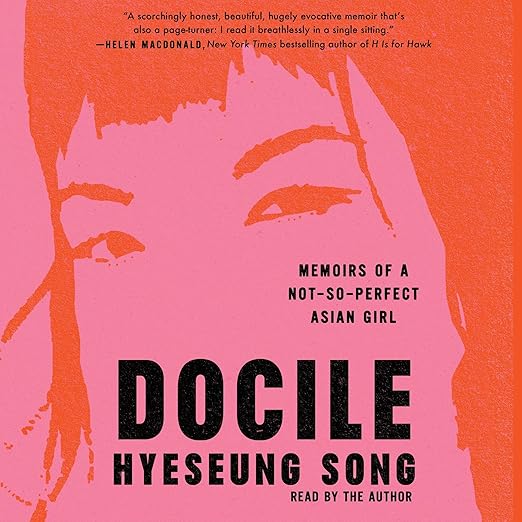
Hyeseung Song narrating her own memoir is the only version of Docile that makes complete sense, because the book is precisely about learning to speak in your own voice after years of ventriloquism, of saying what your parents needed to hear, what your institutions expected, what the model minority script demanded. Song's narration has the quality of someone working through something in real time rather than delivering a polished performance, and that quality is a strength, not a rough edge. This audiobook lands differently than the print edition because Song's actual voice carries the weight of everything the prose describes.
More Korean Words for Hatred Than for Love
The memoir opens in the cane fields of Texas, where Song's Korean immigrant parents are running a fake Gucci business that will eventually end in bankruptcy. Her father chases a particular American fantasy of Big Money. Her mother is domineering and brilliant and deeply compromised by her own frustrated ambitions. Song grows up learning, in her own words, more Korean words for hatred than love. The book's movement from that beginning through Ivy League universities, psychiatric hospitalization, and the long project of self-recovery is not a redemption arc in the conventional sense. It is something more honest and more provisional than that.
Comparisons to Crying in H Mart and Minor Feelings are apt in terms of cultural territory, but Song's book has its own specific texture. Helen Macdonald described it as 'scorchingly honest and hugely evocative,' and that phrase points to what distinguishes the book from similar memoirs of the second-generation immigrant experience. Song is willing to make the reader uncomfortable, not through sensationalism but through precision. When she recounts the moment her mother tells her that 'happiness is what unexceptional people tell themselves when they don't have the talent and drive to go after real success,' the line sits in the air because Song has made you feel the weight of a childhood organized around that belief.
Mental Illness in an Asian Family, in Her Own Voice
Reviewer Carole Duff wrote that after hearing Song read from the book, she was 'hooked,' describing it as 'a well written story about how a Korean-American girl finds her true self.' That's a capsule that understates the book's complexity but captures its emotional center. Reviewer Texas Buyer called it 'an American story' written 'with specificity and honesty,' which is closer to the mark: Song is not writing about the Korean-American experience in the abstract but about one family's specific struggle, rendered in enough detail that the particular illuminates the general.
The psychiatric hospitalization section is one of the book's most carefully handled sequences. Song writes about depression and mania without aestheticizing either, and the account of her time in hospital, surrounded by other patients with similar struggles, has the quality of genuine witness rather than dramatic narrative. Reviewer VIDFAN pointed out that tackling mental illness in the context of an Asian American family is 'the most radical thing about the book,' and that assessment seems right. The taboo Song breaks is real, and breaking it in her own voice on audio makes it more potent.
Song's narration handles the affectively demanding passages with what sounds like earned steadiness. She does not perform distress; she describes it. The difference matters enormously over seven-plus hours. The memoir covers a lot of territory, from childhood in Texas to elite universities to breakdown to recovery, and Song's voice carries the listener across that territory without emotional manipulation or artificial suspense.
A Love That Cannot Tell Caring From Control
Listeners expecting a conventional immigrant success story will need to recalibrate quickly. Song's memoir is pointedly about the cost of that success story's demands, and the book's emotional center is the damage inflicted by the model minority myth rather than its validation. Some sections are difficult, particularly the descriptions of recurring depression and the hospitalization episodes. Song handles them with directness rather than protection, which is the right artistic choice but may be challenging for listeners managing their own experiences of mental illness.
One of the book's quieter achievements is in how it handles the mother-daughter dynamic. Hyeseung Song's mother is not a villain and the memoir does not present her as one. She is a woman whose own ambitions and disappointments have been compressed into a specific, damaging form of love, the kind that cannot distinguish between caring for someone and controlling them. Song's account of learning to hold both the love and the damage simultaneously, without either canceling the other, is the book's most emotionally complex work, and Song's narration of those passages carries the specific weight of someone who has done that holding over a long time rather than for the purpose of a book.
The Ivy League sections of the memoir are also more interesting than they might sound in summary. Song is not writing a critique of elite higher education so much as an account of what it feels like to be inside a system that validates the model minority myth even as it exhausts the person living it out. The gap between external achievement and internal depletion is rendered with enough specificity that it does not function as generic social commentary but as a precise record of one person's experience in one set of institutions at a particular historical moment.
Sounds Lived Rather Than Constructed
Readers drawn to Crying in H Mart, Minor Feelings, and similar memoirs at the intersection of immigration, identity, and mental health will find Song's book a meaningful addition to that conversation. The self-narration is particularly compelling for listeners who value a memoir that sounds like it was lived rather than constructed. Those interested in the specific dynamics of model minority expectations and their psychological costs will find the most resonant material here. Listeners who prefer memoirs with more linear narrative resolution may find the book's provisional, open-ended quality less satisfying, though that quality is precisely what makes it honest.
Questions Listeners Ask
How does Hyeseung Song's self-narration affect the audiobook's emotional impact?
Profoundly. Song is writing about recovering her own voice after years of performing the identity others required, and hearing her deliver that story in her actual voice gives the material a resonance the print edition cannot replicate. Her delivery is not polished performance but something closer to genuine testimony.
Does the audiobook follow a linear narrative structure?
Broadly yes, moving from childhood through adulthood, but Song is more interested in psychological excavation than chronological progression. Some sections circle back to revisit earlier experiences with new understanding, which gives the memoir an essayistic quality alongside its narrative one.