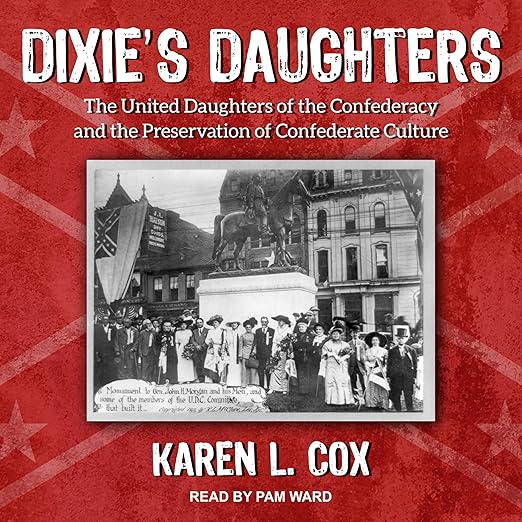
Karen Cox's Dixie's Daughters offers one of those rare historical arguments that reframes something you thought you already understood. The United Daughters of the Confederacy - founded in 1894, still active - is not a trivial or peripheral organization in American history. Cox's audiobook-length scholarly history, narrated by Pam Ward, makes the case that the UDC's influence on Southern culture, public education, and monument placement was decisive and lasting in ways that shaped how millions of Americans learned to understand the Civil War. That argument is not comfortable. Cox does not intend it to be.
The premise that women without voting rights could nonetheless exercise enormous social and political power is the central paradox Cox unfolds with care. The Daughters, as they were popularly called, understood that cultural influence - over textbooks, over memorial practices, over the socialization of children - operated independently of electoral politics. They could not vote but they could determine what a white Southern child read in a classroom about states' rights and the antebellum South. Cox documents precisely how they pursued that leverage, and the results are documented in the monuments still standing across American cities today.
Memorialization Becomes Vindication in Southern Textbooks
Cox frames the UDC's project around two intertwined impulses: memorialization and vindication. Earlier Confederate memorial organizations had focused on honoring the dead. The Daughters shifted the mission toward arguing that the Confederate cause was just - states' rights, in their framing, rather than the preservation of slavery. That distinction mattered enormously for what followed. Memorialization asks for grief and respect; vindication asks for agreement. The pro-Southern textbooks the UDC sponsored and the monuments they erected were acts of argument as much as acts of remembrance.
The chapter on public schooling is perhaps the most quietly disturbing section of the book. Cox traces how UDC members monitored classroom history for what they called truthfulness - meaning conformity to the Lost Cause narrative - and how they successfully pressured publishers and school boards across the South to adopt textbooks that framed slavery as a secondary cause of the war and Reconstruction as a period of Northern tyranny. Generations of white Southern students were educated in this version of events, and Cox's argument is that this educational campaign is part of why Confederate monument controversies remain so heated: the monuments were always arguments, and some of the people defending them are defending what they were taught.
Ward's Scholarly Register, Written Before Charlottesville
Pam Ward's narration manages the scholarly register well. Cox writes with academic precision - this is a history derived from archival research, not popular narrative - and Ward maintains a tone that respects the material's weight without becoming dry. The book's even-handedness is worth noting: Cox does not characterize the Daughters as uniquely villainous women in isolation from their time and class. She contextualizes their project within the world of Southern white women of the period, which makes the analysis more historically rigorous even when it makes the book harder to reduce to simple condemnation.
Reviewer larry roeder made a point worth considering: the book's original scholarship, while well-researched and important, was published before the Charlottesville events of 2017, and the reprint does not expand the analysis to engage with the more recent monument debates. Readers hoping for direct engagement with the contemporary removal controversies will need to look elsewhere. Cox's contribution is the historical foundation - explaining how the monuments came to be there, who built them, and what arguments they encoded - rather than the political argument for what should happen to them now. That restraint is probably correct for a scholarly work, and it also means the book has aged better than a more reactive treatment would have.
Methodical, Not Polemical, Across Six Decades
Listeners who come to this audiobook from a casual interest in Confederate monument debates rather than from a background in Southern history should prepare for a work that is more methodical than polemical. Cox is arguing a thesis, not writing advocacy journalism. The pace is that of a scholarly book adapted for audio: dense in places, reliant on accumulated evidence across chapters rather than single dramatic revelations. The reviewer who called it a startling, disturbing, and oh so fascinating read was drawing on a background in Southern culture that informed their response. Listeners without that background will still find the core argument accessible, but the texture of the historical detail will land differently.
The book's timeframe is focused primarily on the period from the UDC's founding in 1894 through the mid-twentieth century. It is a historical study of an organization's formative and most influential decades rather than a complete institutional history through to the present. Listeners expecting coverage of the UDC's activities in recent decades or a comprehensive account of the monument removal debates will need to supplement with more recent scholarship.
The Infrastructure Behind Confederate Monument Culture
This audiobook is indispensable for listeners trying to understand the intellectual and organizational infrastructure behind Confederate monument culture. History readers with interest in the American South, gender history, the Lost Cause, or the political uses of public memory will find it among the most useful books on those subjects. Teachers, journalists, and civic advocates working on monument policy debates will benefit from the analytical framework Cox provides, even though the book itself does not enter those debates directly. For general history readers without a specific interest in the subject, the academic register and the narrowness of the organizational focus may feel limiting - but for anyone who has wondered why monuments that were built long after the Civil War ended exist in the first place, Cox provides the clearest available answer.
Does the Dixie's Daughters audiobook cover the recent monument removal debates following Charlottesville?
Not substantively. Cox's original scholarship predates the 2017 Charlottesville events, and the reprint does not expand the analysis to engage with recent controversies. Reviewer larry roeder noted this as a limitation of the edition. The book's focus is on the UDC's historical formation and influence, providing context for current debates rather than engaging in them directly.
Is this audiobook accessible to general history listeners, or does it require specialist background knowledge?
Accessible to engaged general readers, though it is written in a scholarly register. Cox contextualizes her claims and does not assume specialist knowledge of Southern history or Civil War historiography. Listeners who have read other popular histories of the Civil War era will find the level comfortable; those with no background may want a general overview of Reconstruction first.
Does the Dixie's Daughters audiobook cover the UDC's activities beyond the American South?
Primarily not. The UDC was a Southern organization and Cox's focus is on its influence within Southern states, particularly regarding public schools, monument placement, and the regional culture of Lost Cause memorialization. The organization's national reach is acknowledged but not the book's central concern.