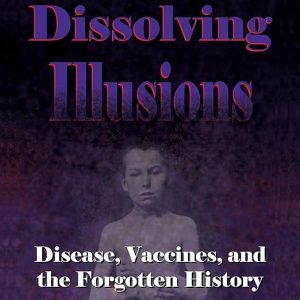
Suzanne Humphries opens this audiobook with a deceptively simple historical claim: by the time most major vaccines were introduced in the twentieth century, the diseases they targeted were already in steep decline. Published alongside co-author Roman Bystrianyk, Dissolving Illusions spends nearly fifteen hours building that case from primary sources: Victorian public health records, pre-war mortality charts, obscure medical journals, and newspaper accounts that rarely surface in modern textbooks. Narrator Tyler Behnke delivers the material with measured authority throughout, never sensationalizing a thesis that will strike different listeners as either revelatory or alarming depending on where they begin.
This is not a book that arrives without context. Controversy has followed Humphries, a nephrologist turned vaccine critic, for more than a decade. Whether you regard her as a corrective voice or a dangerous one, the audiobook format forces you to sit with her argument at length and in order. Reviewer Kimberly Warner describes herself as a parent of four who had never questioned vaccines before two of her children had severe reactions, and her response captures the range of people this audiobook addresses: not just researchers but ordinary people who encountered something in their lives that made them start examining the primary record.
Behnke's Pacing Turns Statistics into a Lecture
The central claim is historical rather than purely medical: Humphries argues that mortality from most major infectious diseases, including scarlet fever, typhoid, and tuberculosis, had already declined dramatically before vaccines were introduced for them, driven primarily by improvements in sanitation, nutrition, and living conditions. She draws on Victorian and Edwardian graphs and contemporaneous quotes from public health officials who were themselves skeptical of vaccination mandates. The argument is carefully assembled and internally consistent. Behnke gives it the pacing of a well-structured lecture course rather than a polemic, which helps considerably when the statistical chapters accumulate.
The challenge for general listeners is that evaluating the methodology requires some familiarity with epidemiology. Humphries is selective in her sources in ways that critics have documented at length, and the absence of a rebuttal framing means you are hearing one side of a sophisticated argument. That said, the historical record she draws from is real, the mortality curves are not invented, and her contention that mainstream medicine has sometimes preferred convenient narratives over messy data has legitimate philosophical grounding. Reviewer Jeffrey Dach MD, who calls it a book that "pulls back the curtain," is a physician who treats it seriously as historical documentation. Even skeptical listeners will find passages that make them want to cross-check the standard accounts against the sources she cites.
Controlled Narration Keeps This from Tipping Conspiratorial
A book this dense rewards the audio format because Behnke's controlled narration prevents the argument from tipping into the conspiratorial register that this subject matter could easily attract in other hands. He reads statistical chapters, historical citations, and contemporary quotations with equal steadiness, treating this as the serious historical work Humphries intends it to be rather than an activist manifesto. At nearly fifteen hours, real staying power is required. But the chapters are organized thematically rather than strictly chronologically, which means you can return to specific sections, and the audio production is clean throughout the full runtime.
For listeners trained in critical reading of medical literature, the experience will be bracing regardless of their ultimate conclusions. The historical methodology is detailed enough to evaluate, which is more than many contrarian-science books provide. For general listeners approaching this because they have questions about vaccine history or public health epistemology, the audiobook is likely to deepen uncertainty rather than resolve it neatly in either direction. That is probably the most intellectually honest outcome the material allows, given how genuinely contested some of the historiographical questions remain among researchers who have engaged with the same primary record.
Scarlet Fever Convinces More Than Polio Does
The strongest sections are those dealing with scarlet fever, whooping cough, and tuberculosis, diseases for which the historical mortality record is unusually clear and for which the timing of vaccine introductions relative to mortality decline is genuinely worth examining. These chapters illustrate the central argument at its most rigorous and are the parts most likely to provoke genuine reflection even from listeners who arrive with firm prior views.
The sections on polio are more contested and draw more selectively from the literature. Humphries argues that polio incidence was declining before the Salk vaccine and that reporting changes affected apparent success rates. This is disputed more sharply by mainstream epidemiology than her claims about scarlet fever or tuberculosis, and listeners with particular interest in polio would benefit from reading scholarly critiques of these chapters alongside the audiobook. Also notable is the book's treatment of eugenics and its entanglement with early twentieth-century public health campaigns, a largely forgotten chapter of that history that has genuine historiographical value regardless of one's views on vaccines specifically.
Fourteen Hours of Argument, Never a Verdict
Listeners who should seek it out include those with a serious interest in the history of public health, medical epistemology, or the sociology of how institutional scientific consensus forms and hardens over time. It is equally worth the time for anyone who wants to understand the historical sources that vaccine-hesitant communities draw on, whatever their personal position. Healthcare professionals who engage with vaccine-hesitant patients will find it more useful to understand this argument than to dismiss it, because Humphries draws from public record, selectively but from real materials. Listeners who want a definitive debunking or a definitive confirmation will be frustrated: this is a fourteen-hour argument, not an answer. Anyone coming to this audiobook expecting clean resolution should know that the questions it raises are ones the historical record has not tidily settled for anyone.
At a Glance
- Narrator: Tyler Behnke reads this dense historical argument with scholarly steadiness, making fourteen hours of statistical evidence genuinely listenable without editorializing the contested material.
- Subjects: vaccine history skepticism, public health epistemology, infectious disease mortality
- Tone: Methodical and quietly provocative
- Bottom line: A serious, heavily sourced audiobook that will deepen questions about public health history for listeners willing to engage critically rather than looking for confirmation in either direction.
A Few Questions About Dissolving Illusions
Is the Dissolving Illusions audiobook a straightforward anti-vaccine argument, or does it engage seriously with historical data?
The audiobook is built around primary historical sources including Victorian mortality charts, medical journal records, and contemporaneous public health reports. Humphries's argument is that sanitation and nutrition drove the decline in infectious disease mortality, not vaccines. It is a historically grounded claim, though heavily debated, and Tyler Behnke narrates it as a serious scholarly presentation rather than a polemic.
Is narrator Tyler Behnke a good fit for the dense, evidence-heavy material in this audiobook?
Yes. Behnke delivers the statistical and historical sections with measured clarity, avoiding both the flat monotone that often plagues nonfiction narration and any editorial heat that might bias the material. At nearly fifteen hours, his consistent pacing is essential to sustaining attention through the book's more data-intensive passages.
Should I listen to Dissolving Illusions if I disagree with vaccine skepticism?
It depends on your goal. If you want to understand the historical and epidemiological arguments that vaccine-skeptical communities find compelling, the audiobook is genuinely useful. If you want a balanced overview of the science, this is not that, and supplementing it with mainstream epidemiology sources is advisable.