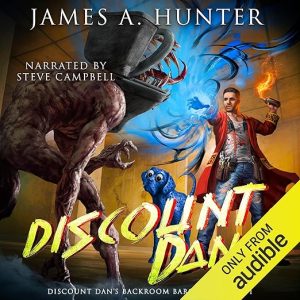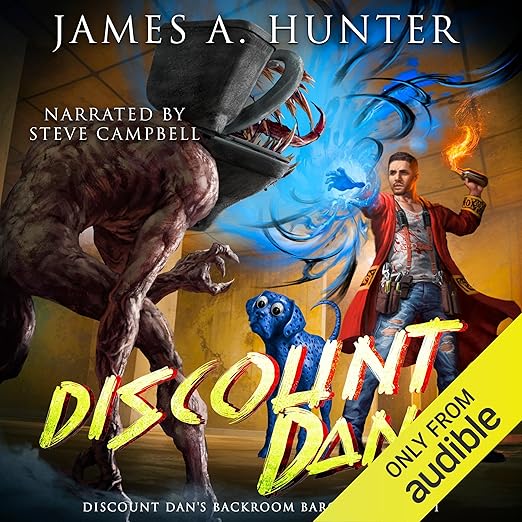
Comedy set inside a dungeon has a short half-life, which is the risk hanging over any audiobook that asks for fifteen and a half hours of your attention on a joke premise. James Hunter's setup sounds like a sketch: a hungover man noclips out of reality and lands in the Backrooms, an endless shifting maze assembled out of condemned asylums, janky laundromats, abandoned malls and twisted carnivals. All he wants is a beer and somewhere to sleep it off.
What kept me going past the first hour was how seriously the world takes its own nonsense. A death mark from the Flayed Monarch of the 999th floor is treated as a bureaucratic fact. The Skinless Court is a real institution with real rules. Nobody in the book winks at the reader, and that straight-faced commitment is why the humor survives a runtime that would flatten a lesser gag. Hunter is working the oldest rule in absurdist comedy, which is that the joke only holds if every character inside it behaves as though nothing funny is happening.
Reviewer Krystin Scott gets closer to the appeal than the marketing copy does. That review sums up the operating law of the place as follows, that "in the backrooms, everything, everywhere, all the time is both lying to you and trying to murder you", which is a genuinely elegant description of what the book does to its protagonist for fifteen hours. Paranoia is the load-bearing structure. Dan cannot trust a corridor, a vending machine, or an ally, and the game-like magic he has to learn is less a power fantasy than a survival grammar. My own reservation going in was that a setting designed to be arbitrary cannot generate real stakes, and the answer the book gives is that arbitrary threats are terrifying precisely because you cannot prepare for them.
Hunter also solves the problem that sinks most LitRPG in audio. Stat blocks and inventory screens read fine on a page and turn into sludge when spoken aloud. Krystin Scott notes approvingly that the book "does not get weighed down by too much world-building or pages and pages of character and item stats", and that restraint is what makes a fifteen hour listen viable. The discount-store conceit does a lot of quiet work here, since a bargain-bin item description is funny in a way a damage calculation never is. Turning the progression system into a joke is the cleverest structural decision in the book, because it converts the genre's biggest liability in audio into its most reliable source of laughs.
Andrew's Four Stars Praise the Narrator's Pacing
One reviewer here graded the performance itself, and the verdict is specific enough to be worth quoting in full. Andrew, at four stars, writes that "The narrator did a great job! The character voices were distinct, the pacing felt right, and the humor translated well in audio format." The same review goes further and argues the format is the better one: "It's one of those books that benefits from being listened to rather than just read." Steve Campbell has the job, and the demands are obvious from the premise alone, since a cast that includes Dan, his companion Croc and an assortment of Dwellers needs to stay separable in a listener's ear without tipping into cartoon. A second reviewer, David Laverdure, stops short of grading the performance but confirms the audio edition is worth having alongside the text. That makes two separate readers endorsing the format, which for a fifteen hour comedy is a more meaningful signal than another round of praise for the jokes.
The other reason to press play is the comparison two of the five reviewers reach for unprompted. Patrick opens by recalling an entry into the genre through Dungeon Crawler Carl, followed by years of "chasing that same high ever since", listing two other series that fell short before he arrived here. Ryan Miller names the same touchstone and puts the remedy in blunter terms: "if you have a hole to fill waiting on DCC, this is the right stuff to fill that hole". Fellow author Eric Ugland, quoted in the publisher copy, lands on the same register when he calls it "an excellent use of pop culture to make something fun and horrific and awesome". A book that keeps drawing that particular comparison is announcing its lane clearly.
Numbers That Don't Add Up on This Page
The numbers on this listing do not add up, and I would rather say so than repeat them. A 4.6 average is displayed against a rating count of one, and a single rating cannot produce 4.6 by any arithmetic. Meanwhile five written reviews sit right there on the page, four of them at five stars. Treat the average as a placeholder rather than a measurement, read the responses themselves, and note that every one of them was posted within roughly a year of the March 2025 release by readers still early to the series.
Two content cautions matter more than the score. First, the horror is not decorative: nightmare creatures, a court that skins people, and a hunt that runs the length of the book. Readers who came for the comedy and expect the jokes to soften the threat will find the balance tilted further toward dread than the cover suggests. Second, this is book one of Discount Dan's Backroom Bargains, so the fifteen hours buy you an opening movement rather than a resolution. Anyone who resents committing to an unfinished series should check how far the sequels have progressed before starting.
Dakota Krout Calls It Fast-Paced and Awesome
Listeners who finished Dungeon Crawler Carl and have been restlessly auditioning replacements are the obvious audience, and the reviews confirm it loudly. Beyond that, the book suits anyone who enjoys absurdist horror played entirely straight, and anyone who has bounced off LitRPG before because the mechanics smothered the story. Fellow author Dakota Krout's blurb describes "a fun, fast-paced read with awesome game mechanics, surprising humor, and a brutal adventure", and the emphasis on pace over accounting is accurate to how the audio moves.
Skip it if body horror bothers you, since the Skinless Court is exactly what the name implies. Skip it too if you want fantasy with lore you can settle into, because the Backrooms are designed to refuse coherence by definition, and a world built to make no sense will frustrate a listener who wants a map. One reader here owns the audio, the digital copies and a signed hardcover. That is the level of enthusiasm on offer if the premise catches you, and none of it if it does not.
A Few Questions About Discount Dan
Does the audiobook drown in stat blocks like a lot of LitRPG?
Not according to the reviews, and that matters more in audio than in print. Krystin Scott specifically credits the book with avoiding pages of character and item stats. The discount-store framing turns most progression into item descriptions with jokes attached, which spoken aloud plays as comedy rather than bookkeeping.
Is fifteen hours a lot for a comedy audiobook like this one?
It is long, and worth weighing before you commit. The saving grace is that Hunter treats the absurdity seriously instead of stacking punchlines, so the tension carries the stretches where the jokes rest. Andrew, the only reviewer to grade the performance, reported that the pacing felt right and that the humor survived the move into spoken form.