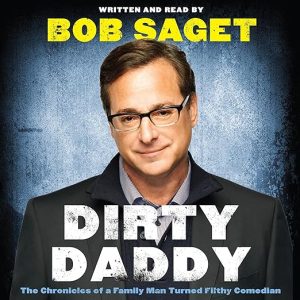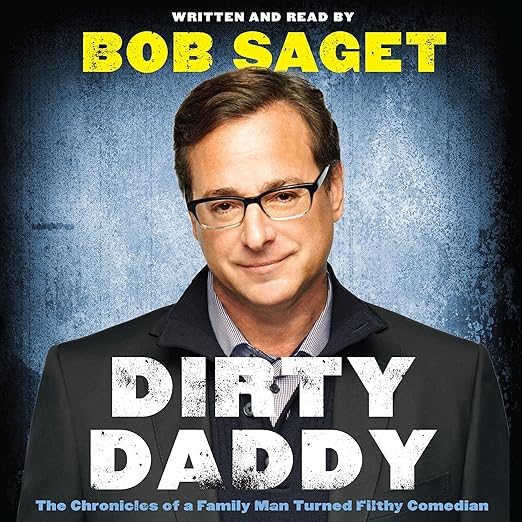
Bob Saget's Dirty Daddy audiobook, narrated by Saget himself and running six hours and forty-five minutes, starts with a premise that should create cognitive dissonance: the man America knew as Danny Tanner, the sweetly neurotic Full House patriarch, wants to tell you some very dark, very filthy stories. The cognitive dissonance is the point. The gap between Saget's television persona and his stand-up comedy reputation was always part of his brand, and this memoir is built on exploiting that gap as fully as possible while also - and this is the part the marketing undersells - being genuinely moving about friendship and death.
Saget wrote Dirty Daddy primarily as an extension of his stand-up sensibility. The structure is associative rather than chronological, and one reviewer's observation that the book seems "clearly driven by Attention Deficit Disorder" is meant as a compliment. Saget jumps between topics, loops back, interrupts himself with tangents, and operates on the principle that if the next thought is funnier than the current one, you follow the funnier thought. In audio this works considerably better than it would on the page, because Saget's voice - high-energy, slightly nasal, always slightly self-amused - signals when you are being set up for something versus when the sincerity is real.
Dangerfield and Pryor Through a Sitcom Dad's Eyes
The material about Rodney Dangerfield, Richard Pryor, and Don Rickles is the most interesting section of the book, and it is the section where Saget's dual identity as a clean-TV performer and a legendarily filthy comedian makes the most sense. These were his people - the stand-up tradition he came from, the performers whose work he studied before he became America's favorite sitcom dad. His portraits of them are funny but also clearly written by someone who understood what they were doing and why it mattered. The Dangerfield material in particular captures something specific about that generation of comedian: the way self-deprecation was a survival strategy as much as a comic technique.
The Full House behind-the-scenes content is present but not the book's center of gravity. Saget is protective of his co-stars - references to John Stamos and the Olsen twins are handled with affection rather than score-settling - and the show-business anecdotes read more as context for who he was during that period than as revelations. If you are listening for material that would embarrass anyone, you will not find it. What you will find is a performer's candid account of what it costs to maintain a family-friendly public identity while being, in private, someone considerably more complicated.
Grief Passages His Narration Never Overplays
The death and grief passages are what make this audiobook worth recommending to people outside Saget's existing fanbase. He lost his sister to scleroderma, and the passages about her illness and death arrive without much preparation inside what is otherwise a comedy memoir. In Saget's narration, these sections have a rawness that print could not replicate. He is not performing grief - you can hear the difference - and the tonal shift from broad comedy to real sadness and back again is managed with the instincts of a performer who has spent forty years on stage reading rooms.
Several reviewers noted the same thing: following his stream-of-consciousness delivery is funny and exhausting in the best way, but the moments when the comedy stops cold are the ones that stay with you. That structure - the way serious material ambushes you inside a comedy - is classic stand-up technique elevated to memoir length. In audio, with Saget himself doing the ambushing, it works every time.
Riffs and Impressions Instead of a Narrative Arc
The book's weaknesses are structural rather than substantive. The associative organization means there is no strong narrative arc, and some listeners will find the constant pivoting disorienting if they want a conventional memoir shape. This is not a book about one sustained journey. It is a collection of impressions, stories, and riffs organized by the logic of a comedian's set list rather than a biographer's timeline.
The filth, when it arrives, is specific and unapologetic. Saget does not ease you in. The book lives up to its title, and listeners who hoped the dirty reputation was mostly myth should know it is not. The comedy is of a particular generation - his influences are visibly the Borscht Belt tradition filtered through the anything-goes 1980s stand-up scene - and some of the material has aged differently than the emotional parts. The passages about friendship and loss feel as immediate as the day they were written. A few of the raunchy jokes feel like artifacts of a specific comedy culture that has since shifted.
The Real Saget Behind the Full House Dad
This audiobook is for listeners who want the real version of a performer they thought they knew. If your primary reference for Saget is Full House, this will genuinely surprise you - and then, in the grief passages, genuinely affect you. The narration is the experience: there is no version of this material that works as well without his voice in your ear.
Skip it if you are looking for a tightly structured Hollywood memoir with a conventional arc. Saget's method is controlled chaos, and the payoffs depend on tolerating the chaos long enough to reach them. Fans of stand-up memoir in the tradition of Norm Macdonald's Based on a True Story or Steve Martin's Born Standing Up will find familiar pleasures here - the confessional comedy, the dark material treated with a light touch, the sense that the performer you are listening to is showing you more than they usually would.
- Read by: Bob Saget narrating his own memoir is the only way this audiobook could work - his timing is the whole game, and the passages about grief and friendship land harder precisely because they interrupt the comedy without warning.
- At its heart: Comedy as coping mechanism, the two-faced nature of celebrity, friendship and loss in show business
- Vibe: Anarchic, unexpectedly tender, fast-moving
- Short version: Dirty Daddy is the audiobook version of watching a great stand-up set that keeps stopping to get sincere, and somehow that's the best version of both.
Good to Know
Is the Dirty Daddy audiobook significantly different from just reading the book?
Yes, substantially. Saget's comedy is timing-dependent, and the associative structure of the book - constant tangents, loop-backs, sudden tonal shifts - plays much better in audio than on the page. This is one of the clearest cases where self-narration changes the experience.
How explicit is this audiobook, and is the title accurate?
The title is accurate. The book is genuinely filthy in stretches, and Saget does not apologize for it. It is also genuinely moving in other stretches, and those two registers appear in close proximity throughout. Listeners sensitive to crude humor should know it is present in abundance.
Does this audiobook cover what actually happened on Full House?
Some, but not as the main focus. The behind-the-scenes material is present and includes mentions of John Stamos and the Olsen twins, but Saget treats his co-stars protectively. The book's energy is more invested in his stand-up career and his friendships with Dangerfield, Pryor, and Rickles.